The Wandering Ranch Hand Who Rebuilt Her Windmill Before The Autumn Storms
The wind came down off the San Juan Range that first week of September.
It moved through the Florida River Valley south of Durango the way a long-held thing finally gets said.
It carried a sound the whole county had stopped hearing.
Tick.
A pause.
Tick.
It was the sound of a seized windmill wheel turning a quarter turn against the wind and stopping.
The way a door opens a crack and gives up.
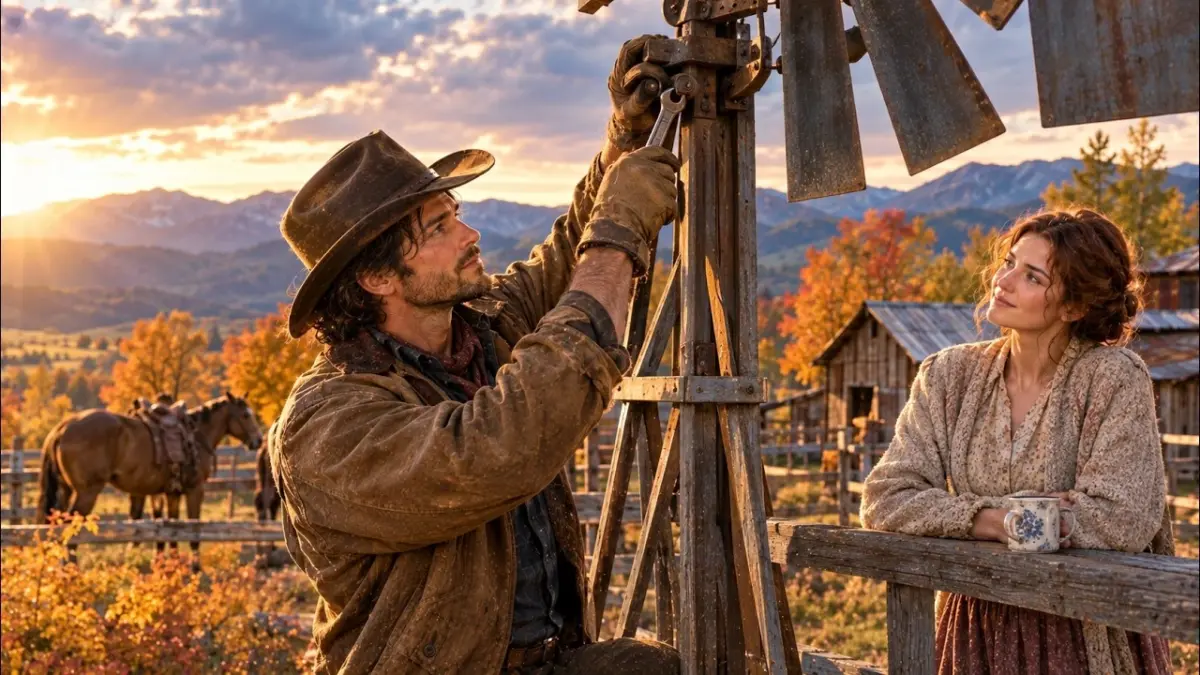
The mill stood at the edge of the south pasture, thirty-six feet of rusted angle iron set against the blue shoulder of the La Plata Mountains.
Its wheel had been bent down into the tower since the March blizzard of 1905.
One vane was peeled back and gone, like a hat that had been stepped on.
The wellhead below it was dry as a bone.
The stock tank was a drum of windblown dust with a grasshopper sitting in the bottom of it.
The cattle had taken to walking a mile down to the river to drink, and the river was running thin, and the men who counted such things were beginning to talk.
Storms don’t break a windmill.
The waiting does.
There was a man on the county road that Thursday morning.
He walked south out of Durango at the pace of a man who had no appointment, which is a pace with its own gravity.
He carried a canvas bedroll over one shoulder and a long canvas tool roll over the other.
The tool roll was heavier than the bedroll, which was the first honest thing about him.
His boots were good boots, resoled twice and oiled.
His coat was duck canvas, the color of the road gravel, and under it a striped work shirt washed so many times it had gone soft as flannel.
He did not look at the mountains the way visitors looked at them.
He looked at the fences, at how deep the dust lay in the wagon ruts, at the way the wind moved the dry grass.
Then he looked at the windmill the way a doctor looks at a patient who has been waiting a long time for somebody to come.
He stood at the gate of the Holt place a full minute, his hand on the top rail.
Behind the house on the hill, the mill went on ticking into the wind.
He shifted the tool roll, unlatched the gate, crossed the yard, and knocked on the kitchen door.
“It’s the mill, isn’t it?” he said before the woman had finished opening the door.
Sarah Holt was braced for a drummer or a seed salesman or the man from the bank.
It took her a moment to reset.
She was thirty-nine years old, and she had run the Holt place alone for nearly two years.
She managed twelve hundred acres of bottomland and bench along the Florida River, one hundred and forty head of white-faced cattle, a barn with a sagging ridge pole, a house her father had framed out of cottonwood in 1879, and a windmill that had not turned since the blizzard of 1905.
Her husband, Wes, had died in November of 1904 from the grip that went through the valley that fall.
The county said she was doing well, which is what the county says about any widow who has not sold out yet.
“I haven’t got a day’s work,” she said.
It was the first line of a speech she had been practicing since spring.
“I didn’t ask for a day’s work,” the man said. “I asked about the mill.”
“The mill’s been broken eighteen months,” Sarah replied, leaning against the doorframe. “It’ll be broken nineteen, and it isn’t your mill.”
“No,” he said, “but I’ve rebuilt mills in four states, and that hill has been calling to me since the county road.”
Sarah looked at him.
He was in his middle forties, lean and sun-leathered, gray at the temples, with the stillness of a man who had watched a lot of weather do its worst and get over it.
His hands hung at his sides like they were not in a hurry.
She had learned to read the men who came to her door by the way they stood in it.
They stood square, or sideways, or with their weight on the back foot.
This man stood with his weight even on both feet, and something in her chest let go half an inch without her permission.
“I can pay a dollar and a half a day and board,” she said. “I can pay it for one week. I can’t pay it for a week and a half.”
“Yes, ma’am.”
“You understand the bank note comes due the first of November,” she added, her voice dropping lower. “And I don’t know yet where the money’s coming from.”
“I don’t need to understand that to fix a mill,” he said.
“Then your name would be?”
“Jud Weller. Out of the Arkansas Valley and a good many places between.”
She hired him.
He took the bunkhouse, swept it out, aired the straw tick, laid his tools in a row on the bench, and lit the stove against the evening chill.
That first night, he sat on the step with a cup of coffee and watched the mill turn its quarter turn and stop against the dark.
The wind came down off the range and moved through the cottonwoods along the river.
It was the first night in ten years he had lain down knowing where he would be in the morning, and he did not mention that to anyone.
The valley ran its days by a clock of its own making.
The train whistle on the branch line, the bawl of calves at first light, the mission bell when it had pupils to call.
Sarah moved through her days the way a person moves through a house she has inherited.
Carefully, in rooms other people had built and furnished, keeping the dust off things she had not chosen.
She kept the place the way you keep a promise you did not exactly make.
For two years, she had carried the note the way you carry a stone in your pocket until it was simply part of what you weighed.
The whole place went back further than Sarah.
Her father, Hyram, had come up out of Pueblo in 1876 with a wagon, a Scotch plow, and a Methodist conviction that the San Juan country was going to be worth something.
He had married her mother in 1865 up in Pueblo, and Sarah was born there in 1867.
The family came to the valley when she was nine years old, and the house went up out of green cottonwood in 1879.
Hyram dug the well in 1885 and raised the mill tower in 1886, one stick at a time.
The wheel ran nineteen years without a serious complaint until the March blizzard of 1905 bent it down into the tower and tore the wind vane clean away.
There were two losses under that roof before Wes.
Sarah’s mother took sick in the summer of 1891 and was gone inside a week.
Hyram died of consumption in December of 1901, sitting in the chair by the parlor window with the county road in sight.
And then Wes.
Wes Holt had come to work for her father in 1886, a big, quiet boy from the Mesa country, and he married Sarah in 1888.
He took over the place the way a river takes over a channel without asking, and the mill was the thing he was proudest of.
He greased the oil cups every spring, kept the leathers soft in the pump, cut the new bucket valves out of harness hide, and used to say the mill was the only thing on the place that never waited on anybody.
The morning Wes died, the mantel clock in the parlor stopped at 4:12, and Sarah never wound it again.
The grip took him in four days.
She buried him on the hill above the river in the family plot under the two cottonwoods.
She signed the note at the San Juan Mercantile Bank the following April—six hundred dollars to buy hay and pay the men who had helped her through the calving.
She paid one hundred and ninety dollars of it back that October.
The balance of four hundred and ten dollars was due the first of November of 1906, and the interest came to a little under twenty-two dollars.
There was one hundred and thirty dollars in the sack under the kitchen floorboard and thirty-two head of good steers standing in the south pasture.
She had a plan.
It was a quiet plan, and it had a hole in it, and the hole was nineteen feet of bent wheel iron standing on a hill.
Without the mill, the hay meadow could not be watered.
Without the hay, the steers would go to the October sale thin.
Thin steers fetch thin money, and thin money does not pay a note.
So the mill had to turn, and it had to turn before the autumn storms, because the autumn storms were what had broken it in the first place, and the autumn storms were four weeks off and closing.
The first thing Jud Weller did the first morning was take the whole wheel down.
He rigged the block and tackle to the tower with a rope that sang when the load came on it.
He lowered the bent wheel to the ground like a man lowering a coffin.
Sarah watched from the kitchen window and told herself she was watching her money.
He laid the wheel across two sawhorses in the yard and went over it spoke by spoke with a three-foot rule, marking each bend in chalk.
He did not hurry.
The hammer rang across the yard in a rhythm she found herself listening for, the way she had once listened for the six o’clock whistle of the Rio Grande train.
On the third day, he went into Durango on the wagon and came back with a sheet of galvanized iron, a sack of bolts, and a coil of new sucker rod.
When she came out and asked him to put the supplies on her bill, he shook his head.
“It’s on me,” he said, tightening a strap on the wagon. “I don’t build things with other people’s money.”
“I pay for my own repairs, Mr. Weller,” Sarah said firmly.
“And I buy my own materials,” Jud replied, not looking up from his work. “We can argue it when the job is done.”
The supper she set out on the kitchen step those first evenings was plain fried beef, bread, and the last of the cellar apples.
He ate it on the bunkhouse step with his back to the wall, the way a man eats who has been eating alone a long time.
She noticed he left the plate clean and never once complained about the wind.
She came out one evening, sitting on the edge of a sawhorse while he filed a rivet.
“Why did you stop at the Holt place out of all the places on the road?” she asked.
“Windmills don’t fix themselves,” he said, pausing his file. “And this one’s been asking.”
He did not say anything more about himself, and she did not push.
There was a kind of man who gave you his work and kept the rest, and she decided she could live with the work.
By the end of the first week, the wheel was true again.
Every bent spoke was straightened and reset.
The missing vane was replaced with new galvanized iron, cut, drilled, and riveted into place.
The whole wheel stood in the yard catching the September light like something that had forgotten it was beautiful.
Sarah found herself standing closer to the sawhorses than she meant to.
Jud did not step back.
The wind came through the yard and lifted the edge of the new vane.
For a second, the whole wheel seemed to lean into the wind like a thing remembering its purpose.
“The storms come the middle of October,” she said to him one morning over the coffee she had taken to bringing out. “You really think it’ll be turning by then?”
Jud looked at the tower, then back at her. “The storms don’t break a windmill, Mrs. Holt. The waiting does.”
She stood with the cup in her hands and looked at him.
He looked back, and neither of them said anything, while the wind moved through the dry grass and the morning went on.
On the twelfth of September, he replaced the window sash rope in the parlor and planed the kitchen door until it shut cleanly for the first time since the blizzard.
He worked while she was in town on errands.
When she came home, the house held its heat in a way it had not held heat in eighteen months.
She stood in the middle of the kitchen and did not know what to feel.
It is a strange thing to be taken care of by a stranger and to find it familiar.
The clock was something she discovered herself.
She came in from the barn one evening, and the parlor was ticking.
Not the wind, not the woodstove.
Ticking steady and whole.
The mantel clock that had stopped at 4:12 on the morning Wes died was running.
Its hands were set to the true time by the train whistle, and the polished walnut case stood where it had always stood.
Sarah pressed her hand to her mouth and stood in the doorway a long minute.
Jud was out on the step sharpening a saw and did not look up.
She had thought the clock was broken.
It had only been waiting for somebody to come and wind it.
She lifted it down off the mantel that night and held it—the first time she had touched it in two years—and it was still warm from the running.
During the week of the blue sky, Jud worked on the small repairs that no one had seen to.
He put new felt on the storm windows and reseated the range door so it shut without a shove.
He rehung the pantry door on a good hinge and shimmed the saddle that had rocked on the kitchen floor since before her father died.
He rebuilt the latch on the henhouse that the fox had learned to open, and he set the calving pen gate so it swung true.
Sarah came out one evening to find him in the barn at dusk.
The harness was spread across his knees, the saddle soap going on in slow, steady circles.
She leaned in the doorway a long moment before she spoke, searching for something to say that would not give her away.
“You don’t have to oil the leather, Jud. That wasn’t in the agreement.”
“Leather rots if you leave it dry,” Jud said quietly, rubbing the soap deep into the reins. “It doesn’t care whose agreement it is.”
“You do a lot of extra work for a dollar and a half a day.”
“I do the work that needs doing,” he replied. “A place tells you what it wants if you sit still long enough to listen.”
The week after that, he went up the tower.
He reinforced the A-frame, rebolted the legs where the rust had fretted them, and set four new guy wires singing in the wind.
Then he pulled the pump rod—all seventy feet of it—and laid it in the grass to go over every coupling.
He cut new bucket valves out of a piece of harness hide the way Wes used to cut them.
Sarah stood at the fence and watched him do it, saying nothing, while the cottonwoods along the river were just beginning to turn gold.
He hung the wheel on the twenty-sixth of September.
It was a day of high blue sky, the whole yard quiet.
The wheel went up in one long heave of the tackle, and it settled onto the hub with a sound like a key turning in a lock.
The vane stood out full against the La Plata shoulder.
The wheel spun a half turn in the wind and stopped.
Jud stood looking up at it the way a man looks at a letter he has waited a long time to receive.
The next morning he dropped the sucker rod down the well and worked the pump handle manually.
Nothing came.
He worked it again.
The pipe coughed—a sound like a man clearing his throat after a long silence—and water came up over the top of the standpipe.
It came brown at first, then clear, falling into the tank with a sound that carried clear across the yard.
Sarah came out of the house, wiping her hands on her apron.
She stood at the edge of the tank and watched the water fill the drum until she had to turn away so he wouldn’t see her eyes.
It was done before the storms.
The hay meadow was watered.
The steers drank from the tank again and put on weight, and the county road stopped carrying that particular sound of a door giving up.
If you are listening to this from a kitchen on the far side of the world, tell me what country you’re watching from.
It is a comfort to know a Colorado windmill turning can be heard that far away.
The first warning came from town.
Sarah drove in for oats and salt in the third week of September.
Milt Feain, who ran the feed store and knew everybody’s business across his front counter, leaned on a sack of grain and looked at her.
“The Coline Valley Irrigation Company out of Denver has been buying river frontage all up the valley,” Milt said, shifting his tobacco. “Paying three-fifty an acre. Cash, sight unseen.”
“Not mine, they won’t,” Sarah said. “Holt land’s been Holt land since ’79.”
Milt looked at her with the kind of pity men give a thing they have already counted up. “They’re paying cash, Sarah. Cash don’t care whose daddy built the fence.”
The banker came out on the eighteenth of September.
Cyrus Bell of the San Juan Mercantile was a careful man in a black coat who had never once raised his voice in twenty-two years of banking.
He sat at the kitchen table with his hat on his knee and spoke softly.
“The note itself isn’t the trouble, Sarah,” Bell said gently. “The trouble is that the note has been looked at.”
“Looked at by whom?”
“The Coline Company,” Bell said. “They want the river frontage of the whole place for a ditch scheme, and they’ve put a price to it. Three dollars and fifty cents an acre for the four hundred acres along the Florida. That’s fourteen hundred dollars. It’s more than the note, and more than this place can make in three good years.”
“It’s my land, Cyrus.”
“It’s a fair price, Sarah,” Bell insisted. “I tell you honestly, it’s in your best interest to take it. The mill’s gone. The river’s all that’s left that anybody wants.”
Sarah stood up straight. “The mill’s not gone. The mill turns.”
Cyrus Bell looked at her with something like sorrow. “Sarah, I admire you. But a banker can say fair and mean it, and still be the man carrying the harder news.”
She tried to pay Jud his first week’s wages that Saturday evening, pushing the bills across the kitchen table.
Jud looked at the money and banked the bills back toward her.
“We’ll settle when the mill’s turning,” he said.
“It is turning,” Sarah said, pushing them back.
“Turning’s not settled,” Jud replied.
He stood up and went out to the barn.
Sarah remained in the kitchen, holding the bills in her hand.
She put them back in the sack under the floorboard, while the clock ticked on in the parlor.
On the thirtieth of September, she went back to town and sat across the desk from Cyrus Bell.
He shook his head slowly. “The papers are drawn, Sarah. I can’t hold them past the first of November. After that, it goes to Denver, and I can’t stop it. I’m sorry.”
She rode home in the wagon with the oats, the salt, and two sacks of flour.
She did not let herself think about it, which was her way, while the cottonwoods along the road turned three-quarters gold.
The surveyors came on the first of October.
Three polite men in new leather boots arrived on the property.
They strung line along the south fence and set a row of white wooden stakes in the grass, one every hundred feet.
The head surveyor, a young man named Norwood, took off his hat to Sarah.
“Sorry for the trouble, ma’am,” Norwood said politely. “It’s just survey work.”
Sarah stood at the fence and watched them set the last stake.
She did not say anything.
The wind came down off the range and moved through the gold leaves, and the mill turned over behind her, creaking, patient, full of water.
Jud pulled the stakes that evening.
He laid them in a neat, even row on the top rail of the fence.
He did not mention it to her, and she did not ask.
Cyrus Bell came out again on the second of October.
He found Sarah at the south fence and Jud working on a corner post nearby.
Bell stood with his hands on the rail and made his case again, speaking softly the way a man breaks news to a widow.
“It’s only fair, Sarah,” Bell said. “It’s in the best interest of the place and of you. The company will pay the note and take the river. You’ll have money left to start over on the bench land. No woman should have to fight a note and a winter with one pair of hands.”
Sarah looked down the fence line at the wooden stakes sitting in their neat row on the rail.
Then she looked Bell straight in the eye.
“I’m not selling, Cyrus,” she said. “Not the river, not the meadow, not an inch of it. The mill turns, the hay will be in the barn, and I’ll have your money by the first. That’s my answer, and it’s the only one I’ve got.”
Bell stood silent for a long moment while the wind moved through the wire.
Something in his face changed.
“Lord,” Bell said softly, taking off his hat. “I’d have eaten the note myself before I let them have your river, Sarah, if I’d known you meant to stay.”
“I mean to stay,” she said.
“I’ll carry the note myself to the first of November,” Bell said. “After that, I can’t stop them, and that’s the truth.”
He turned his head to look at Jud, who had been working quietly and had not said a word.
Jud reached up, lifted one of the survey stakes off the rail, and handed it to the banker.
“She’s not selling,” Jud said. “Some fences are there to keep things in. Some are just where two people learn to stand.”
The representative from Denver came on the fifth of October.
He arrived on the morning train and walked out to the Holt place wearing town shoes.
His name was Hollis, and he was the Coline Company’s land agent.
He was polite in the way men are polite when they have already spent the money in their heads.
He walked the river frontage with Sarah, looking over the hundred acres of bottomland along the Florida.
They stopped at the south fence where the white stakes had been pulled.
Hollis made a speech that came out of his mouth smooth as poured cream.
“It’s nothing personal, Mrs. Holt,” Hollis said, gesturing toward the water. “Our engineer swears the ditch will raise the whole valley’s water level. We take the river in March and return it in July. It’s an honest trade. We pay three-fifty an acre, and you have not a day’s trouble.”
He looked up at the mill turning on the hill.
“Reasonably speaking,” Hollis continued, “you can’t water twelve hundred acres with one wheel. Nobody can. The river is the only thing out here that moves enough water to matter, and the company will move it either way. It’s in your best interest to be paid for what’s coming.”
Sarah stood at the fence with her hand on the top rail and let the wind move through the grass before she answered.
“The river’s been moving water for this place since before your company had a name, Mr. Hollis,” she said. “The mill turns, the hay is in the barn, and the note gets paid on the first. There’s nothing here for you to buy, and I’d thank you to take your stakes with you when you go.”
Hollis looked at her for a long moment, recalculating.
“Two thousand,” Hollis said. “I’ve got authority to go to two thousand dollars. Sight unseen, cash on the counter. I’ll tell you plainly, Mrs. Holt, that’s more than this place is worth.”
Jud had walked up the fence line unheard and stopped with his hand resting on the same rail.
No one spoke for a moment while the mill creaked over on the hill.
“I’ve got authority to one thing,” Sarah said, “and it’s not for sale.”
Hollis stood there in his town shoes on the dirt side of the fence.
Then he did an honest thing.
He bent down, pulled the last remaining stake out of the dirt, and handed it to her.
“Then I’ll tell Denver the lady keeps her river,” Hollis said. “It’s a poor season for ditches anyway.”
He turned and walked back toward the road.
The bend of his back as he went down the crossing was that of a man accepting a loss, not a man scheming.
Sarah watched him go and let out a long breath she had been carrying since the surveyors first arrived.
The wheel had been turning for three weeks when the first autumn storm came down off the range on the sixteenth of October.
It brought a cold wind out of the northwest, sleet in the dark, and heavy rain all through the next day.
The La Plata peaks went white halfway down.
Sarah sat in the kitchen with the lamp lit, listening to the storm work on the mill the way it had worked on it in 1905.
She did not sleep.
In the gray light of the morning, she put on her coat, went out, and stood at the edge of the yard.
The wheel was turning full circles, slow and patient.
The tower stood firm, the stock tank was brimming over, and the steers were standing at the water with rain streaming off their backs.
The storm had been the test.
The mill had passed it simply by being there when the wind came.
They trailed the steers to Durango on the twenty-third of October.
There were thirty-two head, with Jud riding on the offside and Sarah driving the wagon.
It was twenty-five miles up the wagon road over two days, and it was the first time in two years she had ridden that road with someone beside her.
They camped the first night above the Florida crossing on a bench of dry grama grass.
The fire went down to coals, and the herd settled into the quiet dark.
“Wes used to say the trail to the yards was the one place a man could think,” Sarah said into the quiet.
Jud shifted a log on the coals. “He was a man who knew his country.”
“He was,” she agreed.
They lay out under the wagon the second night, with stars stretched across the whole length of the sky.
“Wes would have liked this herd,” Sarah said into the dark. “Thirty-two head down the road and not one broke a leg on the washouts.”
“It’s a good road,” Jud said softly. “It just needs driving.”
Sarah laughed low—the first real laugh she had let out in over a year.
She lay awake a long time listening to the horses stamp and the river run, and she did not feel alone in the dark.
At the stockyards in Durango, the steers brought thirty-eight dollars a head, which came to twelve hundred and sixteen dollars.
Sarah stood at the rail with the money counted in her hands and told herself she was not going to cry in a stockyard.
She held it together.
She had tried to pay Jud his wages at the end of September, but he wouldn’t take them.
She tried again at the stockyard gate in Durango, pushing the paper money toward him.
Jud pushed the bills back into her hand. “I told you we settle when it’s turning.”
That evening, back at the ranch, they walked up from the barn together while he carried a new sack of flour she had bought.
“The mill’s turning, Jud,” she said, stopping in the path.
“It is,” he said, stopping with her.
“Then settle.”
He stood in the dirt path with the heavy flour sack on his shoulder and looked at her.
He reached out, took the wages from her hand, counted the bills once, and put them into his coat pocket.
Sarah did not know why a man taking what was owed to him should feel like a man saying yes, but it did.
On the first of November, she walked into the San Juan Mercantile Bank carrying the money in a flour sack.
She paid the four hundred and ten dollars balance and the twenty-two dollars in interest beside it.
Cyrus Bell counted the money twice, took his pen, and wrote *PAID IN FULL* across the face of the note before handing the paper to her.
Then he stood up behind his desk to tell her the rest, being a man who could not leave a story half-told.
“I mailed the transfer papers to Denver on the twenty-ninth of October, Sarah,” Bell admitted, looking down. “I truly believed you wouldn’t make the payment.”
Sarah held the canceled note tight. “And?”
“This morning, before you came in, I wired the company and paid their processing fee out of my own pocket to recall the papers,” Bell said, looking her in the eye. “It cost me a month’s salary, and I paid it standing up. I didn’t want this bank to be the thing that took your place, Sarah. That’s all.”
He reached across the desk and shook her hand.
Sarah walked out through the heavy wooden door into the November air.
A debt paid is a door shut, and a door shut is sometimes the exact same thing as a door opened.
On the evening of the second of November, they sat on the wooden bench by the barn in the last of the light.
Behind them, the mill turned steadily on the hill, while the whole valley changed from gold to gray to a deep November blue.
Jud told her about Cora.
He had married her in 1886 down in the Arkansas Valley, and she had died of the fever in June of 1895.
He rebuilt the windmill on their home place the year after she died, and it was the best work he had ever done.
Then he sold the land and walked away from it.
“A mill turning in a yard with nobody in it was worse than a broken one,” Jud said, his voice quiet in the dusk.
For ten years, he had walked across four states working on other people’s mills, from the Nebraska sandhills down to the Llano Estacado.
He had never stayed anywhere past the first frost.
“I kept outrunning the one thing I was good at,” he said.
Sarah sat quietly beside him for a long time before she spoke.
“I let our mill sit broken for eighteen months,” she said, “because I thought if it turned, it would belong to somebody else’s keeping, and I wasn’t ready to be kept.”
She looked out toward the river.
“There’s a difference between being alone and being empty,” she continued. “I got them confused. I thought the mantel clock was broken, but it was just waiting for somebody to wind it. You fixed the mill, then you fixed the kitchen door, then you fixed the clock. I kept waiting to feel something again, and then the water came.”
She turned to look at him in the fading light.
“Grief is a wheel, Jud. It turns a quarter turn and stops. A quarter turn and stops. Until somebody comes along and oils it.”
Jud did not say anything for a long time while the mill clanked over, patient and steady on the hill.
“I’ll be moving on when the snow flies,” Jud said softly. “That’s been my way. A place like this needs somebody who stays.”
“You said you’ve never stayed past the first frost,” Sarah said, her voice steady. “Then stay past the first snow.”
Jud looked at her directly. “I need a place for my tools.”
“There’s a bench in the bunkhouse,” she said.
“The mill will need greasing in the spring.”
“It gets greased in the spring,” Sarah replied.
Jud sat with that while the darkness settled over the valley.
Along the banks of the Florida River, the very last fireflies of the late season began to rise into the cool air.
“Then I guess I’ll see the spring,” Jud said.
(Descargo de responsabilidad: Este contenido puede haber sido generado por IA con fines de entretenimiento. Cualquier parecido con personas, eventos o lugares reales es pura coincidencia.)