A CEO Returned From a Business Trip and Found a Shy Girl Cooking in His Kitchen—“You Live Here?”
Owen Foster’s flight landed two days early, and that alone should have told him something was off.
Sturgeon Bay in late afternoon looked the way it always did in October, with cherry trees stripped bare along the county road and lake wind pushing at the porch flags.
He expected a dark house, his father’s television maybe humming low from the recliner, but he did not expect the smell of onions and thyme drifting out to meet him on the porch.
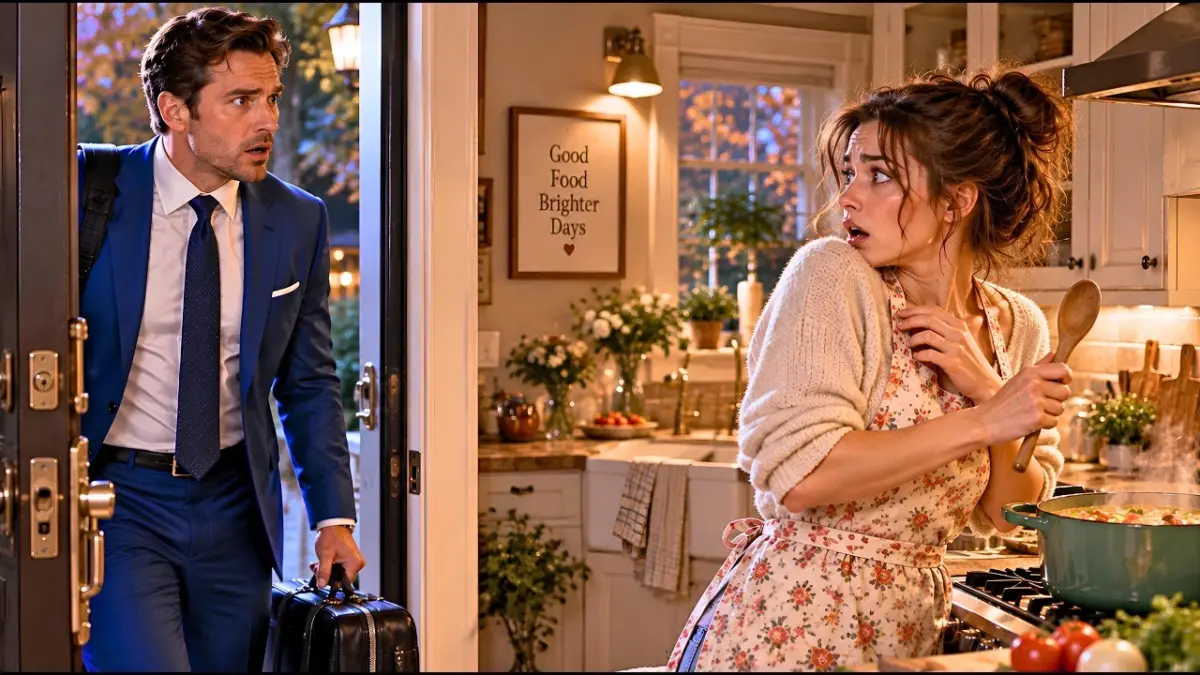
Owen stood in his own doorway for a second too long, keys still in his hand, listening to a wooden spoon tap against a pot somewhere past the front hall, and then he walked in.
The kitchen light was on, and a woman stood at the stove with her back to him, her dark hair pulled into a loose knot, stirring something that smelled better than anything that kitchen had produced in three years.
She was using the enamel soup pot, chipped blue, with a hairline crack near the handle that had belonged to Margot, his late wife.
Owen’s voice came out sharper than he meant it to as he asked, “You live here?”
The woman turned so fast the spoon clattered against the pot’s rim, and for a moment, neither of them said anything because she had the look of someone caught somewhere she didn’t feel she’d earned the right to stand.
“Mr. Foster,” she said, reaching back and switching off the burner without looking at it with a reflex like she’d practiced leaving quickly. “Desmond told me you weren’t back until Friday.”
Owen heard the wheels of a walker before he saw his father easing around the corner from the den with the slow, deliberate rhythm Owen still wasn’t used to.
“There he is,” Desmond said, pleased, like Owen arriving unannounced was the good news of the day. “Owen, this is Norah. Norah, my son, who apparently reads flight schedules for fun.”
“A pipe burst in my building,” Norah said quickly. “Your father offered me the guest room while it’s being fixed, and I should have called first. I didn’t think…”
She stopped herself, and Desmond added from his chair, “She’s been bringing me dinner from her shifts for two weeks now, and it didn’t seem right letting her cook for both of us in some borrowed kitchen with a busted pipe.”
Owen’s eyes went to the pot again, because he knew that crack and he knew exactly which drawer that ladle came from.
Something in his face must have shown it, because Norah set the spoon down and began transferring soup into containers with quick, careful movements, labeling lids in neat handwriting that read *Thursday lunch* and *Thursday dinner*.
“I can be out tonight,” she said, not pleading, just stating it like a fact she’d already accepted.
“That’s not…” Owen started and didn’t finish because he wasn’t sure what he meant to say next.
She carried her bag upstairs a few minutes later, and Owen heard the guest room door close, and then twice, the distinct click of the dead bolt on the front door being checked, first from the hallway, and then again near the sink, where a ceramic pie dish sat drying on a folded towel with its glaze worn thin at the edges.
Owen recognized that one, too, as Margot used to keep it on the highest shelf because she claimed peach filling tasted better in old ceramic.
“She borrowed that the first night,” Desmond said, watching his son notice it. “Made a peach pie at pegs and brought it back in the same dish, and said, *You shouldn’t move into somebody’s house empty-handed*.”
Owen didn’t answer, standing in his own kitchen a long time after his father had gone to bed, looking at a pot that still smelled like time.
Later, passing the guest room, he heard her voice low and tight through the door saying, “I told you I’m not discussing this over text,” followed by a pause and the sound of a phone screen going dark deliberately, completely.
He was still standing by the hallway window when her phone buzzed again, not a call this time, and he caught only a flash of it in her hand as she came down for water, showing a name tagged in an Adore County community page comment thread with thirty-one people already seeing it.
*Anyone know where Norah is staying these days? Just want to make sure she’s okay.*
Norah’s hand went still around the glass.
“That wasn’t nothing, was it?” Owen said quietly.
She didn’t look up right away, and when she finally did, her voice was even, almost rehearsed. “He doesn’t need to follow me, Mr. Foster, not in a town this size, because everyone does it for him.”
Norah brushed off Owen’s questions about the comment thread the next morning, calling it nothing more than an old acquaintance being nosy, but Owen let it go even though the ease in her voice hadn’t quite reached her eyes, and something about that stayed with him longer than he expected.
He spent part of the morning going through the folder his assistant kept updated for Desmond’s care, listing lawn service twice a month, grocery delivery Tuesdays, a cleaning crew, a medical alert pendant, and a standing account with the pharmacy two blocks over.
On paper, it read like a well-managed account that Owen had built that way on purpose, a system that couldn’t fail because he wasn’t always there to catch it if it did.
Then he opened the kitchen junk drawer looking for a pen and found three unopened prescription bottles pushed to the back with dust settled along their caps.
“Dad,” he held one up, “these are from August.”
Desmond didn’t look particularly alarmed as he said, “I forget sometimes, but Nora usually catches it.”
“It happened three times last week,” Norah said from the sink, not turning around, her tone careful like she hadn’t meant to be the one to say it.
“Why didn’t anyone call me?” Owen’s voice came out harder than he intended.
Desmond sat down his coffee slowly. “You were in Milwaukee, then Chicago, then Minneapolis, I think by Thursday.”
He said it without cruelty, which somehow made it worse, adding, “Every time I picked up the phone, you sounded like you had somewhere else to be.”
Owen didn’t have an answer for that, watching Nora move through the kitchen instead, setting pills beside his father’s coffee mug where he couldn’t miss them, pouring soup into containers light enough for unsteady hands, and taping a note to the microwave in blocky handwriting that read *90 seconds then stir*.
She’d muted the television earlier without being asked the moment a loud pharmaceutical ad started blaring during Desmond’s crossword, and none of it was in any folder or showed up on an invoice.
He noticed something else, too, like how little space Norah seemed to take up in his house, keeping her toiletries zipped inside a plastic grocery bag on the bathroom shelf instead of the empty cabinet beside it, and washing and drying every dish she used within minutes like leaving one in the sink might cost her something.
“You work at the coffee shop on third,” Owen said mostly to fill the silence.
“The cherry door, six years now,” she dried her hands. “Pegs owned it longer than I’ve been alive, and she and Colin’s mother went to school together, actually, in small towns.”
She said it lightly, like a piece of trivia, but Owen filed it away without knowing why.
At breakfast the next day, Desmond went pale mid-sentence, his hand finding the edge of the table, and Norah was beside him before Owen had even registered what was happening, checking his pulse at the wrist, easing him back into the chair, pressing a glass of water into his hand, and talking him through it in a low, steady voice.
Owen stood frozen by the counter, useless, watching a woman he’d known for two days handle something he hadn’t even known was a risk.
“Does this happen often?” he finally managed.
“More than he tells you,” Norah said, not unkindly, just true.
Later, Owen mentioned Desmond’s Thursday cardiology appointment, saying he’d clear his calendar to drive him.
“Already handled,” Desmond said. “Asked Nora last week. Figured you’d have that board call.”
Owen looked at the calendar on his phone, and the board call was still there, still scheduled, still exactly where he would have left it if no one had asked.
He closed the app and looked at his father, a man he paid thousands a month to keep safe, who had quietly, without ceremony, decided to trust a woman who’d been in the house eleven days.
“I would have cleared it, Dad,” Owen said, hearing the strain in his own voice.
Desmond studied him for a long moment, not unkindly, before he answered, “You’re available everywhere in the world, Owen, except in this house.”
The cardiologist adjusted Desmond’s blood pressure medication and told him, not for the first time, to stop skipping meals, and on the drive home, Desmond insisted they stop at the grocery store mostly because Norah had teased him the week before that his refrigerator held nothing but condiments and optimism.
The three of them moved through the store like a crew that hadn’t quite settled into its roles yet, with Desmond grumbling over the price of cereal, holding two boxes up like evidence in a trial, while Owen read sodium content off frozen dinners the way he read quarterly reports, brow furrowed and lips moving slightly.
Nora, without seeming to think about it, swapped half of what landed in the cart for fresh vegetables and a chicken that wasn’t breaded into something unrecognizable.
“You don’t have to do that,” Owen said, watching her return a box of freezer waffles to the shelf.
“I know,” she didn’t stop, and in the baking aisle, she picked up a bag of flour, turned it over, checked the protein content on the label, and set it back down for a different brand, automatic and practiced.
When Owen asked why it mattered, she launched into an explanation of gluten structure and pastry crusts that went on for nearly a full minute before she caught herself and laughed a little embarrassed, marking the first time Owen had heard her laugh outright, and it landed somewhere he hadn’t expected.
“You know a lot more than coffee shop training covers,” he said.
“I read a lot,” she said, which wasn’t really an answer, and she moved the cart forward before he could ask anything else.
At the register, Owen noticed the cashier glance at Nora not rudely, just a beat too long, with a flicker of recognition that didn’t quite turn into a greeting, causing Norah’s shoulders to go tight while she said nothing and paid for nothing, just watched the belt move until the moment passed so quickly Owen almost convinced himself he’d imagined it.
That evening, back at the house, Owen found himself at the cutting board under Norah’s direction, chopping carrots into pieces uneven enough to make her wince, while Desmond sat at the table pretending to struggle with a crossword he’d clearly already finished, filling in answers slowly so he’d have an excuse to stay in the room, and Owen noticed he’d started coming home before seven most nights now without quite deciding to and without telling anyone he had.
Norah reached past him for the salt and her sleeve rode up, revealing a thin silver bracelet worn a little tarnished, the kind of thing that had clearly been kept rather than bought recently, and Owen didn’t ask about it while she didn’t offer.
Later, moving her recipe notebook off the counter before a water glass could tip onto it, Norah’s gaze caught on the thin chain at his collar, and she hesitated for half a second, her expression changing before she looked back at him.
“Your ring,” she said quietly.
“You still wear it every day,” he said, and he didn’t explain further, nor did she push.
That night, after Desmond had gone to bed, Owen picked up Norah’s notebook again to move it off a spill she hadn’t noticed, and as he lifted it, a folded paper slipped free and landed at his feet.
He picked it up without meaning to read it, finding a commercial lease listing for a small storefront two doors down from the cherry door, owned by a Mr. Halverson, underneath the printed address in dark ink scribbled over three times like she’d tried to unwrite it and couldn’t quite manage it, reading *Dreams are not meant for temporary people*.
Beneath the listing was a page of figures in Norah’s handwriting detailing savings, projected rent, equipment costs, and one line marked *June’s inheritance*, where the amount beside it wasn’t enough to make the dream easy, only enough to make it possible.
Owen looked away almost immediately, knowing he had already seen more than she’d meant him to, standing there a long moment with the paper in his hand while the house was quiet around him, understanding for the first time since she’d walked into his kitchen that Norah Vance wasn’t just passing through his father’s life, but was carrying something she hadn’t let either of them see yet.
Owen brought up the lease at breakfast, sliding a folded sheet of notepad math across the table like it was a gift he’d been saving.
“I ran some numbers based on what I saw with the lease, and if you used part of what your grandmother left you as a down payment, I could structure the rest with a business loan and favorable terms, knowing people at the bank in Sturgeon Bay who’d move fast on it.”
Norah sat down her coffee slowly. “You went through my notebook.”
“I moved it off a spill and the lease fell out.”
“That’s not what I asked.”
Her voice stayed level, but something behind it had gone still as she said, “You’re doing it again.”
“Doing what?”
“Turning something quiet into a project you can manage.”
She stood, carried her mug to the sink though it was still half full, and said, “I’ve had someone else do that to me before, where Owen decides what’s best, builds the plan, and hands it to me finished, which doesn’t feel like help, it feels like being edited.”
Owen didn’t answer right away, and later that afternoon, Desmond found him standing at the window replaying it.
“She doesn’t need you to make good decisions for her,” Desmond said, easing into the chair across from her. “She needs the dignity of making her own, even the bad ones.”
Owen turned that over for a long moment, and that evening, he found Norah on the back steps and sat down beside her without a notepad this time.
“I’m sorry, as I wasn’t trying to take it from you, I just wanted to fix something for once.”
“I know,” she said quietly. “That’s what scares me about you a little.”
Days later, unprompted, she asked his opinion on foot traffic near the storefront, whether the corner by the marina drew more walk-ins than the block past the hardware store, and Owen answered carefully, waited to see if she wanted more, and stopped when she didn’t ask for it, feeling different this time, invited instead of imposed.
That night, she told him about Colin, not crying, saying it the way you describe weather that had already passed.
Colin Brandt hadn’t yelled or broken anything, but he’d monitored her spending down to the coffee she bought for herself and called it partnership, easing her away from friends one cancelled plan at a time always with a reasonable excuse attached, and belittling the bakery dream so gently it took her a year to notice he’d been doing it.
When she finally broke the engagement, he never once threatened her outright, but instead just made sure people kept checking on me, she said, keeping me boxed in as someone a little unstable, someone who needed managing, which is worse than a threat in a town this size because a threat you can name, but this you can’t point to.
Owen’s first instinct was legal, wanting to call his attorney to put something formal between her and Colin’s family, but Norah stopped him with a hand on his arm.
“That’s exactly what he’d want, a scene he can explain away as concern for poor Nora, so let me handle this the way I choose to handle it.”
She went to see Mr. Halverson about the lease that week, walking to his office above the hardware store with her own folder and her own numbers, with no one beside her, and he was warm and encouraging, telling her he’d have paperwork ready within days, causing her to come home lighter than Owen had seen her since she had arrived, making it feel for one evening like the storefront was already hers.
Two days later, her phone rang while she was drying dishes, and Owen watched her face change before she’d said a single word.
“Mr. Halverson,” she said into the phone, something in her posture bracing as she listened for almost a full minute before speaking quietly. “I understand. No, of course. Take whatever time you need.”
She set the phone down on the counter like it weighed more than it should have.
“He needs more time to think it over, and nothing’s personal, he said.”
Owen watched her go very still, the dish towel forgotten in her hands, as she said, “He and Colin’s father have been hunting buddies for twenty years, Owen, and nobody has to say a single word to me directly because that’s the whole point of a town like this, where the silence does it for them.”
Owen told himself it was a small thing, a phone call, nothing more, but he waited until Norah had left for her shift, then dialed Halverson’s office himself, keeping his light, almost casual voice, mentioning he was glad Norah had found a space she liked, and mentioning carefully like it cost him nothing that Foster Furniture Company had been looking for a new supplier for its retail displays and that Halverson’s cousin ran a shop that might be worth a look.
He never said it as a trade, and he didn’t have to, because men like Halverson heard what wasn’t said just fine.
By the next morning, Halverson called Norah, cheerful again, the lease back on track after all, and papers ready whenever she wanted them.
Norah thanked him, hung up, and stood in the kitchen with an expression Owen couldn’t read until it was too late to stop what was coming.
“You called him,” it wasn’t a question.
“I mentioned we might send some business his cousin’s way, that’s all.”
“That’s all?”
She set her phone down carefully like she didn’t trust her own hands with it. “Owen, do you understand what you just did, as I spent a week building an honest case for that lease, my own numbers, my own reliability, and in one phone call, you turned it into something you bought for me.”
“I didn’t buy anything.”
“You didn’t have to, and that’s the whole problem,” her voice shook, not with anger exactly, but with something older than this argument. “Colin used to do this, not with money like yours, smaller, quieter, but the shape of it is the same, handled for you, taken care of, and every time it meant I got to keep the outcome, but lost the credit, so if that storefront opens now, half this town will believe it exists because you paid for it, not because I earned it.”
“That’s not what I meant to…”
“I know what you meant,” she looked at him steady even through the hurt. “But meaning well doesn’t undo what it does to me, and if you can’t let me lose, Owen, if you can’t let me fight my own small, humiliating battles, then I’ll pack tonight, I mean that.”
The kitchen went quiet enough that Owen could hear the refrigerator hum, and he thought about every account he’d ever managed, every problem he’d ever solved by moving faster than the people around him, realizing it had never once occurred to him that solving something could be its own kind of taking.
“Give me an hour,” he said, and he called Halverson back and unwound it plainly, with no supplier deal and no favor implied, leaving the lease decision entirely Norah’s to make on whatever she brought to the table herself.
Halverson sounded confused, then embarrassed, then quiet.
That afternoon, Norah walked to Halverson’s office alone, laying out her savings, her plan, and six years of steady work at the cherry door as her only real collateral, mentioning Owen not once, telling Halverson she’d rather hear an honest no than a yes that belonged to someone else’s name.
She came home with no answer yet, but she came home standing taller than she had in days.
That evening, they tried to make caramel together, her instructing him and ruining it twice, the kitchen filling with the smell of burnt sugar and her laughter unguarded in a way he hadn’t heard before, and when he finally got it right on the third try, she looked up at him, flour on her wrist, and kissed him first, feeling not sudden, but like something that had been waiting for both of them to stop managing each other long enough to let it happen.
The next afternoon, Nora arrived at the cherry door for her shift and found Peg waiting by the register ringing a dish towel that didn’t need ringing.
“Someone called this morning,” Peg said, not quite meeting her eyes. “Said they were concerned, said you’d been let go from your last job for erratic behavior. I know that’s not true, Nora, I do, but I’ve got regulars asking me questions now, and I have to cut your hours just until it settles.”
Norah stood very still, having never once in her whole working life been let go from anywhere, and walked to the back hallway alone past the espresso machine, catching her own reflection in its steel, pale, steady, already bracing.
“It’s happening again,” she whispered to no one. “Exactly like before.”
Norah spent two days trying to trace the rumor back to a single source and found nothing to hold on to, because it didn’t move like a lie someone had told once and could be made to answer for, but moved like weather with no origin point, no fingerprints, just suddenly everywhere, always dressed up as concern like *I heard she had some trouble at her old job* or *I heard the foster boy took her in out of pity, poor thing really*.
That was Colin’s signature, and she realized he never said anything you could quote back to him, just letting doubt travel person to person until it arrived somewhere far enough from him that no one thought to ask where it started.
Halverson called again on the third day, his voice having the same apologetic vagueness as before, but firmer this time as he said, “I’m just not comfortable moving forward, Nora, not with everything going around,” mailing her deposit check back the same afternoon folded once with no note.
Owen wanted to drive straight to the Brandt Orchard and end himself, but Norah put a hand flat against his chest before he could reach for his keys.
“If you do that, you prove him right, saying I need a powerful man to fight my battles for me, which is the whole story he’s telling, so don’t hand him the ending he wants.”
That week, an old business school friend invited Owen to dinner in Green Bay, and halfway through the meal, the friend mentioned carefully that he’d heard Owen was being taken advantage of by some unstable young woman who’d moved into his house.
Owen set down his fork. “She’s not unstable, and she hasn’t taken anything from me she didn’t earn twice over.”
The friendship cooled after that in the particular quiet way old friendships do when one person refuses to nod along.
Owen didn’t call Halverson again, didn’t use his name or his company to lean on anyone else in town, having learned that lesson the hard way already, and instead just kept showing up beside Nora at the grocery store, beside her at Desmond’s appointments, sitting at the counter at the cherry door during her shortened shifts, ordering coffee he didn’t especially want, not defending her out loud, just letting the town see, unmanufactured, who she actually was.
Nora, working fewer hours than she needed, spent her afternoons quietly asking around, trying to find the actual claim behind the rumor about her last job, something specific enough to correct, but she found nothing specific, only shapes without edges.
Desmond did his own small work at his weekly card game, unprompted, mentioning how Norah had caught his missed pills three times and how she’d sat with him through a dizzy spell his own son hadn’t known could happen, not framing it as defense, just telling the truth the way old men tell stories and letting it sit at the table with the cards.
Two weeks later, they sat down to celebrate Desmond’s seventy-sixth birthday with a small dinner and candles on a store-bought cake, Desmond pretending to grumble about his age, when the phone rang in the middle of it with Peg’s name on the screen.
Nora stepped into the hallway to take it, and when she came back, her face had changed.
“That was Peg,” she said slowly, sitting back down. “Her niece works the front desk at Colin’s office, and she says she overheard him on a call weeks ago before any of this started talking about me, like he already knew exactly what he was going to say before he’d said it to a single other person.”
Owen stopped moving altogether, his attention narrowing to her face.
“That means he planned it, which means there’s a timeline now, one that doesn’t match his story.”
Desmond looked between them with birthday candles still burning down in front of him. “The cherry festival’s in three days, and the whole county turns out for it every year.”
No one said anything else, and the candles burned themselves out on their own.
The cherry festival filled the waterfront the way it did every October, with booths strung with lights not yet needed, the smell of fried dough and roasted nuts, the Brandt family’s orchard stand set up dead center, and crates of jarred cherries, preserves, and late-season apples stacked like a monument as half the county moved through it in a slow current, waving to people they’d known their whole lives.
Peg’s niece was helping at the coffee booth that afternoon, moving paper cups across the counter with her head down whenever Norah passed, and Norah stood near the cherry doors booth handing out samples when she saw Colin cutting through the crowd toward her, dressed for it in a pressed shirt, easy smile, and the posture of a man performing concern for whoever might be watching.
“Nora,” his voice carried, pitched just loud enough. “I’ve been worried about you. I heard you lost your hours at pegs. I just want to know you’re okay.”
Owen a few feet away with Desmond shifted forward, but Norah caught his sleeve with two fingers without taking her eyes off Colin.
“Let me do this,” she said quietly.
Owen stopped, and she turned back to Colin, her voice when it came even, not raised, not shaking. “I’ve never lost a job for erratic behavior, Colin, not once, not anywhere, and you know that.”
A few heads nearby had already turned. “What I’d like to know is who you told that story to and when, because it turns out there’s a timeline, and it doesn’t start where you’d want people to think it starts.”
Colin smiled, thinned, but held his ground. “You’re not well, Nora, you’ve always looked for someone to save you, first me, now him,” gesturing toward Owen without looking at him.
Norah didn’t argue with the characterization, simply letting it sit in the air unanswered and repeating the fact underneath it, “I’d like to know who you told and when.”
A young woman near the coffee booth shifted her weight, glanced at the friends beside her, and then stepped forward visibly uncomfortable. “I work at his office,” she said loud enough for the small crowd to hear. “I heard him on a call weeks before any of this started going around, and he told someone Norah had been fired from a previous job for erratic behavior, saying if people heard it early enough, they’d know what kind of situation they were dealing with before she started telling her side.”
Her voice faltered, but she kept going. “I knew it wasn’t true, and I should have said something then.”
(Descargo de responsabilidad: Este contenido puede haber sido generado por IA con fines de entretenimiento. Cualquier parecido con personas, eventos o lugares reales es pura coincidencia.)