“Can You Be The Father Of My Baby For One Day” She Asked… And I Said, “Only If You Tell Me Why”
The autumn wind blew down Main Street, carrying the scent of dry leaves and distant rain.
Inside Whitaker Hardware, the air smelled of sawed pine, motor oil, and iron dust.
Dean Whitaker stood behind the counter, holding a heavy cardboard box filled with brass hinges.
He was thirty-four years old, built with broad shoulders and quiet hands that knew the weight of every tool in the building.
He knew where every single bolt, screw, and nail lived on the wooden shelves.
His father had opened the hardware store in 1986, and when he died eight years ago, he had left the entire place to Dean.
It was a small town of four thousand people in central Ohio, the kind of place where everyone knew everyone else’s business before the morning coffee was brewed.
At four o’clock on a cool Wednesday afternoon, the front door clicked open.
Clare Bennett walked inside.
She was thirty-two years old, with dark hair held up by a plastic clip, always moving, always running on invisible momentum.
She worked at the insurance office two doors down, raising her six-year-old son, Charlie, entirely on her own.
Usually, when Clare entered the store at five to pick up Charlie, she stayed near the counter and apologized for the inconvenience.
This afternoon, Charlie was sitting on a wooden stool behind the register, diligently sorting a tin of mixed wood screws.
Clare did not walk over to her son.
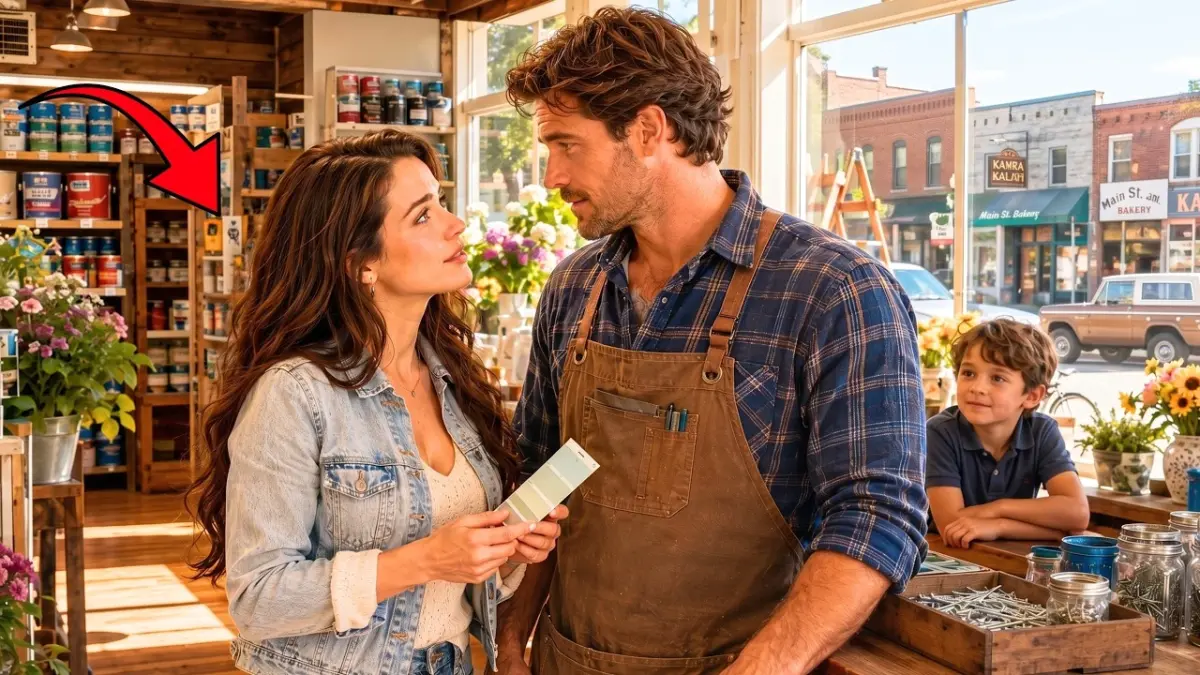
Instead, she turned down the third aisle, where tall steel shelves held rows of interior paint cans and color cards.
Dean set the heavy cardboard box down on a wooden pallet.
He wiped his hands on his canvas apron and followed her down the aisle.
“Looking for a specific shade today, Clare?” Dean asked gently.
Clare was holding a paper color swatch, staring at it so intently that her fingers trembled.
She did not look up at him.
“Dean,” she whispered, her voice barely carrying over the quiet hum of the fluorescent lights.
“Can you be the father of my baby just for one day?”
Dean stopped in his tracks.
The hardware store was silent except for the faint sound of Charlie humming to himself near the cash register.
He looked at her trembling hands, then at the bright blue swatch she wasn’t even reading.
Three years ago, a specialist in Columbus had sat Dean down in a small, cold room with beige walls.
The doctor had delivered the news with medical precision: Dean would never be able to father a child.
Eleven months after that diagnosis, his wife, Rachel, had packed her bags and walked away.
She had not been cruel, only heart-broken, grieving for a family that Dean could never provide.
Now, a woman he had known for only four months was standing in his paint aisle, asking him for the one thing he believed he was forbidden to be.
Dean took a slow breath.
“Only if you tell me why,” he said quietly.
Clare lowered the color card and pressed it against her mouth, breathing in hard through her nose.
A tear escaped the corner of her eye, tracking through the faint dust on her cheek.
“Charlie’s school is having an event on Friday morning,” she said, her voice cracking under the tension.
“It’s called Donuts with Dad.”
Dean nodded slowly.
He knew the event well.
When he was seven years old, his own father had closed the hardware store for two hours, walked over to the elementary school, and squeezed his large frame into a tiny wooden chair just to eat a glazed donut off a paper napkin.
“There are twenty-two kids in Charlie’s first-grade class,” Clare continued, looking up into Dean’s eyes.
“Every single child has someone coming. A father, a grandfather, an uncle, a stepfather. Someone.”
She swallowed hard, her chest heaving.
“Charlie has nobody. His biological father left when he was two. I have no brothers, and my own father passed away five years ago. There is no man in that boy’s life except…”
She stopped, unable to finish the sentence.
“Except me,” Dean said quietly.
Clare gave a single, hesitant nod.
“Except you,” she admitted.
“He talks about you every evening, Dean. But I have no right to ask this of you. It’s a massive favor, and you have a business to run.”
Dean looked past her, down the long aisle toward the front counter.
Little Charlie was sitting upright on the old wooden stool—the same stool Dean’s father had used for thirty years.
The boy had his tongue poked out the side of his mouth, carefully placing a sheet-metal screw into a plastic jar.
“I’ll close the store on Friday morning,” Dean said.
Clare blinked in shock, wiping her cheek with the sleeve of her cardigan.
“Dean, no. You can’t close the shop during business hours. You’ll lose morning sales.”
“My dad closed the store for me,” Dean replied, his tone steady and unyielding.
“Showing up is the whole trade, Clare. Everything else is just inventory. I’ll be at the school at seven-thirty.”
—
The origin of Charlie’s presence in the hardware store had begun four months earlier, in September.
School let out at three-fifteen, but Clare’s insurance job did not finish until five o’clock.
Between those hours lay a difficult gap that many working mothers struggled to fill.
On a rainy Tuesday afternoon, six-year-old Charlie had walked through the glass door of Whitaker Hardware.
He was small for his age, wearing a faded navy blue backpack and worn sneakers with a tiny hole starting near the right toe.
He had stood near the entrance, frozen, looking like he wasn’t sure if he was allowed inside.
“You lost, buddy?” Dean had asked from behind the counter.
“My mom said to wait here,” the boy had answered in a tiny, polite voice.
“She said not to touch anything.”
“All right,” Dean had replied.
“You can stand right there as long as you need.”
The boy had stood motionless for twenty minutes, refusing to sit on the floor or lean against the shelves.
The following afternoon, Dean had walked into the back storage room and dragged out his father’s old wooden stool.
He placed it right behind the high counter, next to the heavy metal register.
“That’s your spot,” Dean had told him.
“Sit down whenever you like.”
Charlie had looked at the stool as if Dean were handing him the keys to a brand-new bicycle.
By the second week, Dean realized the boy was bored watching customers buy nails and wire.
He found a large coffee tin filled with a chaotic mess of mixed fasteners in the storage room.
He set the tin on the counter alongside three empty glass mason jars.
“Wood screws go in the first jar, sheet metal in the second, drywall in the third,” Dean explained, pointing out the distinct thread patterns.
“Can you handle that?”
“I don’t know how,” Charlie whispered, staring at the pile.
“Neither did I until somebody showed me,” Dean said gently.
“Now I’m showing you.”
For two hours every afternoon, Charlie sorted fasteners with absolute concentration.
By the third week, Dean took a blank plastic magnetic strip into the back room, where an old engraving machine sat on a workbench.
He carefully carved out letters, wiped away the white plastic dust, and walked back to the counter.
He pinned the custom badge onto Charlie’s cotton shirt.
The badge read: *CHARLIE – ASSISTANT MANAGER*.
The boy’s face had transformed instantly, glowing with a profound sense of pride.
According to Clare, Charlie had worn that name badge to school every single day since, refused to let anyone touch it, and had even fallen asleep wearing it on several occasions.
When Clare came to pick him up at five o’clock, she always offered an apology.
“Dean, I am so sorry,” she would say, reaching for Charlie’s hand.
“He must be getting in your way.”
“He’s not,” Dean would answer with a slight smile.
“He’s the only employee I’ve got who doesn’t try to steal the tape measures.”
That remark had earned a genuine laugh from Clare—a sound that Dean found himself thinking about long after he locked the store and returned to his quiet, empty house on the edge of town.
—
On Friday morning, Dean woke up early.
He shaved carefully, put on a clean ironed button-down shirt, and drove his truck to the elementary school.
The cafeteria was filled with noise, the smell of fried dough, fresh coffee, and loud laughter.
Men in work boots, business suits, and jackets sat at low wooden tables designed for seven-year-olds.
Dean spotted Charlie sitting alone near the far corner of the room, looking down at his lap.
Dean walked across the linoleum floor, his heavy boots sounding loud in the room.
He pulled out a small plastic chair across from Charlie and sat down, his knees coming almost to his chest.
“Mind if I join you, Assistant Manager?” Dean asked.
Charlie’s head snapped up.
His dark eyes widened, and a brilliant, unrestrained smile spread across his face.
“Dean!” Charlie shouted, almost jumping out of his seat.
“You came!”
“Of course I came,” Dean said, reaching for a paper napkin and picking up a chocolate-frosted donut from the tray in the center of the table.
“I said I would, didn’t I?”
As Dean began eating the donut, he noticed the children at the neighboring table looking at him.
A boy named Tommy pointed a finger toward Dean.
“Are you Charlie’s dad from the hardware store?” Tommy asked loudly.
Dean paused, adjusting his position in the cramped chair.
“My name is Dean,” he clarified politely.
“Charlie says you have a machine in the back that makes real metal name tags!” another boy shouted from down the table.
“He said you let him cut large pieces of wood with the electric saw!”
“Correction issued,” Dean said immediately, looking at Charlie with raised eyebrows.
“Charlie sorts screws. Nobody touches the electric saw.”
Charlie giggled, burying his face in his hands.
Then a little girl sitting nearby leaned across the table, her brow furrowed in confusion.
“Charlie told us his dad was going to come today,” she said softly.
“He said it every day this week. Joey said he was making it up.”
Dean turned his gaze toward Charlie.
The six-year-old was sitting up perfectly straight, his back not even touching the chair, his little plastic badge pinned firmly to his red sweater.
He was looking around the cafeteria with supreme confidence, completely owning the space around him.
Dean felt a strange, tight lump form in his throat.
Charlie hadn’t been making up a fictional father.
He hadn’t been inventing an imaginary hero or a distant astronaut.
For four months, the boy had been describing Dean to his classmates—the store, the wooden stool, the coffee tin of screws, the custom badge.
Every single detail had been completely true.
The boy had simply been using a different word for him.
Dean managed to stay through the remaining thirty minutes of the event, answering questions from the children about tools and hardware.
When the bell rang for class, Charlie gave Dean a quick, tight hug around the waist before running off down the hallway with his classmates.
Dean walked out of the school building into the cool morning air.
He unlocked his truck, climbed into the driver’s seat, closed the door, and placed both hands firmly on the steering wheel.
The emotion caught him without warning.
Dean buried his face in his arms and wept harder than he had at his own father’s funeral eight years ago.
When he finally pulled himself together and looked up, he saw Clare standing near the edge of the parking lot by her modest sedan.
She had seen him in the truck.
Dean opened the truck door and walked over to her.
“You knew,” Dean said, his voice husky.
“You knew what he was telling people.”
Clare started crying right there in the bright morning sunlight, wiping her eyes with her coat sleeves.
“His teacher called me back in October,” Clare confessed, her voice trembling violently.
“She said she was worried. She said Charlie kept talking about his dad’s hardware store, and she knew there was no father listed on his paperwork. She thought he was dissociating or making up stories to cope.”
Clare shook her head, her shoulders shaking.
“So I sat him down at home that night. I asked him who he was talking about. And he described you, Dean. Every single detail was about you.”
“Why didn’t you stop it?” Dean asked softly.
“Because I couldn’t bear to take it away from him!” Clare sobbed.
“He was so happy every afternoon. And I didn’t know how to tell you without making things weird between us. I was so ashamed of letting it go on.”
Dean looked at her for a long moment.
“He didn’t pick me because I was the only man available,” Dean said quietly, realizing the truth as he spoke it.
“He picked me because he needed someone to be there.”
—
Word travels fast in a town of four thousand people.
By Sunday evening, news of the hardware store owner attending Donuts with Dad at the elementary school had spread across the county.
And on Monday afternoon, the past came calling.
At four o’clock, Charlie was sitting on his usual stool behind the counter, carefully placing sheet-metal screws into a glass jar.
The glass door of Whitaker Hardware opened with a sharp, heavy slam.
A large man walked into the shop.
He was in his mid-thirties, wearing a tight leather jacket, with dark sunglasses resting on top of his head indoors.
He walked with an aggressive, possessive stride that immediately filled the room.
It was Trent Bennett—Charlie’s biological father.
He lived in a neighboring town just thirty-five minutes away.
For four years, Trent had not driven those thirty-five minutes once.
He had started a new family, remarried, and left his firstborn behind.
The moment Trent entered, Dean saw Charlie’s entire body shrink.
The six-year-old pulled his shoulders in, making himself as small as possible on the wooden stool.
Dean felt an icy calm settle over his chest.
“Charlie,” Dean said smoothly, keeping his voice entirely steady.
“Go into the back storage room and count the wooden paint stirrers on the shelf for me, please.”
Charlie didn’t hesitate.
He slid off the stool and hurried through the swinging door into the back room.
Trent stepped up to the front counter, looking around at the rows of tools and lawnmowers with a dismissive smirk.
“So, you’re the guy?” Trent asked, his voice deliberately loud.
There were two older customers browsing in the plumbing aisle nearby, and Trent clearly wanted an audience.
“My name is Dean,” the hardware store owner replied quietly.
“You’re playing house with my son,” Trent said, leaning his heavy forearms onto the wooden counter.
“You know what this looks like to people in this town? A thirty-four-year-old guy, no wife, no kids of his own because everybody knows you can’t have them. Hanging around a little boy in the back of a store every day, making him little badges, giving him little jobs.”
Dean felt his hands tighten into fists under the counter, but his expression remained unreadable.
“And now you’re showing up at his school, pretending to be his father in front of his class,” Trent continued, raising his voice higher.
“He’s mine. You don’t get to just take another man’s kid because you couldn’t make one yourself.”
The two customers in the plumbing aisle stopped talking.
The store was dead silent.
Trent had taken facts and stripped them of every single truth that gave them meaning.
He had left out the fact that Clare worked two doors down, that there was a critical gap between three-fifteen and five o’clock, and that Charlie had simply needed a safe place to sit.
Most of all, he had left out the thirty-five minutes of highway between their towns that he had refused to travel for four years.
Dean took a deep breath.
He laid his large hands flat on the wooden counter.
“Trent,” Dean said in a low, even tone.
“How far is it from your front door to this store?”
Trent blinked, caught off guard by the unexpected question.
“What?”
“It’s thirty-five minutes,” Dean said, looking Trent straight in the eye.
“I looked it up on the map on Saturday.”
Trent shifted his weight, his mouth opening to speak, but Dean continued without raising his voice.
“You’ve had four years and thirty-five minutes of open road,” Dean said quietly.
“You didn’t drive it for his birthday. You didn’t drive it when he had severe pneumonia last winter and his mother slept in a hospital chair next to his bed for three straight nights. You didn’t drive it once.”
Trent’s face flushed dark red.
“You have no right to talk about my—”
“You drove it today,” Dean interrupted calmly.
“Twelve hours after you heard that a hardware store owner ate a donut with him at school. You aren’t here for Charlie, Trent. You’ve never been here for Charlie.”
Dean leaned forward slightly across the counter.
“You’re here because somebody else showed up, and you can’t stand what that says about you. You don’t want your son. You just want to not be the guy who abandoned him. And I can’t help you with that. Only thirty-five minutes of road can help you, and you’ve had it the entire time.”
Trent stood frozen behind the counter.
His mouth worked silently, trying to find a harsh insult or a threat, but the quiet truth offered him no leverage.
“I’ll call my lawyers,” Trent muttered defensively, stepping back toward the exit.
“I have legal rights.”
“The door opens at seven every morning,” Dean said simply.
Trent turned, pushed the glass door open violently, and walked out into the afternoon street.
He never called a lawyer, and he never drove those thirty-five minutes again.
—
That evening, the emotional fallout hit Clare.
At eleven o’clock at night, Dean heard a soft knock on his front door.
He opened it to find Clare standing on his porch under the amber porch light, her coat pulled tight around her, tears streaming down her face.
Dean stepped aside, but she refused to step inside the entryway.
“He’s right, Dean,” Clare said, her voice shaking violently as she leaned against the porch railing.
“That’s what makes this so unbearable. Trent is right about what people will say.”
“Clare, come inside out of the cold,” Dean urged softly.
“No, listen to me,” she insisted, shaking her head.
“I’ve let my son build an entire father figure out of a man who was just being polite to a kid in his shop. What happens when this ends? What happens when you meet someone, or you get tired of having us around, or you realize we aren’t your family? Charlie is six years old, Dean. He cannot lose a father twice.”
Dean walked out onto the porch, closing the door behind him.
He sat down on the top wooden step.
“Sit down, Clare,” he said gently.
She hesitated, then sank onto the step beside him, pulling her knees to her chest.
“My dad ran that store for thirty years,” Dean began, looking out toward the quiet, dark street.
“He wasn’t an affectionate man. He didn’t say more than forty words a day. Honestly, he was a hard man to live with.”
He turned his head to look at her.
“But he opened that front door at seven o’clock every single morning. And every kid in this town knew that if their bike broke, or if they needed help, there was a man behind that counter. Same place, same hours.”
“Dean…”
“He told me once that the whole job of being a man was just showing up,” Dean continued.
“I used to think he was being cheap about it, like it was a low bar to set. But it’s not a low bar, Clare. It’s the only bar.”
He reached out and took her cold hand into his broad, warm palm.
“Trent had thirty-five minutes of road and four years, and he didn’t show up. I’m just a guy with a hardware store and a wooden stool. I’m not going to make you grand romantic promises tonight because promises are cheap. I’m just going to open the shop door at seven tomorrow morning. And then I’m going to do it again the day after that.”
Clare stared at him through her tears, her fingers tightening around his.
“You’ve been open at seven for four months,” she whispered.
“Yes,” Dean said simply.
“I have.”
—
What followed over the next year was not a sudden fairy-tale romance.
It was slow, careful, and deliberate.
Both Dean and Clare had been severely hurt by past relationships, and neither was willing to move quickly when a child’s heart was involved.
They took things step by step.
First, it was coffee at the local diner while Charlie was at school.
Then, simple dinners at Clare’s house after Charlie had gone to sleep, with Clare’s sister sitting in the living room as a chaperone.
Eventually, they went to a movie in the neighboring town like quiet teenagers.
The turning point occurred late one evening in March.
Charlie had contracted strep throat, running a high fever, and Clare had been awake for two nights in a row.
At ten o’clock on a rainy Tuesday, Dean’s phone rang.
“Dean?” Clare’s exhausted voice came through the speaker.
“I’m sorry to call so late. I don’t need anything… I just needed to hear an adult voice for two minutes.”
“I’ll be right over,” Dean said.
Twenty minutes later, Dean knocked on her back door.
He was holding a container of chicken noodle soup from the twenty-four-hour diner and a box of orange popsicles.
When Clare opened the door, she looked entirely overwhelmed.
Her hair was messy, her eyes were bloodshot, and she was wearing the same gray sweatshirt she had worn for two days.
“You didn’t have to do this,” she whispered, leaning against the doorframe.
“I know,” Dean said quietly.
Clare broke down right there in the doorway, burying her face in her hands and weeping from pure exhaustion.
Dean didn’t offer empty platitudes.
He stepped inside, set the food on the counter, and stood quietly beside her, offering a steady shoulder until the storm passed.
Clare wiped her face with a paper towel and let out a breathless, embarrassed laugh.
“God, I’m sorry,” she said, shaking her head.
“I’m a lot to handle right now.”
“You’re not a lot,” Dean said.
“Dean, look at me,” she argued, pointing to her messy clothes.
“I’m a single mother with a sick kid, no money, and an ex-husband who causes drama. Objectively, I am a lot.”
Dean looked at her with absolute sincerity.
“Clare, I own a hardware store in a town of four thousand people. I’ve lived alone in a quiet house for three years. A doctor told me I’d never have a family of my own.”
He walked over to the counter and picked up the popsicles.
“You think you’re a lot? I’m not a little. I’m just quiet about it.”
Clare stared at him, her lips parting slightly.
“I’m not here because your life is easy,” Dean said softly.
“I’m here because it’s ten o’clock at night and you called.”
That night, in the dim light of her kitchen, with the rain coming down outside and her sick son resting down the hall, Dean pulled Clare close and kissed her gently for the first time.
When she pulled back, she rested her forehead against his chest.
“I’m so scared of this,” she whispered.
“Me too,” Dean admitted.
“Just don’t be someone who leaves,” she asked softly.
“Clare,” Dean chuckled, his chest vibrating against her forehead.
“I’ve never left anywhere in my life. It’s actually my primary personality flaw.”
Clare laughed—a genuine, warm sound that filled the quiet kitchen.
—
A year later, when Charlie was seven years old, the final truth revealed itself.
It was a quiet Sunday afternoon.
Dean, Clare, and Charlie were in Dean’s kitchen.
Charlie was sitting at the wooden dining table, working on his second-grade math worksheet with a yellow pencil.
Dean and Clare were standing by the sink, washing the lunch dishes.
They weren’t touching, but they stood close enough that their shoulders occasionally brushed.
Out of nowhere, without looking up from his paper, Charlie spoke up.
“Mom, when are you going to marry Dean?”
Clare accidentally dropped a ceramic plate into the soapy water with a loud splash.
She quickly dried her hands on a dish towel and walked over to the table.
She pulled out a chair and sat down facing her son.
She decided it was time to address the reality she had feared for over a year.
“Charlie, sweetheart,” Clare began gently, taking his small hands in hers.
“We need to talk about that. Dean is wonderful, and he is our best friend. But you know that he isn’t your biological father. Your dad is Trent. I am so sorry I let you tell your class at school that Dean was your dad. That was my fault, not yours.”
She was trying desperately to keep her voice steady, though tears welled in her eyes.
Charlie looked at his mother with a expression of pure boredom, as if she were explaining something blindingly obvious.
“I know Trent is my dad,” Charlie said matter-of-factly.
“I’m not a baby, Mom.”
Clare paused, caught completely off guard.
“Then… honey, why did you tell everyone at school that Dean was your father?”
Charlie rolled his eyes, holding his yellow pencil up.
“Because you get to pick,” Charlie said simply.
Clare blinked, shaking her head.
“Charlie, you can’t just pick a father.”
Charlie turned his head and looked straight across the room at Dean, who was standing still by the kitchen sink.
“Why not?” the seven-year-old asked confidently.
Dean felt the breath leave his lungs.
He turned around, walked out of the kitchen, and stepped into the quiet hallway.
He leaned his back against the wall, putting his hand over his mouth as tears spilled down his cheeks.
In that single moment, Dean realized everything.
Charlie hadn’t been lying to his classmates.
He hadn’t been confused or making up stories.
The boy had been actively choosing Dean every single day.
He had looked at a thirty-four-year-old man who had been told he would never be a father, a man who simply opened the shop door at seven every morning, and the six-year-old boy had walked in, sat on a wooden stool, and made his choice.
—
Dean and Clare were married the following autumn in Dean’s backyard.
It was a small, quiet ceremony attended by forty people from the town.
Clare’s sister cried through the entire service.
Charlie served as Dean’s best man, wearing a dark suit and a clip-on necktie, taking his duties with absolute seriousness.
The following spring, the official adoption papers were signed at the county courthouse.
Trent Bennett signed the relinquishment papers without putting up a fight and did not attend the hearing.
Five years later, Charlie turned twelve.
He officially started working at Whitaker Hardware on Saturdays, receiving a real paycheck for his labor.
On the morning of the wedding, eight-year-old Charlie had walked into Dean’s room before the ceremony.
He had reached into his pocket and handed Dean a brand-new plastic badge he had engraved himself on the machine in the back of the store.
The letters were slightly crooked, but the white text on the blue plastic was clear: *DEAN – DAD*.
Dean wore that badge on his canvas apron every single day while working behind the counter.
Whenever customers from out of town asked about the crooked lettering, Dean would smile, lean over the counter, and tell them that his assistant manager had made it for him.
(Descargo de responsabilidad: Este contenido puede haber sido generado por IA con fines de entretenimiento. Cualquier parecido con personas, eventos o lugares reales es pura coincidencia.)