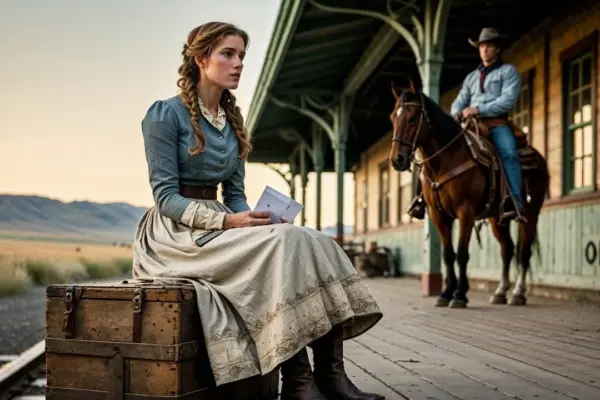
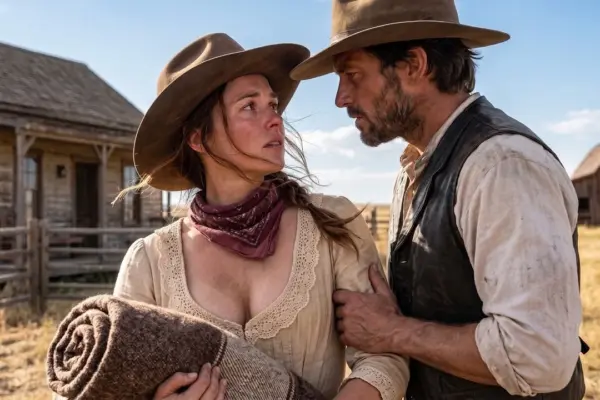
“I Can’t Read or Write, But I Can Work Your Ranch”—”I Asked God for a Husband to Lead Me to Him”
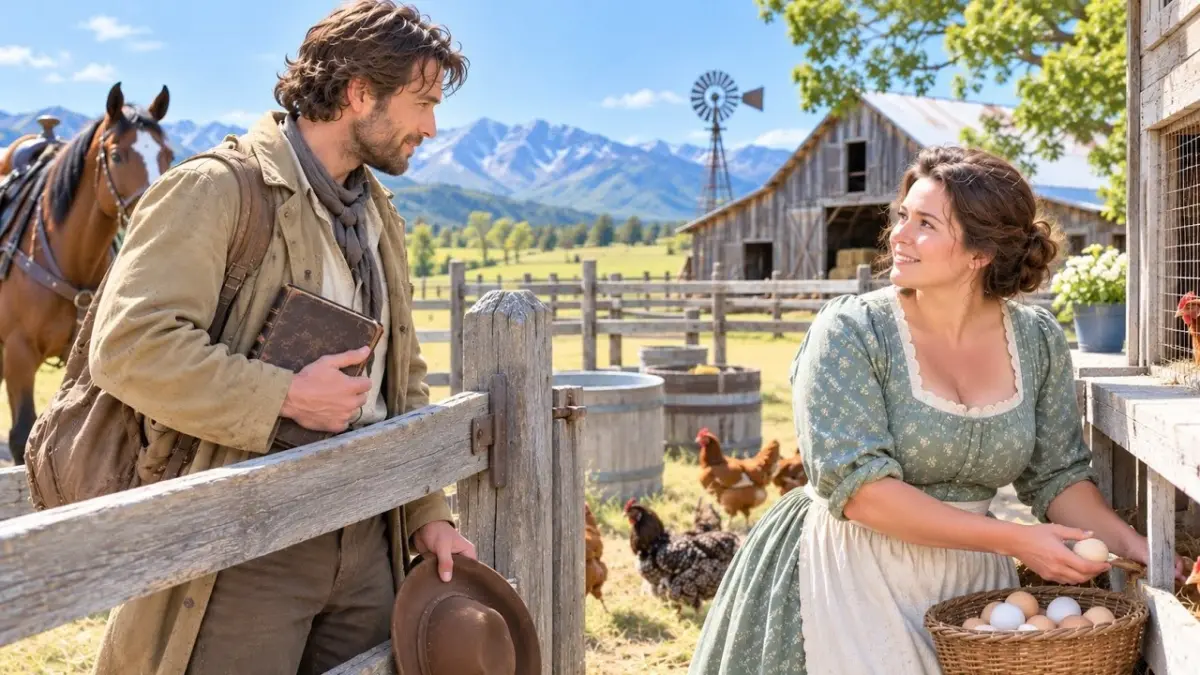
In September 1891, the rolling Missouri Hills had already begun turning the warm, dull color of weathered brass.
Clara Whitfield stood by the cedar pasture gate with a heavy coil of rusted fence wire hanging from her calloused hand.
The autumn wind carried the scent of dry prairie grass and distant pine wood smoke.
She paused in her mending, wiping her sweat-dampened brow with the corner of her faded apron.
Down the narrow dirt wagon road, a solitary figure emerged around the bend.
The stranger was tall, gaunt, and coated in a thick layer of yellow road dust from his worn leather boots to his broad-brimmed felt hat.
He carried a canvas duffel bag slung over his broad shoulder, and clutched tightly under his left arm was a heavy, leather-bound volume.
Clara watched his steady approach, her hand instinctively resting on the wooden gate latch.
She had turned away three different wandering drifters that summer, wary of lonely men looking for easy hand-outs.
Yet there was something fundamentally steady and unhurried in this man’s gait that made her stay her hand.
He came to a stop a few paces from the fence, lifting his hat to reveal dark hair graying at the temples and eyes that held the quiet patience of a long-travelled road.
“Good morning to you, ma’am,” the stranger said, his voice deep and raspy from the road dust.
“Good morning,” Clara replied, her tone cautious but polite. “Are you just passing through these parts?”
“I’m finding my way,” he answered simply, setting his heavy canvas bag down onto the dry grass. “I’m looking for honest work, if you’ve got any to spare.”
Clara appraised him carefully, taking in his patched trousers and the quiet dignity in his posture.
“What kind of work can you do?” she asked.
“Whatever kind you’ve got,” the man answered without hesitation. “I can mend wire, chop timber, pull calves, or drive a team.”
“Can you read or write?” Clara inquired, leaning slightly against the oak gate post.
The stranger looked directly into her eyes, offering neither excuses nor pretense.
“I can’t read or write, ma’am,” he admitted plainly.
Most men in the county would have hung their heads in shame at such a confession, but this man showed no embarrassment.
“I know cattle, ma’am, and I know hard work,” he added. “That’s all I’m offering.”
Clara was on the verge of shaking her head and sending him along down the county road when her gaze fell upon the book tucked beneath his arm.
It was an ancient, beat-up Bible, its dark leather cover cracked and faded by years of sun and rain.
The spine had been carefully hand-stitched and reinforced with raw strips of deer hide to keep the heavy pages from falling away.
“If you can’t read,” Clara asked, pointing a finger toward the volume, “why do you carry an old Bible around with you?”
The stranger lowered his gaze to the weathered book, his coarse fingers tracing the stitched hide on its spine with remarkable gentleness.
His rigid posture softened slightly.
“My mother, Hannah, read this very book to me when I was just a boy,” he explained softly. “Some of those words stayed inside me, even after she took fever and passed away. She was the only person who ever made me feel like those words belonged to me, even if I couldn’t make out the letters on the page.”
Clara listened in silence, a sudden ache settling behind her ribs.
She knew intimately what it meant to carry heavy memories inside an empty house.
Her husband, Daniel, had been laid in the cold earth behind the orchard more than a year ago, yet every evening at sundown, she still caught herself setting two pewter plates on the kitchen table before remembering she was completely alone.
“My name is Clara Whitfield,” she said, lifting the latch on the pasture gate and pushing it open. “I can’t offer you permanent wages right now, mister, but you can sleep in the bunkhouse tonight and take a hot meal at the kitchen porch.”
The stranger inclined his head in quiet gratitude.
“Silas Bennett,” he offered, holding out a large, weathered hand. “I appreciate the mercy, Mrs. Whitfield.”
Early the next morning, as the first gray light broke over the eastern timber, Eli Turner came creaking out of the barn.
Eli was an old, weathered ranch hand who had worked the Whitfield land for over thirty years, his knees stiffened by decades of wet winters.
Clara introduced the two men over a pot of black coffee on the porch before sending them out to inspect the northern pasture herd.
Silas walked the dirt ridges beside Eli, his sharp eyes scanning the seventy head of cattle scattered across the hills.
While Eli checked the perimeter fencing, Silas stood quietly near a pine grove, watching the herd’s behavior.
He noticed a subtle trouble that had escaped the old hand’s notice.
The cows were noticeably lean, their hip bones showing sharp beneath their hides, despite the pasture offering plenty of dry buffalo grass.
When Eli ambled back over, pulling a tin of tobacco from his coat, Silas gestured toward the cattle.
“They’re wasting their meat, Eli,” Silas observed, pointing down the sloping ridge.
Eli squinted through the morning glare.
“Grass is decent enough for September,” Eli grunted. “They’ve got plenty to graze.”
“It isn’t the grass,” Silas replied, leaning down to examine the worn dirt paths cutting deep into the turf. “Look at those trails. These cows are walking nearly three miles south every single afternoon just to reach the main creek for a drink. The trek is burning off every pound of fat they put on, especially the heifers carrying winter calves.”
Eli stroked his gray beard, staring down at the cut dirt paths in realization.
“Well, damn if you ain’t right,” Eli muttered, rubbing the back of his neck. “The creek’s the only standing water left on this side of the property.”
Silas didn’t answer immediately; instead, he followed the oldest cattle trail upward, tracking it toward the steep northern hillside.
Thick brush and wild blackberry brambles choked the incline, but beneath the overgrown vines, Silas spotted a row of ancient, moss-covered fieldstones.
He pushed through the thorns and uncovered an old natural spring trickling weakly into a collapsed stone basin.
An old stone water line had once piped the fresh spring water directly down to a large wooden stock tank in the upper pasture, but it lay broken, choked with mud and fallen shale.
Back at the farmhouse, Silas met Clara near the pump house and described what he had found on the hill.
Clara looked away toward the northern ridge, her face clouding with old sorrow.
“I know that spring, Silas,” she said softly, her hands tightening on the handle of her tin water pail. “My Daniel started rebuilding that stone pipe the summer before he fell sick. After he died… I couldn’t bear to walk up that hill. Every stone he laid out there felt like a ghost standing in the brush.”
Silas stood respectfully, letting the silence rest between them for a moment before speaking.
“If you’ll let me stay through the winter, Mrs. Whitfield, I’ll clear those brambles and finish laying those stones,” Silas offered quietly. “We can bring that spring water straight down to the stock tank. Your herd won’t have to walk a mile for a drink, and your calves will make it through the freeze.”
Clara looked at the tall stranger, seeing the quiet sincerity in his dark eyes.
“You’ve got a job, Silas Bennett,” she said.
For the next four weeks, the quiet of the northern pasture was broken by the rhythmic clinking of iron shovels against stone.
Silas worked from sunrise until the stars showed through the timber, assisted by old Eli and Wesley, a green seventeen-year-old hired hand Clara brought on for the harvest.
They hauled away broken shale, dug out choked roots, replaced cracked stone sections, and re-lined the mortar channel with clay and fresh lime.
On a chilly afternoon in late October, Silas knocked away the final wooden wedge choking the spring head.
With a soft, rushing gurgle, crystal-clear spring water surged through the restored stone line and poured out into the wooden stock tank in the upper pasture.
Within three days, the cattle stopped making the grueling afternoon march down to the distant creek.
They lingered near the lush northern pasture grass, resting beneath the shade of the walnut trees and drinking their fill from the full tank.
That evening, Clara sat at her small desk by the window, opening her leather leather-bound ledger.
For the first time in over a year, she dipped her steel pen in ink to record a noticeable improvement rather than a financial loss.
The cattle were gaining weight, and the pregnant cows looked sturdy enough to endure the coming snows.
A quiet sense of hope, long absent from the house, settled over her hearth.
Later that evening, after the sun had dipped behind the black pines, Clara stepped out onto the porch to fetch another log for the stove.
She caught sight of a dim yellow lantern beam glowing from the steps of the bunkhouse.
Silas was sitting on the wooden steps, the cool night wind rustling his dark hair.
Spread open across his denim knees was his mother’s old leather Bible.
He wasn’t reading it, for he could not decipher the black characters printed on the thin parchment.
He was simply resting his broad, calloused thumbs against the yellowed paper, staring down at the words in reverent silence.
Clara pulled her heavy woolen shawl tighter around her shoulders and walked down the porch steps, her boots soft on the frost-dusted grass.
“Silas?” she called softly so as not to startle him.
Silas looked up, reflexively pulling the old book a little closer to his chest before relaxing.
“Evening, Mrs. Whitfield,” he said.
“It’s cold out here to just be sitting,” she remarked gently, stepping closer to the lantern light. “Would you… would you like me to read a chapter aloud to you?”
Silas looked down at the book, a long, heavy silence stretching between them as the night wind whistled through the oaks.
“I wouldn’t want to take up your evening, ma’am,” he said quietly.
“It’s no trouble at all, Silas,” Clara insisted, sitting down on the step beside him. “It’s been a long time since anyone read out loud in this house.”
Silas carefully handed the heavy volume over to her.
Clara rested the worn leather on her lap, turned the delicate pages past the family record births and deaths, and found the Book of Psalms.
By the yellow glow of the tin lantern, her voice rose clear and melodic into the crisp night air, reading of green pastures, still waters, and the restoration of weary souls.
Silas sat completely motionless beside her, his hands clasped tightly between his knees, his eyes fixed on the distant dark line of the woods as he drank in every spoken syllable.
That chilly October evening marked the beginning of something neither of them had anticipated.
Almost every night thereafter, when the day’s hard chores were finished and the stock was fed, Silas would clean his hands at the pump, walk up to the farmhouse porch, and hand his mother’s Bible to Clara.
As the autumn nights grew longer and colder, they moved inside to the warmth of the kitchen fire.
Silas sat in the wooden rocker by the hearth, listening intently as Clara read by the yellow light of an oil lamp.
Soon, he began asking questions—not about the ranch or the cattle, but deep, probing questions about the God behind the words.
“Does the Book say a man can be forgiven if he spent twenty years running away from what’s right?” Silas asked one night, his deep voice heavy with old regrets. “Can a man who wasted his youth wandering around like a stray dog ever find his way back home?”
Clara set the open Bible on her lap, looking across at the tall ranch hand.
“I believe that’s the very reason the Book was written, Silas,” she answered softly.
Over the crackle of the wood fire, Silas gradually shared the story of his youth.
His mother, Hannah, had died of summer fever when Silas was only eleven years old.
His father had been a stern, exhausted tenant farmer who believed that schooling was a luxury for wealthy town folk and that a boy’s only duty was to swing an axe and hold a plow line.
Silas had worked from dawn till dark, never setting foot inside a schoolhouse.
When his father died years later, Silas took to the road, drifting from one cattle outfit to another across Texas, Kansas, and Missouri.
Through all those lonely, homeless years, he had carried his mother’s Bible wrapped in a piece of oiled canvas inside his sack.
“There was a winter six years ago in Abilene,” Silas recalled, staring into the red embers of the stove. “I was broke, starving, and sleeping in a livery hayloft. A pawn dealer offered me two whole dollars for the leather on that Bible. Two dollars would have bought me a week’s worth of hot meals and a dry pair of boots.”
“And you didn’t sell it?” Clara asked softly.
Silas shook his head firmly.
“No, ma’am,” he replied. “It wasn’t mine to sell. My mother put her blessing on those pages, and selling it would have been like selling the only part of her that was still alive. She gave me something worth far more than gold, even if I was too ignorant to read it myself.”
One evening in mid-November, as a cold rain rattled against the glass windowpanes, Clara turned the pages to the fifteenth chapter of the Gospel of Luke.
She began to read the familiar parable of the prodigal son.
Silas leaned forward in his chair, his broad elbows resting on his knees as he hung on every word.
When Clara reached the verse describing the lost son returning home—how his father saw him while he was still a great way off, felt deep compassion, ran out into the road, threw his arms around him, and kissed him—Silas suddenly raised a broad hand.
“Wait, Mrs. Whitfield,” Silas interrupted, his voice thick and strained. “Read that part to me again. The part about the father.”
Clara paused, her eyes lingering on his face before she re-read the passage slowly: “‘But when he was yet a great way off, his father saw him, and had compassion, and ran, and fell on his neck, and kissed him.'”
Silas sat frozen in the firelight.
A tear welled up in the corner of his eye, catching the amber light of the hearth before tracing a line through the dust on his cheek.
“All my life,” Silas whispered, his chest heaving with silent emotion, “I thought a man had to fix himself up first. I thought I had to walk the whole dirty road back, clean my clothes, and prove I was respectable before God would even look at me.”
Clara set the Bible on the wooden table, looking at him with deep tenderness.
“Maybe grace means finding out He was already running down the road toward you before you even knew how to ask,” she said gently.
That night, beside the small kitchen table, Silas Bennett bowed his dark head and prayed his very first prayer aloud.
His words were simple, unpolished, and devoid of grand religious phrases.
“Lord,” Silas choked out, his large hands trembling on his knees. “I don’t know how to speak to You properly, and I’ve wasted a whole lot of years wandering in the dark. But if You’ll take back a man who can’t even read Your own book, I’d like to come home tonight.”
Clara sat beside him, tears quietly spilling down her own cheeks.
She had spent two years in cold, silent grief after Daniel’s death, shunning her Bible and feeling entirely abandoned by heaven.
She had thought she was merely acting as a teacher to a poor, illiterate drifter.
Yet as she listened to Silas pray, she realized that her own cold, hardened heart had begun to melt back to life.
She was opening the Scriptures again, praying again, and feeling the warm presence of God in her home for the first time in years.
A few days later, while they sat at the kitchen table after supper, Clara laid down a clean sheet of paper and a freshly sharpened lead pencil in front of Silas.
“It’s time you learned your letters, Silas,” she said with a warm smile.
Silas stared at the slim graphite pencil as if it were a dangerous weapon, pulling his big, calloused hands back onto his lap.
“No, Mrs. Whitfield,” he said, shaking his head in embarrassment. “A grown man of thirty-five has no business fumbling around with children’s slates. My hands are too stiff from iron axes and leather reins to hold a pencil.”
“Nonsense,” Clara insisted gently, placing the pencil back into his rough fingers. “It is never too late to learn the truth, Silas. We will take it one letter at a time.”
They began that very evening with the basic alphabet.
Silas struggled terribly at first.
His heavy, muscular fingers, hardened by decades of brutal physical labor, cramped painfully as he tried to trace the delicate loops of letters on the paper.
He accidentally snapped the pencil lead three times in his frustration, cursing under his breath before apologizing profusely to Clara.
Yet, with unwavering patience, Clara guided his wrist, tracing the shapes over and over until his hand grew accustomed to the movement.
They practiced spelling simple words: *grass*, *barn*, *rain*, and *rain*.
Then, on a quiet evening in early December, Clara pointed to a specific word written at the top of a page in his mother’s Bible.
Silas leaned close to the paper, his breath holding still in his chest as he painstakingly sounded out the letters one by one.
“J-E-S-U-S,” Silas whispered slowly, his voice shaking.
He stopped, staring at the five letters on the page as if they were made of pure gold.
“Jesus,” he repeated aloud, his voice breaking entirely.
He covered his face with his heavy, calloused hands and wept silently right there at the kitchen table.
After twenty-seven long years of carrying his mother’s Bible in the dark, he could finally read the very name she had taught him to love.
Winter settled over the Missouri Hills with brutal, unforgiving severity.
The spring line held firm, and the cattle remained healthier than in years past, but maintaining a ranch in freezing weather required endless, exhausting toil.
In mid-December, a warm, sudden rainstorm struck the frozen ground, followed immediately by a bitter flash freeze.
Torrential runoff poured down the northern hillsides, overflowing the drainage channel Silas had dug above the pasture.
The surging water washed across the lower wagon road, tearing away three spans of timber fence and flooding the lower calving barn with deep, freezing mud.
Silas stood in the pouring rain the following morning, staring at the ruined fence and the flooded barnyard in silent dismay.
He felt a deep surge of shame, believing he had failed Clara by not predicting the massive wash.
When Eli ambled up beside him, leaning on his shovel, Silas turned to the old hand.
“I built that channel too shallow, Eli,” Silas admitted candidly, offering no excuses. “I thought the hillside would absorb the runoff. I was wrong.”
Eli spat a stream of tobacco juice into the mud and looked at the younger man with quiet respect.
“A foolish man defends his mistakes, Silas,” Eli said. “A wise man fixes ’em. We need to dig a deeper retention basin up top and build a stone spillway to redirect the surge toward the creek.”
Silas didn’t let pride stand in his way; he picked up his spade and listened carefully as Eli explained the proper slope required for heavy hill drainage.
For two agonizing weeks, Silas, Eli, and young Wesley worked in freezing mud, digging out a massive stone catch basin and reinforcing the spillway with heavy oak timbers.
Through that ordeal, Silas learned a profound lesson: being a godly man did not mean being infallible or knowing everything.
It meant having the humility to admit when he was wrong and the wisdom to learn from those with more experience.
Clara watched him work from the kitchen window, her respect and affection for Silas deepening far more than if he had been a man who refused to admit a fault.
Their quiet evening readings continued by the warm hearth.
As Clara read through the Gospels, Silas began to understand that faith was not a magic shield that prevented hard times, storms, or cold winter rains from falling on a man’s life.
Rather, faith was the absolute assurance that he would never have to stand alone in the midst of those storms again.
The true test of their collective strength arrived in mid-February.
A devastating ice storm swept down from the north, coating every tree, fence rail, and roof in a thick, glass-like sheet of heavy ice.
Rain continued to pour over the frozen earth, and the northern creek rose at an alarming rate.
Up in the northern pasture, sixty heavy cows—many of them heavy with spring calves—were trapped against the swollen drainage ditch.
If the ice dam holding the spring basin gave way, the rushing wall of water would sweep straight through the lower fence, wiping out half the herd in the freezing darkness.
At two o’clock in the morning, Silas pounded frantically on Clara’s bedroom door, his face pale with urgency.
“Clara! Wake up!” he called out.
Clara pulled on her heavy coat and boots, running into the kitchen where Silas stood by the door, covered in sleet.
For the very first time since he had arrived at the ranch, Clara saw real, stark fear in his eyes.
“The ice is jamming the spillway,” Silas said, his breath rising in white clouds in the cold room. “If that basin bursts, we’ll lose the cows and the lower barn. Clara… I can’t hold that timber wall by myself. I’m afraid I’ll lose everything you built here.”
Clara stepped forward without hesitation, reaching out and grabbing his freezing, glove-less hands in her own.
“Look at me, Silas,” she commanded softly but firmly.
Silas looked down into her steady eyes.
“What were the words we read last night from the Psalms?” Clara asked gently.
Silas swallowed hard, his jaw tightening as he recalled the passage.
“‘God is our refuge and strength… a very present help in trouble,'” Silas whispered, the words anchoring his panicked heart.
“He is with us tonight, Silas,” Clara said, nodding firmly. “Now let’s go save our herd.”
They roused Eli and Wesley from the bunkhouse, lighting pitch torches and plunging out into the screaming, ice-laden dark.
For five agonizing hours, the four of them fought the rising floodwaters in pitch darkness.
They used heavy iron crowbars to shatter the thick sheets of ice choking the spillway, forcing the frozen blockages down the overflow channel.
They hauled heavy oak logs through the freezing mud to reinforce the sagging pasture fence, their hands numb and bleeding from the sharp ice.
Clara worked right alongside the men, swinging an iron bar to clear the clogged drainage grates without a single word of complaint.
At one point, when the ice dam threatened to buckle the main timber support, Clara stood ankle-deep in freezing water, held an iron lever against the wall, and prayed aloud into the howling wind.
She didn’t pray for an easy life or for the storm to magically vanish; she simply prayed for the strength to take the next right step.
By the time the pale yellow rays of dawn broke through the gray winter clouds, the floodwaters had finally receded into the designated overflow channels.
The retention basin held firm, and the timber spillway remained standing.
Though they lost three older cows who succumbed to the freezing cold during the night, the vast majority of the herd was saved, resting safely on the high ground of the upper pasture.
Exhausted, soaked to the bone, and shivering uncontrollably, Clara sat down on an overturned crate in the barn.
She felt a deep ache for the three lost cows, but as she looked at Silas, Eli, and Wesley standing together in the pale morning light, her heart was filled with a profound sense of gratitude.
Later that afternoon, she opened her ranch ledger and wrote a brief entry:
*February 14, 1892. Severe ice storm. Lost three head. Retention system held. We are not alone.*
Those final four words meant more to her than any financial ledger could ever reflect.
For two dark years, she had carried every burden, every repair, and every fear entirely on her own fragile shoulders.
Now, God had surrounded her with faithful people, and more importantly, she had found her way back into a living, daily conversation with her Creator.
Spring arrived in the Missouri Hills with sudden, joyous splendor.
The thick sheets of ice melted away, giving rise to lush green carpets of clover and bluegrass across the northern slopes.
The cattle flourished on the spring water, and calf after calf was born strong and healthy in the sunny pastures.
Out of sixty pregnant cows, only a single weak calf was lost that entire season.
In late May, a livestock buyer from St. Louis visited the Whitfield ranch to inspect the herd.
He walked among the sleek, heavy cattle in awe, shaking his head in amazement.
“I haven’t seen stock this heavy and healthy anywhere in the county, Mrs. Whitfield,” the buyer remarked, pulling out his checkbook. “What in the world are you feeding them?”
Clara smiled warmly, looking over at Silas, who was quietly repairing a fence post near the barn.
“We stopped making them walk three miles every day just to get a drink of fresh water,” Clara replied simply.
That very evening, however, Clara saw something through the kitchen window that made her heart drop.
Silas was standing outside the bunkhouse door, his old canvas duffel bag packed tightly and slung over his shoulder.
His boots were polished, his mother’s Bible was safely tucked under his arm, and he was looking out toward the main road leading west.
Clara wrapped her shawl around her arms and hurried out down the porch steps.
“Silas!” she called out, her voice trembling slightly. “What are you doing?”
Silas turned, his expression full of quiet sadness.
“The spring line is finished and holding strong, Clara,” Silas said gently, using her Christian name for the first time. “The herd is healthy, the calves are sold, and you’ve got Eli and Wesley to help you with the haying. My work here is done. It’s time I moved along farther west to find work.”
Clara walked straight up to him, stopping just a foot away, refusing to let him turn his eyes away from hers.
“Silas, stand still and listen to me,” she commanded softly.
Silas paused, his dark eyes locked onto her face.
“The night before you walked up my wagon road last September,” Clara revealed, her voice soft and thick with emotion, “I knelt beside my bed for the first time in two years. I hadn’t truly prayed since Daniel died. I felt cold, hollow, and completely lost in the dark. I begged God to send someone to this ranch who could help me find my way back to Him.”
Silas listened in complete, stunned silence.
“When I saw you walking up that road the next morning,” Clara continued, tears shining in her eyes, “a tired, dusty drifter carrying an old Bible he couldn’t even read, I never imagined you were the answer to my prayer. But you were. By reading to you every night, I opened the Scriptures again. By watching you learn to trust God, I learned to trust Him again.”
Silas stood frozen, a sudden, profound realization sweeping over his soul.
All his life, he had believed he was merely a useless, uneducated wanderer drifting aimlessly from town to town.
He had never considered that Almighty God might have ordered his steps, leading him across three states to save a grieving widow’s heart just as she was saving his.
“Silas,” Clara said gently, laying her small hand lightly against his warm, flannel-clad arm. “If you stay on this ranch, don’t stay just because you think God sent you here as a laborer. Stay because you choose this land, this life… and stay because you choose me.”
Silas looked away toward the farmhouse, the big red barn, the green pasture hills glistening in the twilight, and then back to Clara’s beautiful, expectant face.
“All my life, Clara,” Silas whispered softly, his deep voice trembling, “I’ve been packing this canvas bag and leaving places before people could grow fond of me or before I could call a place home. I guess… I guess I’m finally tired of running.”
Slowly, deliberately, Silas unslung the heavy canvas bag from his shoulder and set it down onto the wooden porch steps behind him.
He reached out his broad, calloused hand and wrapped his fingers gently around Clara’s, sealing a silent promise between them.
They continued their evening readings at the kitchen table, but a rich, quiet intimacy now graced their conversation.
Silas continued practicing his letters every night, his reading improving with each passing week, while Clara continued to grow deeper in her renewed faith.
They didn’t pretend that their future would be free of hardship; they knew full well that farming required dealing with droughts, unpaid bills, sickness, and hard winters.
Yet they knew with absolute certainty that whatever trials came their way, they would never have to face them alone again.
In August of 1892, as the Missouri Hills turned golden under the summer sun, Clara Whitfield and Silas Bennett were married in the small wooden church at Cad’s Mill.
Old Eli Turner stood proudly beside Silas as his best man, while young Wesley sat in the front pew, wiping tears from his eyes with his sleeve.
Their wedding was a simple, quiet affair, but the home they built together became full of warmth and life.
There were now two heavy winter coats hanging on the wooden pegs near the kitchen door, two tin coffee mugs resting beside the woodstove, and an open Bible resting permanently in the center of the oak kitchen table.
One warm evening in late autumn, Silas sat in his rocking chair by the stove, holding his mother’s old Bible in his sturdy hands.
He turned the delicate pages to the Gospel of John, tracing the line of text with his broad thumb.
He struggled slightly with a few long words, paused to sound them out, corrected himself, and kept going.
When his eyes reached the fourteenth chapter, he read aloud in a slow, clear, steady voice:
“‘Jesus saith unto him, I am the way, the truth, and the life: no man cometh unto the Father, but by me.'”
As the final word left his lips, Silas stopped.
He covered his face with his heavy, calloused hands, his broad shoulders shaking as he wept silent tears of profound joy.
For nearly thirty long, lonely years, he had carried that holy book through darkness, poverty, and shame without being able to read a single line.
Now, sitting in his own warm home beside the woman he loved, he was reading those beautiful words of life in his own voice.
Clara walked quietly across the room, wrapped her arms gently around his neck from behind, and rested her cheek against his dark hair, tears of gratitude streaming down her face as well.
Years passed, and the Whitfield-Bennett home bore no resemblance to the cold, lonely house Clara had inhabited after Daniel’s death.
The empty chairs around the dining table were no longer sad symbols of grief and loss; they were simply places where friends, neighbors, and hands gathered to share hot meals and sweet fellowship.
The old canvas duffel bag remained tucked safely under the bed in the master bedroom, its leather straps securely buckled, for Silas no longer lived like a drifter ready to flee at a moment’s notice.
His mother’s Bible remained open on the kitchen table every day.
Whenever Silas stumbled over a long, difficult word during their nightly readings, Clara never corrected him harshly or rushed his speech.
She simply waited in loving patience until he worked his way through the letters, offering a gentle smile when he succeeded.
Together, they had learned the grand truth of existence: that true faith does not promise a life free from trouble, but it gives us a Savior to walk beside us and a companion with whom to share the load.
The greatest transformation on that Missouri ranch had not occurred in the pastures, the cattle, or the restored stone spring line.
It had occurred deep within two once-lonely hearts that had learned to love and trust again.
Clara had prayed for a leader to guide her back to God, expecting a scholar or a preacher who had all the answers; instead, God brought her a humble, hard-working drifter who needed her to read to him.
Silas had carried a Bible for twenty-seven years in dark ignorance; yet that very book became the key that opened the door to his salvation, his purpose, and his home.
They no longer walked the long, dusty roads of life in lonely isolation.
They walked hand in hand, one steady step at a time, knowing with absolute certainty that no matter how difficult the trail ahead might become, they would never have to walk it alone again.
(Descargo de responsabilidad: Este contenido puede haber sido generado por IA con fines de entretenimiento. Cualquier parecido con personas, eventos o lugares reales es pura coincidencia.)