The Farmer Noticed His Eggs Were Disappearing—So He Followed the Little Boy… and Discovered Why.
The morning mist hung low over the frost-dusted pastures of Missouri in the late autumn of 1885.
Walter Finch walked toward his hen house with a wooden bucket swinging lazily at his side.
At thirty-five years old, Walter was a man crafted by solitude, hard earth, and unyielding routine.
He had farmed these acres alone for nearly a decade, inheriting the land after his father’s passing.
He knew every fence post, every creaking timber of the barn, and every subtle shift in the weather.
Because he knew his farm so thoroughly, he noticed the discrepancy immediately.
For nearly two weeks, the eggs had been disappearing.
It was never a full sweep, just three or four eggs gone every morning from the quietest nesting boxes.
At first, Walter suspected a clever fox or perhaps a hungry skunk.
Then he considered tramps riding the nearby railway.
Yet, no wire was torn, no hen was harmed, and the thief picked the locks of the wooden coop latch with a strangely gentle touch.
Determined to catch the culprit, Walter rose an hour before dawn on a crisp Tuesday morning.
He wrapped his heavy wool coat tightly around his chest and settled into the shadowed alcove between the barn doors.
He waited in silence as the sky bled from charcoal to a soft, bruised purple.
Just as the sun touched the horizon, a rustle came from the treeline bordering his eastern pasture.
Walter shifted, expecting a wild animal or a desperate grown man.
Instead, out stepped a small boy.
He could not have been more than eight years old.
The child wore an oversized jacket with frayed cuffs and trousers that dragged in the wet grass.
He moved with astonishing stealth, checking over his shoulder twice before unlatching the hen house door.
Walter held his breath and watched through a gap in the barn siding.
Inside the coop, the boy spoke in soft, soothing whispers to the startled hens.
He selected four fresh eggs, handling each one as if it were made of delicate glass.
He slipped them carefully into a small cloth sling hidden beneath his coat.
Then, he latched the door back up and darted back toward the woods at a steady trot.
Walter stood up, his jaw set and his boots crushing the cold frost.
His first instinct was a sharp surge of anger.
He had worked nine years in unrelenting isolation to keep this farm solvent.
He thought of running after the child, grabbing him by his collar, and marching him straight to the county sheriff.
He took three long strides toward the treeline before stopping himself.
There was no malice in the boy’s eyes, no childish mischief in his movements.
The child moved with the heavy, solemn discipline of someone carrying a burden far too large for his shoulders.
Driven by an emotion gentler than anger, Walter decided to follow.
He kept a discreet distance, slipping from tree to tree through the dense timber.
The boy led him nearly a mile across the eastern border of Walter’s property.
There, tucked inside a neglected hollow, stood a forgotten tenant cabin.
The cabin had belonged to a tenant farmer years before Walter’s father died.
Its roof sagged badly, one window was boarded up with rough timber, but thin gray smoke rose from the chimney.
Walter crouched near the edge of the clearing, keeping out of sight behind an old oak tree.
He crept toward the cabin’s unboarded side window and peered through a small gap in the dirty glass.
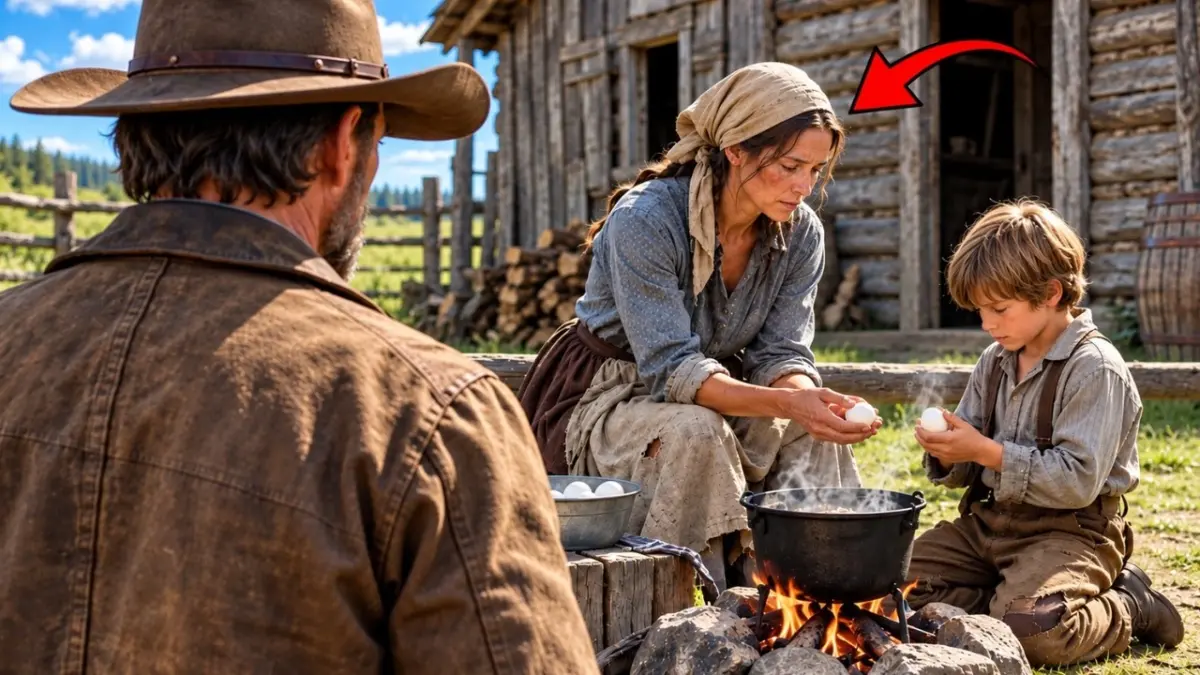
Inside, a young woman sat on a low wooden crate beside a meager hearth fire.
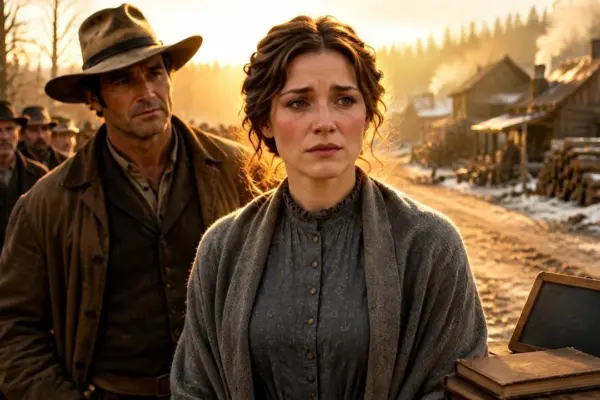
She was thin, her face drawn with exhaustion, and a heavy shawl was wrapped around her narrow shoulders.
The boy ran inside, carefully lifting the four eggs from his sling.
“You found four today,” the woman said, her voice trembling with unmistakable relief.
“That is a fine morning’s work, Jack.”
“Mr. Peterson’s rooster near got me,” the boy said, taking a breath as he sat on a three-legged stool.
“Had to wait him out behind the fence.”
The young woman pulled her son into a swift embrace, pressing her lips to his forehead.
She turned to a battered iron pan resting on the embers and carefully cracked the eggs inside.
Watching from the cold shadows outside, Walter felt a sudden tightness in his chest.
He realized in an instant that he was not watching a thief.
He was watching a starving family surviving on the only lifesaver they could reach.
Walter turned silently and walked back to his main farmyard, his mind swirling with uninvited thoughts.
He spent the remainder of the day working on his fences, but his mind refused to stay on his labor.
He thought of his own long history with solitude.
Nine years ago, shortly after his father died, Walter had courted a local girl named Clara.
He had bought new furniture, planned renovations, and dreamed of a lively house filled with children.
Then Clara decided that the relentless, quiet isolation of farm life was not for her.
She left for Saint Louis without grand drama, leaving Walter with a hollow house and a quiet disappointment.
He had closed the door to the secondary bedroom, covered the new furniture in canvas dust sheets, and never walked in again.
He built a fortress out of his daily chores, telling himself that solitude was the same thing as peace.
Now, two strangers were living at the edge of his land, surviving on his eggs.
Over the next two days, Walter made discrete inquiries in town while buying grain at the general store.
He learned that the woman was Anna Miller, a widow whose husband had died of fever two years prior.
She had worked as a housekeeper for the wealthy Wentworth family in town until they moved East three months ago.
Left without employment or savings, she had quietly moved into the abandoned cabin, unable to afford town rent.
Her son, Jack, had convinced her that he was doing small chores for neighboring farms to earn the food he brought home.
She had no idea her son was stealing from Walter’s coop.
On Thursday morning, before dawn broke, Walter made his choice.
He did not call the sheriff, nor did he set a trap.
Instead, he gathered a dozen fresh eggs and laid them inside a woven basket lined with clean straw.
He placed the basket on a flat stump right inside the hen house door where it could be seen immediately.
From his hiding spot in the barn, Walter watched as Jack arrived a short while later.
The boy unlatched the door, stopped in his tracks, and stared at the basket.
He looked around the empty coop, his brow furrowed in deep confusion.
Slowly, Jack reached out, took the basket, and left without disturbing a single hen on her nest.
Walter refilled the basket every morning for two straight weeks.
Through the cabin window one evening, Walter watched the mother and son discuss the mystery.
“Someone is leaving eggs out for us,” Jack told his mother, his voice laced with suspicion.
“A full basket right by the coop door, Ma.”
“Are you certain it is not simply luck, Jack?” Anna asked, her eyes full of heavy caution.
“Perhaps someone forgot them.”
“Same spot, every single morning,” Jack insisted.
“Somebody is leaving them there on purpose.”
Anna held her son’s hands, her face showing the weary anxiety of a woman who knew that unexpected charity often carried a hidden price.
Walter knew he could not let the quiet charade continue forever.
On a clear Sunday afternoon, he washed his face, put on a clean linen shirt, and brushed off his hat.
He rode his draft horse out to the eastern hollow and pulled up in front of the weathered cabin.
He dismounted, his heart beating with an unfamiliar nervous rhythm, and knocked firmly on the wooden door.
The door creaked open, revealing Anna.
Her hand gripped the doorframe tightly, and Jack peered out from behind her skirts, his eyes wide with recognition and sudden dread.
Walter removed his hat, holding it awkwardly with both hands.
“Good afternoon,” Walter said, his voice deep and slightly raspy from disuse.
“My name is Walter Finch. I own the farm bordering this hollow.”
Anna stood straighter, shielding her son slightly.
“Good afternoon, Mr. Finch. How can I help you?”
“Well,” Walter began, clearing his throat.
“I am in need of steady help around my main place.”
“The farmhouse needs proper mending, the laundry has piled up, and I could use someone to manage the kitchen.”
“I offer fair wages, paid every Saturday, along with fresh milk and grain.”
“I thought I would ask you directly before I went looking into town.”
Anna studied him intently, searching his face for any sign of cruelty or untoward intentions.
“Why me, Mr. Finch?” she asked softly.
“You do not know me.”
“I know you kept an immaculate house for the Wentworths before they relocated,” Walter replied evenly.
“Good help is difficult to find out here.”
“It seemed sensible to offer the work to a neighbor rather than a stranger.”
Anna’s chin trembled slightly as pride wrestled with sheer necessity.
“I accept the work, Mr. Finch,” she said, her voice steadying.
“But I want it understood clearly between us.”
“This is honest work for honest wages.”
“I will not take charity, and I will not have anyone speaking ill of my household.”
“I wouldn’t offer it any other way, Mrs. Miller,” Walter said, inclining his head.
“You may start tomorrow morning at seven.”
The next morning, Anna arrived at the main farmhouse precisely at seven o’clock, with Jack trailing quietly behind her.
Within a week, the quiet, dusty farmhouse transformed completely.
Anna worked with an efficient, tireless grace.
She organized the pantry, repaired months of neglected mending, and cooked meals that made Walter realize just how meager his solitary life had been.
Jack spent his days shadowing Walter around the barn and outbuildings.
Though young, the boy possessed a sharp mind and an eagerness to prove himself useful.
He helped feed the horses, carried wood buckets, and watched Walter repair broken harness straps.
“You know an awful lot about these hens,” Jack remarked one afternoon while watching Walter inspect the coop.
“A man learns what he needs to when he runs a farm alone for nine years,” Walter said casually, keeping his focus on the wooden nesting boxes.
Jack looked at him sideways, something calculating and old working behind the boy’s eyes, though he said nothing more that day.
By the fourth week of Anna’s employment, the weight of his secret finally became too heavy for young Jack to carry.
One evening, after Anna had finished in the kitchen and gone to gather clean linens from the washhouse, Jack walked into the barn alone.
Walter was sitting on a workbench, mending a leather horse collar by the soft yellow light of a kerosene lantern.
Jack stood in the wide doorway, his shoulders tense and his small hands clenched into tight fists at his sides.
“Mr. Finch?” Jack called out, his voice cracking slightly.
Walter set his leather punch down and looked up.
“Yes, Jack?”
“I used to take your eggs,” Jack blurted out, the words bursting from him in an breathless rush.
“Before Ma started working here, I took them.”
“I’m sorry. I know it was stealing, and I know it was wrong.”
“I just… I didn’t know how else to feed her.”
Jack braced his body, locking his knees as if preparing for a physical blow or a furious tirade.
Walter sat quietly on the bench for a long moment, watching the small boy tremble in the lamplight.
“I know, Jack,” Walter said gently.
Jack gasped, his face draining of color.
“You… you knew?”
“I knew from the very first week,” Walter said, resting his hands on his knees.
“I followed you back to your cabin that morning before I ever spoke to your mother about work.”
“Why didn’t you catch me?” Jack asked, his voice barely a whisper.
“Why didn’t you take me to the sheriff?”
“Because you weren’t stealing out of greed or mean spirits,” Walter answered softly.
“You were doing what you thought you had to do to protect your mother.”
“An eight-year-old boy carrying that kind of weight shouldn’t be thrown in a cell for loving his family.”
“Are you going to tell Ma?” Jack asked, his eyes wide with fear.
“That is your story to tell her, Jack, not mine,” Walter said.
“But if you ask me, I think she will understand better than you think.”
Jack stood still, the immense tension slowly draining from his young frame.
“Why didn’t you just yell at me that first morning?” Jack asked softly.
“It would have been a lot easier for you.”
Walter smiled faintly, a warmth reaching his eyes that had not been there for years.
“Easier for who, son?” Walter asked.
“Yelling might have made me feel powerful for two minutes, but it wouldn’t have put food on your table.”
“It seemed like a poor trade—my pride for a hungry family.”
That very night, Jack confessed everything to his mother in the quiet kitchen of their small cabin.
Anna wept softly, pulling her son tight against her chest and kissing his hair.
“You should have told me how desperate things were, Jack,” she sobbed softly.
“I would rather have known the truth so we could face it together than have you carrying that guilt alone.”
“I didn’t want you to worry any more than you already were, Ma,” Jack confessed quietly.
“That is my worry to bear, sweet boy, not yours,” Anna said, wiping her eyes.
“From now on, we trust each other with the hard things.”
A few days later, an autumn rain kept everyone inside the main farmhouse.
Anna was dusting the hallway when she noticed Walter standing motionless in the doorway of the long-closed second bedroom.
He was staring quietly into the dim room at the heavy wooden bed and dresser hidden under gray canvas dust sheets.
Anna stopped her work and stepped up beside him.
“You never open this door, Walter,” she noted softly, using his given name for the first time.
“Not much reason to,” Walter said, his voice flat, though his eyes remained fixed on the dust sheets.
“Whose furniture is that?” Anna asked gently.
Walter took a slow breath, resting his hand against the doorframe.
“I bought it nine years ago,” he said.
“I was courting a woman from town, thinking we would start a family in this room.”
“She decided the farm was too quiet, too lonely.”
“She left, and I just… covered it up.”
“I never got around to using it, and I never got around to clearing it out.”
Anna did not offer pity or empty platitudes.
Instead, she stepped past him into the stale air of the room, walked to the window, and pulled the dust sheets free with a decisive sweep of her arms.
White dust danced in the pale light as she folded the canvas neatly.
“A man cannot move forward if he is constantly walking around a room he is afraid to enter,” Anna said firmly.
“I have spent my share of time standing outside doors I was terrified to open.”
“Holding your breath doesn’t fix a broken heart, Walter.”
She pushed the glass window open, allowing the crisp autumn breeze to blow through the dusty room.
Neither of them spoke of the matter for the rest of the day, but that night, Walter left the bedroom door wide open.
As autumn faded into early winter, a quiet rhythm established itself within the farmhouse.
The house was no longer a silent museum of past failures.
It smelled of fresh yeast bread, roasted pork, and cedar wood.
Jack’s laughter echoed through the barn rafters as he learned to ride Walter’s old plow horse.
One afternoon, while watching Walter teach Jack how to carve a wooden wheel spoke, Anna leaned against the barn door.
“You are remarkably good with him, Walter,” she said with a warm smile.
“He is an easy boy to teach,” Walter replied, smoothing the wood with a drawknife.
“Far easier than some grown men I have hired in the past.”
Later that evening, as Jack slept near the hearth, Walter sat with Anna at the heavy oak kitchen table.
“I was so used to expecting nothing freely given,” Anna admitted softly, looking down at her teacup.
“When kindness arrived from you, I kept waiting for the hidden cost.”
“It takes practice to accept a good thing without fear,” Walter said quietly, reaching across the table to touch her hand.
“I am still learning that lesson myself.”
By late November, the first heavy snow covered the Missouri hills in a brilliant blanket of white.
The old cabin in the hollow was no longer fit for the freezing winter winds.
Standing on the front porch of the farmhouse as the snow fell softly around them, Walter looked at Anna.
“I am not offering you a rescue, Anna,” Walter said, his heart hammering against his ribs just as it had the day he followed Jack.
“You and Jack are strong enough to manage on your own.”
“I am asking if you would have me as your husband, and if I might have the privilege of raising Jack as my son.”
“Eggs and all.”
Anna laughed through her rising tears, her hands coming up to cover her face as months of lingering fear finally evaporated.
“Eggs and all, Walter,” she whispered, stepping into his arms.
“Yes. Absolutely yes.”
They were married three weeks later in the small town church, with the pastor speaking simple words over them.
Jack stood proudly between them in a new woolen suit, announcing to every farmer on the porch that he had approved the match long before the adults had worked up the courage to speak.
Anna and Jack moved their few belongings into the farmhouse that very afternoon.
The long-closed second bedroom was finally cleared of its dust sheets, becoming Jack’s permanent room.
Walter built heavy oak shelves along the wall to hold the boy’s carved wooden toys and books.
In the years that followed, the story of the stolen eggs became a cherished memory within the Finch home.
On sunny spring mornings, Jack, now older and taller, would occasionally slip an extra egg from the coop and hide it in his pocket with a mischievous grin.
“Still stealing my eggs, Jack?” Walter would ask, leaning against the fence post with a smile.
“Only the ones I have permission to take, Pa,” Jack would answer merrily.
“It feels wrong to give up a fine family tradition.”
“That is a very generous way to describe taking what is already yours,” Walter would laugh.
“Makes it far more entertaining this way,” Jack said, scampering off toward the kitchen.
Walter watched his son run toward the house, where smoke drifted peacefully from the chimney and Anna stood waving from the sunlit porch.
Walter looked out over his fields, realizing that the solitary life he had once guarded so fiercely was completely gone, replaced by a deep, enduring warmth.
A desperate little boy had stolen four eggs from a cold hen house, and in doing so, had given a lonely farmer an entire family.
(Descargo de responsabilidad: Este contenido puede haber sido generado por IA con fines de entretenimiento. Cualquier parecido con personas, eventos o lugares reales es pura coincidencia.)