The Cowboy Bought Her Ranch at Auction—Then Shocked Her: “I Bought It So You Could Stay.”
The heat above the New Mexico dirt did not care about May Holloway’s pride, nor did it soften the crack of the auctioneer’s wooden block as the numbers climbed past her reach. She stood near the center of the courthouse yard, her fingers curled tight around the canvas lining of her skirt pockets, watching years of her life turn into plain arithmetic. Cedar Mesa was gone. It happened in the quietest way possible, without a storm or a stampede, just a series of small, steady bids delivered from the shade of the courthouse porch.
Silas Creed stopped bidding with his mouth and started bidding with his eyes. He looked across the dusty yard directly at May, offered a slow, lingering smile that did not touch his gray eyes, and lifted two fingers casually toward the auctioneer, as if he were buying an old kitchen chair instead of her family’s land.
“Four thousand eight hundred,” the auctioneer called out, his voice thin and dry from two hours in the sun. “I have four thousand eight hundred from Mr. Creed. Do I hear four thousand nine?”
May did not move. She did not open her mouth to speak because there was nothing left in her account to back her voice. She had reached the absolute end of her money.
Around her, leather boots scraped dust beneath the hard glare of the midday sun. Beyond the thick adobe wall that encircled the yard, a freight wagon rattled heavily over the rutted main road, its iron tires grinding against stone.
“Four thousand eight hundred once,” the auctioneer intoned, scanning the crowd. “Any advance on four thousand eight hundred? Cedar Mesa, three thousand acres, spring water, southern corridor. Going once.”
Silas Creed owned the largest stock pens in the entire county. He controlled freight space, railroad buyers, and half the small favors that moved cattle from one grazing patch to another. He had wanted Cedar Mesa for months, not because the house was magnificent or the soil rich, but because it sat like a tight wooden plug in the middle of the valley. Now he was about to own it.
“Going twice,” the auctioneer said, raising the wooden gavel into the white light.
A quiet voice from the back of the crowd spoke up without urgency. “Five hundred more.”
Heads turned toward the sound. The man stood near the rear gate beside a dry cottonwood tree, wearing a faded brown coat with grease stains on the cuffs and thick road dust on his boots. His hat was pulled low over his eyes, leaving only a sun-darkened jaw visible. He looked like a trail hand who had ridden in late from a long haul and stopped only to watch the noise.
The auctioneer paused, his hand staying in the air. He squinted past the sunlight. “Name?”
“Luke Mercer,” the man said.
May had never seen him before in her life. She looked at his hands, which were long and scarred at the knuckles, hanging loosely at his sides.
Silas Creed turned slowly, his broad shoulders stiffening beneath his tailored wool coat. He did not look amused. He raised his chin slightly toward the auctioneer. “Five thousand four.”
“Five thousand five,” Luke said softly.
The bidding climbed again, passing back and forth like a heavy rope pulled across a sharp stone. Silas answered every raise quickly, his voice loud enough to carry across the entire square, establishing his dominance over the yard. Luke answered slower, never raising his voice above a calm, conversational tone. Each time Silas pushed the price higher, Luke waited until the auctioneer opened his mouth to call the sale before adding another small amount.
May stood between them, watching two strangers spend thousands of dollars on the ground where her father was buried. She felt remarkably small, stripped of her agency while the numbers drifted up into the dry heat.
Then Silas stopped. He reached into his vest, pulled out a silver pocket watch, looked at the face, and snapped it shut with a loud click. He gave Luke Mercer a long, assessing look, then turned his back on the stand.
The auctioneer struck the block with a sharp crack that echoed off the adobe wall. “Sold! Sold to Luke Mercer for six thousand one hundred dollars!”
For several seconds, May heard only the wind pushing dry dust along the base of the courthouse wall. The crowd began to break apart, murmuring quietly as people filed back toward the saloons and the dry goods store.
May did not wait for condolences from neighbors who wanted her loss made easier for them to witness. She walked straight to the hitching rail, untied her mare, and mounted up without looking back at the porch or at the stranger in the brown coat.
She rode the seven miles back to Cedar Mesa alone, the rhythm of her horse’s hooves filling the wide silence of the valley.
The ranch gate stood wide open where she had left it that morning, sagging slightly on its heavy iron hinges. Beyond it, the red earth rolled away toward the low, flat-topped mesa country to the south. A tall steel windmill turned slowly in the dry breeze above the stock tank, its blades creaking at every revolution. The small stone house sat beneath two ancient cottonwoods, still hers in every way that mattered to her heart, except under the cold eye of the law.
May dismounted in front of the gate, her knees a little stiff, and took the heavy iron gate key from her skirt pocket. By sundown, she supposed, it would belong to Luke Mercer along with every stick of timber and every blade of grass.
Hoofbeats approached from the road behind her.
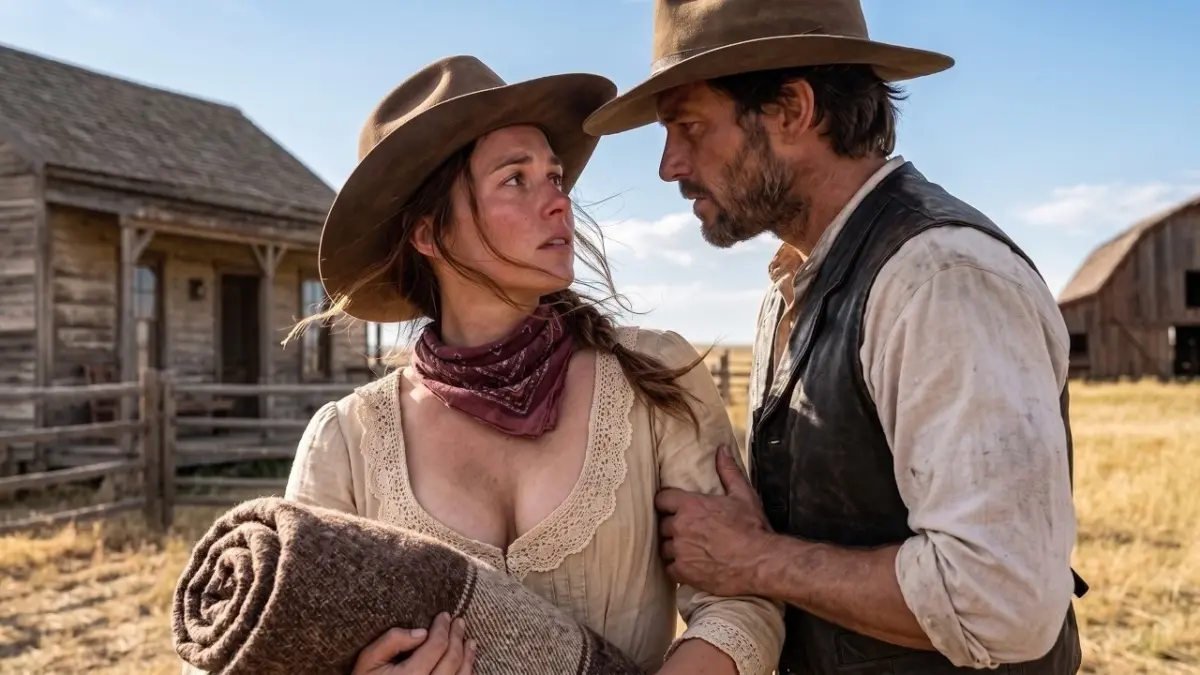
Luke Mercer rode up at an easy, unhurried pace, pulled his horse to a stop, and dismounted. He stopped several yards short of the open gate, standing on the hard dirt of the road. He did not step onto the ranch ground.
May held her horse’s reins tightly. “You came to inspect what you bought?”
“No,” Luke said. His voice was low and quiet in the open space. “You paid enough for it.”
“I know,” May said bitterly.
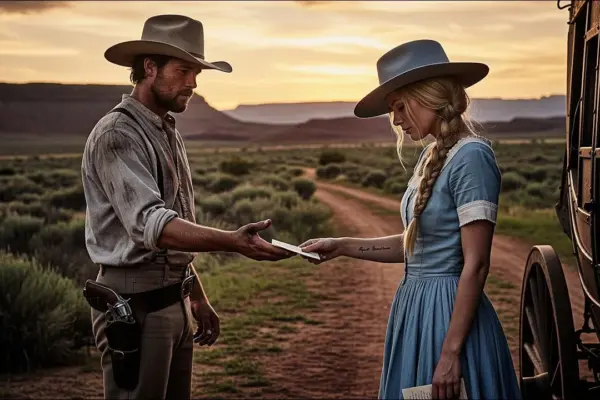
He reached inside his faded brown coat and pulled out a folded sheet of legal paper. Then he held out his other hand toward her. The heavy iron key to the main house lay across his broad palm.
May’s eyes narrowed as she looked from his hand to his face. “What is that?”
“I believe this is yours,” Luke said.
“It isn’t,” May said, her tone sharp. “You bought it at the courthouse ten minutes ago.”
“It ought to be yours,” he corrected gently.
She did not reach for the key. She kept her hands firmly on her reins, watching him like she would watch a strange dog near a water hole.
Luke glanced past her toward the gate frame. “May I come in?”
May almost laughed, a hard, dry sound in her chest. “You own it, Mr. Mercer. You don’t need my permission.”
“That wasn’t what I asked,” he replied, remaining where he stood on the road.
The windmill creaked behind her, a long iron groan in the wind. May looked at his steady, quiet eyes for a long moment before letting out a slow breath. “Come in.”
Only then did Luke step across the invisible line formed by the gateposts. He walked over to her and gently placed the key into her open hand.
“What are you doing?” she asked, her voice dropping.
“I bought Cedar Mesa so you could stay,” he said simply.
May closed her fingers around the warm iron key, feeling the weight of it. “That sentence better have another half.”
“It does,” Luke said. He turned slightly and nodded toward the southern line of cliffs. “Creed wasn’t buying your cattle today. He wanted the corridor.”
May said nothing, waiting for him to continue.
“He controls the stock pens north of town,” Luke explained. “He holds the freight contracts with the rail lines too. Cedar Mesa gives him the easiest, flat passage between all those smaller ranches to the south and the main shipping road. Once he owned this place, he could squeeze every small operator south of town until they sold out to him for nickels.”
May looked at him critically, taking in his worn hat and the fraying hem of his coat. “You expect me to believe you spent nearly everything you had just to ruin Silas Creed’s afternoon?”
Luke’s expression shifted slightly, a faint flicker of dry humor appearing near his eyes. “Who said it was nearly everything?”
“The way you were bidding,” May said directly. “You hesitated every time the price went up fifty dollars.”
Luke looked down at his dust-covered boots. “That obvious?”
“To me,” May said. “I know what a person looks like when they’re counting every quarter in their pocket.”
Luke took off his hat, revealing dark hair damp with sweat, and rubbed his forehead with his sleeve. “I spent nineteen years working cattle for men with land,” he said quietly. “Saved enough to buy a modest place of my own someday. Today I spent most of it making sure Silas Creed didn’t get this place.”
“Why?” May asked, stepping closer. “You don’t know me.”
“Because you kept Cedar Mesa working through two bad drought seasons while men with twice your money folded up and moved back East,” Luke said, looking back at her. “And because Creed doesn’t want ranches to work them. He wants choke points. He wants to own the turnstiles so he can collect a tax on everybody else’s sweat.”
“That still doesn’t explain why I’m holding this key,” May insisted, holding up her closed fist.
“You stay,” Luke said. “You run Cedar Mesa exactly as you did yesterday.”
“As your manager?” May asked, her chin rising.
“No.”
“Tenant?”
“No.”
May’s voice hardened into absolute stone. “Then choose a word, Mr. Mercer. I don’t live on charity.”
“I don’t have a word for it,” Luke admitted.
“I do,” May said. “Temporary.”
Luke waited, his stance relaxed, listening.
May reached into her shirt pocket and pulled out a small, worn pencil notebook and a blunt lead stub. “If I stay on this land, we put terms on it right now. Clear terms.”
“Go ahead,” Luke said.
“I pay no rent,” May said, writing the words down against her knee.
“Agreed,” Luke said without pause.
“You make no ranch decisions. You don’t tell me when to buy, when to sell, or where to graze.”
“Agreed.”
“You take no wages from this place, and you take no share of the cattle sales come autumn.”
Luke’s dark eyebrows lifted slightly at that. “You’re making this a very poor investment, Miss Holloway.”
“I’m making it clear,” May said, looking him dead in the eye.
Luke nodded slowly. “Agreed.”
May wrote each condition down with firm, heavy strokes that dug into the cheap paper. Then she looked up from the pad. “One more.”
“Name it.”
“You sell Cedar Mesa back to me for exactly what you paid at the auction today. Not market value, not improved value, but your exact auction price.”
“When?” Luke asked.
“October fifteenth,” May said without hesitation. “That gives me one full cattle season.”
“That’s less than five months,” Luke noted. “I know.”
“And if you can’t raise six thousand one hundred dollars by October fifteenth?”
“Then I leave,” May said firmly. “No dispute, no lawsuit, no story around town about what I deserve or what was stolen from me. I pack my saddle and I walk off.”
Luke looked at her for a long, silent moment, measuring the hard resolve in her posture. Then he nodded once. “October fifteenth.”
May shut the notebook with a sharp snap. “You agreed too fast.”
“I know when I mean something,” Luke said softly.
“That makes one of us,” May muttered.
Luke accepted her skepticism without argument. He turned his head and looked past the house toward the southern pasture, where the weathered timber roof of an old line shack sagged heavily over one corner. “Near the southern pasture,” Luke remarked, “the roof of that old shack is about to give way.”
May had planned to repair that roof in the early spring, but then feed prices had doubled, a well pump had failed, and the bank had refused to extend her credit any further. “It can wait,” she said.
“Until when?” Luke asked.
“Until I own the ranch again,” May said sharply.
He looked at her, his dark eyes showing neither pity nor amusement, only an open, quiet acceptance. “All right.”
He turned on his heel and walked back toward his horse standing outside the gate. As his hand touched the leather reins, May called out to him.
“Mr. Mercer.”
He looked back over his shoulder.
May held up the heavy key in the sunlight. “You’re legally allowed to come and go as you please. You hold the deed.”
“I know,” Luke said. “But I’ll still ask.”
That answer bothered her far more than arrogance would have. Arrogance was simple to fight; respect made her feel like she owed him something she hadn’t agreed to pay.
After he mounted his horse and rode back down the dusty road toward town, May went inside the quiet house. On the kitchen floor near the door, she found a small piece of blue cardboard—auction card number twenty-seven, which Luke had accidentally dropped while pulling the deed from his coat.
May took a small brass tack, picked up the card, and pinned it securely to the wood casing directly above the kitchen calendar. Then she took her pencil and drew a hard, heavy red circle around the box for October fifteenth. Below the date, she wrote the exact figure in clear numbers: $6,100.00.
She opened her master ledger, sharpened her pencil with her pocket knife, and sat down at the table to calculate how to buy her own ranch twice over in a single season.
By the first week of June, May had turned October fifteenth into a single, relentless number that she carried in her head every hour she was awake. Every morning before breakfast, while the kitchen was still dark and cold, she opened the ledger and checked feed costs, expected calf weights, hardware repair bills, and the precise price per pound she would need from the fall buyer to reach six thousand one hundred dollars.
Some days, when the sky was clear and the grass grew thick in the bottomlands, the number looked entirely possible. Other days, when she looked at the thinness of her herd after the hard winter, it looked like a stone wall built straight across her path.
Luke Mercer came and went exactly as he had promised. He took short-term trail jobs working stock east toward Fort Union, sometimes disappearing from the valley for two full weeks at a time. But whenever he returned to Cedar Mesa, he never once rode through the open main gate without pulling his horse to a complete stop and waiting.
May always saw him pause from the kitchen window or the barn door. Sometimes she purposely made him wait an extra minute, not because she was busy, but because she wanted to see if his patience would wear thin and reveal the owner underneath the visitor. He always waited quietly in the dust until she stepped out and gave him a short nod.
One blistering afternoon in July, she found him standing beside the windmill in his shirtsleeves, using an iron wrench to replace a cracked steel brace on the lower tower.
May stopped near the water trough, her hands on her hips. “I didn’t ask you to fix that brace, Mr. Mercer.”
Luke didn’t look down from his work. “You told the hired hand yesterday morning that it was next on the list.”
“That isn’t the same thing as asking you to do it,” May said tightly.
Luke lowered the wrench and looked down at her through the frame of the tower. “Want me to stop?”
May looked up at the fresh steel brace, then at the rusty, dangerously bent original piece lying in the grass. The windmill was the only thing keeping fifty head of cattle watered in the high heat.
“No,” she said softly.
He went back to work without another word, the metallic clinking of his wrench filling the hot air.
That was how things developed between them over the long weeks of midsummer. Not with grand declarations or long conversations, but with small boundaries tested, permission asked, and permission reluctantly given.
May worked with a fierce, tireless energy. She sold three old freight wagons she no longer needed for hauling, getting eighty dollars for the lot. She altered her hay cutting schedule to save on hired labor, delayed replacing the rusted kitchen stove, and spent three long days patching the southern corral herself with old timber instead of spending cash on fresh lumber.
The calves gained weight steadily on the summer grass. By early August, after running the numbers four times over, May realized she had a narrow, razor-thin path toward reaching the auction price by October.
Then Silas Creed rode through the gate.
He did not stop at the boundary. He did not ask permission. He trotted his grand bay stallion right into the center of the yard, his iron-shod hooves throwing up small clouds of dry red dust.
May saw him from the cool interior of the barn, wiped her hands on a grease rag, and walked straight out into the bright yard before he could reach the front porch of the house.
Creed wore a fine gray wool coat despite the dry heat of the afternoon. A heavy silver watch chain curved brightly across his dark vest. He reined in his horse and looked down at her with a cool, practiced expression.
“Miss Holloway,” Creed said, touching the brim of his pristine hat.
“Mr. Creed,” May said, stopping ten feet from his horse.
He dismounted smoothly and draped his reins over the hitching rail, then took his heavy pocket watch out, checked it, and rested it on the top bar of the rail. “I came to talk business. I can guarantee you pen space at the town stockyards for your October shipping.”
May folded her arms across her chest. “I already submitted my request for six pens three weeks ago.”
“Requests are not guarantees,” Silas said softly. “The yards fill up quickly when the northern herds come down. Space becomes… uncertain.”
May’s voice was dead flat. “What do you want, Silas?”
“Permanent livestock passage across your southern corridor,” Creed said, pointing his gloved hand toward the red gap in the hills. “Properly recorded at the county courthouse. A permanent easement.”
“And in exchange?”
“You get guaranteed space in my pens, first choice of freight cars on the train, and a fair price from my buyers,” Silas said smoothly. “You use the route when you need it. You keep the ranch running. Everybody benefits. You benefit.”
“You benefit more,” May said.
“I’m not ashamed of making a profit, Miss Holloway.”
“Neither am I,” May replied sharply.
“Good,” Silas smiled, stepping closer. “Then we understand each other.”
“No, we don’t,” May said, her voice cutting through the heat. “My cattle go through your pens on the exact same terms as any other rancher in this valley, or they don’t go through your pens at all.”
Silas narrowed his eyes slightly, his polite smile fading. “You’re in a very weak position to be making demands, May. You don’t even hold the paper on this soil.”
“That’s still my answer,” May said.
Creed picked up his silver watch from the rail, wiped a speck of dust off the glass with his thumb, and slid it back into his vest pocket. “October comes very quickly in this county.”
“I know exactly when it comes,” May said. “It’s marked on my wall.”
He glanced past her shoulder toward the stone house. “Does Mercer know you’re refusing a fair deal?”
“Luke Mercer doesn’t make Cedar Mesa decisions,” May said firmly.
“He owns Cedar Mesa,” Silas said, mounting his stallion with a heavy smooth movement. “He holds the deed. Same thing.”
“No,” May said. “It isn’t.”
Creed looked down at her for a long second, his eyes hard. “We’ll see how much that deed is worth when your cattle are standing in the dirt with nowhere to go.” He turned his horse sharply and rode away down the lane.
Luke arrived two days later, his horse lathered from a long ride from the northern trail. May met him right at the gateposts.
“Creed came,” she said without setup.
Luke pulled up immediately, holding his horse steady with one boot planted on the dirt outside the property line. “What did he want?”
“Permanent passage across the south corridor,” May said.
“What did you tell him?”
“No.”
Luke nodded once, his face showing no surprise at all. “That all?”
“That’s all,” she said.
He looked at her, waiting. She stepped back from the post to let him through. Only after she cleared the space did he cross onto the ranch.
Within a single week, May understood the full weight of Silas Creed’s warning.
A brief letter arrived from the town stockyard stating that her October reservation had been canceled due to overbooking. Two days later, a independent cattle buyer from Santa Fe who had bought her calves for five years sent a short note saying he would not be coming north this season. By Friday, the local freight agent who had verbally promised her six rail cars sent word that every wagon and car was fully committed to other shippers through late October.
Silas Creed had closed every door around her.
May took the freight agent’s letter and pinned it quietly to the wall right beside auction card number twenty-seven.
Luke found her sitting at the kitchen table late that evening, two long pages of frantic scribbled calculations spread out before her under the yellow light of an oil lamp. He pulled out a chair and sat down across from her.
“What changed?” he asked quietly.
“Everything easy,” she explained, gesturing at the paper. “Creed locked the pens, bought off the shipping agent, and turned away my buyer. I can raise the cattle, but I can’t turn them into cash if I can’t put them on a train.”
Luke listened patiently until she finished explaining the blockades. He didn’t interrupt or offer shallow comfort. When she fell silent, he looked at her across the table.
“What do you need from me?” he asked.
May stopped her pencil. She stared at him, caught off guard. He hadn’t said, “Here’s what we are going to do.” He hadn’t said, “I own the place, so let me handle it.” He had simply asked what she needed.
“Nothing yet,” she said, lowering her pencil.
“All right,” Luke said.
“I need another market,” May said, looking back at her figures. “A place to sell nearly a hundred head without using Creed’s yards or Creed’s rail contracts.”
“All right.”
May watched his calm face closely. “You’re not going to offer to buy the herd yourself? You have savings left.”
“No,” Luke said plainly.
“Why not?”
“Because then you’d be paying me back for the ranch with money I gave you for your cows,” Luke said, his voice quiet and steady. “That makes the deadline meaningless. You wouldn’t own it. You’d just be trading papers.”
May closed her ledger slowly. “Come outside.”
They walked south into the cool night air as the midday heat finally drained out of the earth. The moon was high, casting long silver shadows across the dry grass. They walked all the way down to the old line shack near the southern boundary line.
May climbed up onto an old wooden packing crate against the exterior wall and reached up, pushing hard against the sagging timber roof beam. The wood creaked dangerously above her head.
Luke stepped close and held the wooden crate steady with both hands so it wouldn’t tip on the uneven ground. “This won’t last another winter,” he said, looking up at the strain in the frame.
“I know,” May said, her arms shaking slightly from the effort of pushing against the wood.
“We can replace the main beam tomorrow,” Luke offered. “I can get pine from the high ridge.”
“No,” May said down to him.
“Until you own the ranch again,” Luke quoted gently.
May stopped pushing and stepped down off the box, standing close to him in the dark. “You remembered.”
“I remember what matters,” Luke said.
She reached down, picked up a heavy iron hammer from the dirt where she had left it earlier, and handed it to him. “Then help me make it hold until October.”
They worked together until nearly midnight under the moonlight, driving thick iron spikes into the supporting braces, bracing the weak wall with scrap timber, but deliberately leaving the warped main roof beam right where it was.
As they worked, May noticed how natural and easy the silence had become between them. There was no tension in the shared work, no need to fill the air with empty chatter.
That ease troubled her far more than an argument would have. Ease was dangerous. Ease could turn into dependence if a person stopped paying attention, and she could not afford to depend on a man who held the legal title to her home.
The next morning, May saddled her mare before dawn and rode south alone, leaving Luke behind at the barn.
Silas Creed had taken away the main road to the town market, but that did not mean there was no other earth under her feet.
Near noon, after six hours in the saddle, May reached a broken sandstone marker half buried in thick wild grass near the edge of a dry wash. She dismounted and knelt in the dust, pulling away the dead weeds with her fingers.
Three faded letters remained carved into the rough gray stone beneath the dirt: CCT.
The Cimarron Cutoff Trail.
May had ridden a short section of it once when she was nineteen years old, helping her father push stock for an old rancher who had refused to deal with Silas Creed’s father decades ago. The trail had been notoriously rough and dry even then, but it ran far to the west around Creed’s holdings, cutting through high volcanic country, and if May remembered the old maps correctly, it ended near the Independent Rail Siding at San Miguel.
She mounted up and rode another seven miles along the faint trail. The path narrowed significantly, cutting between high shelves of jagged black basalt, then opened up onto a broad, high mesa. Old, deep hoof-worn depressions remained visible beneath years of overgrown grass.
The route was still there. It was dangerous, long, and dry, but it was open.
When May returned to Cedar Mesa late that evening, she found Luke sitting outside the barn door, using a leather awl to repair a broken bridle strap. He looked up and saw the dark volcanic dust caked on her boots and her horse’s legs.
“Where’d you go?” he asked, setting the leather down.
May pulled out her small notebook and turned to a page filled with fresh mileage estimates. “San Miguel.”
Luke’s brow furrowed slightly. “That’s sixty miles by the old trail.”
“Fifty-eight if the southern turn through the canyon still holds,” May corrected him.
“Nobody drives cattle over the Cimarron anymore,” Luke said, his voice serious. “Not since the rail line built the town station twenty years ago.”
“I noticed,” May said. “The grass is high.”
Luke took the notebook from her hand and studied her small, neat numbers under the dim light of the barn lantern. “Water?”
“Three known points,” May said. “I need to verify two of them.”
“Terrain?”
“Bad in places. High rock on the middle stretch.”
“Market?”
“Independent siding,” May said. “An old rail company that doesn’t take orders from Silas Creed.”
Luke looked up from the pad, his dark eyes meeting hers. “And Creed?”
May closed her notebook with a firm slap. “Not invited.”
Luke turned his head and looked toward the southern horizon, where the dark outline of the mesa vanished into the summer night.
That night, May took a hand-drawn rough map of the Cimarron Cutoff and pinned it to the wall directly beneath auction card number twenty-seven. Silas Creed had closed every easy path between her herd and the money she needed, but he hadn’t reckoned on a woman willing to take the long way around.
Luke Mercer received the letter offering him the trail boss job three days before May planned to start her drive.
The letter came folded neatly inside a freight receipt brought out from Fort Union by a traveling mail rider. May watched from the pump house as Luke read it while standing beside the barn door. He read it through once, folded it carefully, and slid it into his coat pocket.
“Good news?” May asked, walking over with a bucket of water.
“Good pay,” Luke said simply.
“That sounds like good news,” May said, setting the bucket down.
Luke looked past her toward the southern pasture, where nearly one hundred head of prime cattle were already gathered and separated from the main herd. “The drive starts Monday. Out of Fort Union.”
May stopped writing in her notebook. Her heart gave a sudden, unwanted pinch. Their own drive down the Cimarron Cutoff was scheduled to leave on Sunday morning.
“How long?” she asked, keeping her voice even.
“Six weeks,” Luke said. “Takes a herd clear up to the railhead in Colorado.”
“That is good pay,” May said quietly.
“It is.”
May closed her notebook and looked at him directly. “You should take it.”
Luke said nothing, his face unreadable.
“You spent most of your life savings at that courthouse auction,” May reminded him, her voice firm. “You told me so yourself. This is exactly the kind of high-paying work you need to rebuild your account.”
“I know,” Luke said.
“I can handle the Cimarron drive myself,” May insisted. “I have two hired hands coming from the valley.”
“I know you can handle it,” Luke said gently. “I know how strong you are, May.”
May studied his face, her frustration rising at his calm demeanor. “Then what are we discussing?”
“We aren’t,” Luke said.
He reached inside his coat, pulled out the folded letter from Fort Union, and deliberately tore it cleanly down the middle. He doubled the paper over and tore it again, dropping the small white scraps into his pocket.
May stared at him, her eyes wide with disbelief. “Don’t do that because of me!”
“I’m not doing it because of you,” Luke said.
“You just destroyed six weeks of top trail wages!” May raised her voice, stepping closer to him. “That’s crazy!”
“I destroyed a piece of paper,” Luke corrected her calmly.
“You know what I mean, Luke!”
Luke looked her directly in the eyes, his voice steady and low. “You’re driving nearly a hundred head of heavy stock across a dead trail that nobody has used properly in fifteen years. I know long drives. I know what cattle do when the water holes turn into dry mud. I know how to get stock down country that looks passable until you’re standing right in the middle of a boulder field.”
“That still doesn’t make my ranch your responsibility,” May said, her jaw tight.
“No,” Luke agreed. “It doesn’t.”
“Then why?” May demanded, her chest heaving. “Why throw away your own money for my drive?”
Luke met her gaze without flinching. “Because I want to go.”
May’s mouth tightened into a hard, narrow line. “That is not an answer I can put down in my ledger.”
“Good thing you don’t have to,” Luke said quietly.
She looked away from him, staring hard at the cattle grazing near the southern fence line. The wind rustled the leaves of the cottonwood trees above them.
Finally, she turned back to him. “I’m the trail boss.”
“Yes,” Luke said.
“If I make a call on the trail, we follow it.”
“Yes.”
“If you disagree with my route, you say it once,” May laid out the rules clearly. “One time only.”
“And if you still say no after I speak?” Luke asked.
“Then the answer is no,” May said.
Luke nodded slowly. “Understood.”
May put her pencil notebook back into her pocket. “Sunday before sunrise.”
They left Cedar Mesa under a thin, lead-gray morning sky before the sun had cleared the eastern hills.
The herd moved reluctantly at first, lowing nervously and bunching up tightly near the South Gate where the familiar green pasture ended and the rough stone ground began. May rode at the point, her eyes fixed on the horizon. Luke stayed on the right flank, his long whip coiled over his horn, keeping the stragglers moving, while two young hired hands worked the dusty rear.
For the first six miles, the old Cimarron cut was in far better condition than May had remembered. The old roadbed was clear, and the cattle settled into a steady, walking rhythm.
Then the country began to harden.
Dark volcanic rock rose sharply on both sides of the trail, trapping the midday heat like an oven. The heavy iron shoes of the horses and the sharp hooves of the cattle struck stone with a dry, hollow platter that echoed off the canyon walls.
At noon, May reached the first planned water point in a deep stone basin. She pulled her horse to a halt and stared down.
The shallow pool at the bottom was less than half the size it should have been. Mud and yellow scum lined the edges.
Luke dismounted, walked down the slippery rock bank, and crouched near the dirty water. He dipped two fingers in, then stood up. “Not enough,” he called up to her. “Not for a hundred head. They’ll trample it into mud in three minutes.”
“I know,” May said, looking back at the long line of thirsty cows packed into the narrow canyon behind them.
“We can water twenty head at a time,” Luke suggested, walking back up the path. “Hold the rest back in the canyon.”
“That creates two separate herds for three hours,” May countered, looking at her map. “And if the group in the back gets restless and smells the damp mud, they’ll surge forward and crush the front stock against these rocks.”
Luke stood by her horse’s shoulder, waiting.
May opened her notebook to the hand-drawn route sketch. “There’s another spring seven miles west. Off the main cut.”
“Seven miles off,” Luke calculated quickly. “And seven miles back. That’s fourteen extra miles on thin cattle.”
“Not back,” May said, showing him the paper. “We don’t come back to this canyon. We can rejoin the main cutoff farther south through a dry wash.”
Luke leaned in to examine her pencil line. “That bend through the wash is rough stone. Rough on their feet.”
“It has water at the start,” May pointed out.
“It costs weight,” Luke warned. “Sweat off their ribs.”
“Dead cattle cost more than thin ones,” May said, her tone firm.
Luke looked up from the paper and held her gaze directly. “That’s your call?”
“Yes,” May said. “That’s my call.”
He nodded once without any anger or argument. “West it is.”
The detour took the rest of the grueling afternoon. The heat was relentless, but by sunset, the exhausted cattle reached the hidden mountain spring. The stock drank deeply from the cool, clear water, settling down quietly on the surrounding grass.
May sat on a flat boulder near the spring, her face streaked with gray trail dust and sweat.
Luke walked over and handed her a tin cup of fresh water. “You were right about the spring,” he said, taking a seat on a nearby rock. “It held plenty of water.”
May took a long drink, feeling the cold water clear the dust from her throat. She looked over the cup at him. “You disagreed with the turn.”
“I did,” Luke admitted smoothly.
“You still followed the turn.”
“That was the agreement,” Luke said, looking out over the resting herd.
May lowered the cup into her lap. She wanted to say something more—to thank him, or perhaps to explain why she felt she had to prove herself on every mile of the ground—but she couldn’t find the right words. The silence stretched between them, comfortable and deep.
The next day, the rough terrain tested Luke’s judgment instead.
By mid-afternoon, the trail reached a steep, narrow descent that dropped three hundred feet between two massive shelves of unstable red shale.
May remembered the spot from her youth as steep but entirely manageable for stock. She started to guide her mare toward the edge, but Luke spurred his horse ahead, blocking the path.
He rode down twenty yards alone, dismounted, and pushed at the edge of the path with his boot. A large section of gray shale gave way immediately, sliding down the cliff face with a dry, rushing roar. He climbed back up, his face dark with concern.
“Not this line,” Luke said, taking off his hat.
May frowned, leaning forward over her saddle horn. “This is the old Cimarron route, Luke. My father brought stock down this exact drop.”
“It was the route twenty years ago,” Luke said, pointing down into the ravine. “The winter rains have washed out the soil underneath the ledge. The top looks like solid gravel, but it’s floating on air.”
May rode her horse forward a few feet to see better. “It looks firm enough on the left.”
Luke pointed with his leather crop toward a long, hair-thin crack hidden beneath loose stone. “If the lead animals break that left edge under their weight, the rest will panic and pile up right behind them down the gorge.”
May studied the edge for a long, quiet minute. She watched a small stone roll off the track and plunge straight down to the canyon floor below. He was completely right; the trail was a death trap for a crowded herd.
She took a slow breath, remembering her promise. “What do you suggest?”
“Take them high,” Luke said, pointing toward a crest to the right. “Cross above the old cut along the granite spine. It’s steep, but the rock is solid underneath. Then we come down on the soft eastern slope.”
“That adds two hours of climbing,” May noted.
“Better two hours of climbing than losing twenty cows over a ledge,” Luke said simply.
May turned her horse away from the drop and looked at her hired hands behind her. “We go high! Follow Mr. Mercer!”
Luke said nothing that boasted. He did not smile because she had changed her mind, nor did he remind her that he had spotted the danger first. He simply turned his horse and took the lead, guiding the herd up toward the high granite ridge.
By the fourth evening on the trail, the drive had found a rhythmic, steady life of its own.
They had learned how to work together without friction. May led whenever the route required deep knowledge of Cedar Mesa cattle and their habits; Luke led whenever the wild terrain demanded sharp eyes for footing, distance, and the physical limits of tired stock. They had argued twice more over small details, but neither argument survived past the final decision. They worked like two parts of a single, well-oiled machine.
On the fifth afternoon, as the sun began to dip toward the western horizon, the high mesa land suddenly opened up below them.
Far across the wide, flat valley floor, a long, thin black line cut straight through the pale grass, glittering brightly in the dying light.
The railroad.
May pulled her horse to a sudden stop on the ridge. San Miguel was still several miles to the west, but even from the height of the trail, she could hear the faint, hollow whistle of a locomotive engine carried on the dry wind.
Luke rode his horse up beside hers, his dust-covered face breaking into a slow, rare smile. “You made it, May.”
May looked at the dark line of stock moving steadily down the final slope toward the valley. Her heart felt lighter than it had in months. “We made it,” she said softly.
Luke turned his head and looked at her.
May caught herself, her strict independence asserting itself, and offered a quick, dry correction. “The cattle made it.”
Luke laughed—a low, genuine sound that made her heart leap in her chest. “That sounds a lot more like you.”
She looked at him, her eyes softening, and almost smiled back.
They reached the outskirts of San Miguel shortly before dark.
The independent stockyards were much smaller than Silas Creed’s massive facility in town, consisting of built timber pens beside a single rail siding with one loading ramp and a long wooden fence that had been silvered by years of weather.
May had expected the usual deafening noise of a busy market—shouting buyers, cracking whips, and waving hats. Instead, as she herd the stock up to the main gate, she found a group of ten men standing around the office porch, watching her approach in complete, heavy silence.
A tall, older buyer named Elias Ward stepped off the wooden porch and walked slowly through the gate to meet her. May recognized him immediately from her father’s days; he was a man known for fair dealings and an honest scale.
Elias removed his battered hat, dusting it against his knee. “May Holloway.”
“Elias,” May nodded from her saddle.
Elias turned his head and looked over the long line of cattle standing quietly in the dust behind her. His eyes were filled with quiet disbelief. “You brought these cows all the way over the old Cimarron Cut?”
“Every one of them,” May said proudly. “Fifty-eight miles.”
“That was a hard drive, girl,” Elias said, walking over to inspect the nearest steer. He ran a hand over the animal’s flank, feeling the solid flesh under the hide. “A very hard drive. But by God, they’re sound. They haven’t lost half the weight I would have expected.”
“I had good help,” May said, looking back at Luke, who was holding the rear line steady.
Elias took a deep breath and looked up at her with an uncomfortable expression. “May… Silas Creed was here yesterday.”
May’s smile disappeared instantly. “Creed was here?”
“He came down on the noon train,” Elias admitted, looking down at his boots. “Spent two hours in the siding office with the railroad master. He bought up every open cattle car on the line for the next three weeks, May. Paid double the standard rate just to keep them sitting empty on the siding.”
A heavy, cold knot formed in May’s stomach. She felt the ground beneath her horse seem to tilt. “He bought the cars?”
“All of them,” Elias said mournfully. “I can buy your cattle right now, May. I’ll give you top dollar per pound because they’re fine stock. But I can’t ship them out. I have no cars to put them in, and I can’t hold a hundred head in these small pens for three weeks without running out of feed.”
May sat frozen in her saddle, the cold realization washing over her.
She had survived the drought. She had survived the courthouse auction. She had dragged her herd fifty-eight miles over a dead volcanic trail through heat and broken rock, only to find that Silas Creed had simply moved his wall to the end of her path.
She reached into her shirt pocket and felt the rough edge of her pencil notebook. The deadline was October fifteenth. Without a rail shipment today, she could not turn the cattle into cash. Without the cash, she could not pay Luke Mercer his six thousand one hundred dollars.
And Cedar Mesa would be gone forever.
May turned her horse around slowly and looked back at Luke. He had ridden up near the yard gate and had heard every word Elias had spoken.
He didn’t look angry. He didn’t look surprised. He simply sat on his horse, his dark eyes fixed on her face, waiting to see what she would do when the world broke beneath her feet.
May looked down at her hands on the reins. Her fingers were trembling slightly, not from fear, but from a deep, black exhaustion that seemed to settle straight into her bones.
She pulled her small notebook from her pocket, opened it to the page where October fifteenth was written in heavy lead, and slowly turned the paper over.
The silence in the dusty stockyard was absolute, save for the faint creaking of the wooden loading ramp in the evening wind.
Luke dismounted his horse with a slow, deliberate movement. He walked past Elias Ward without saying a word, stepped right up to May’s stirrup, and reached up his broad, dust-covered hand toward her.
“May,” Luke said, his voice softer than she had ever heard it before. “Give me the book.”
May looked down at him through the gathering dusk, her jaw trembling as she tried to keep her pride intact. “I lost it, Luke,” she whispered, her voice cracking. “I can’t pay you the money by the fifteenth.”
“Give me the book, May,” he repeated, his hand reaching higher.
Slowly, May handed down the worn pencil notebook.
Luke didn’t open it to look at the numbers. He didn’t look at the calculations or the debt lines she had laboriously kept for five months. He simply slid the small notebook into his own coat pocket, right next to the torn scraps of his trail boss contract.
Then he reached into his other pocket, pulled out the folded legal deed to Cedar Mesa—the heavy paper he had carried since the auction day—and placed it directly into her lap over her reins.
May stared down at the crisp white paper in the dim light. “What is this?”
“That’s your deed,” Luke said, looking up at her with an open, unwavering gaze. “It was always your deed.”
“Luke… I don’t have the six thousand dollars,” May said, tears finally spilling over her dusty cheeks. “I didn’t sell the herd.”
“I didn’t buy that land at the auction to get six thousand dollars back,” Luke said, stepping closer and placing his hand over hers on the saddle horn. “I bought it because I worked nineteen years on land that belonged to men who didn’t care about the earth, or the stock, or the people who bled on it. And then I saw a woman stand up in a court yard and fight for three thousand acres of dust with every dime she had left in the world.”
May looked into his eyes, her breath catching in her throat.
“I didn’t want a choke point,” Luke said quietly. “And I didn’t want an investment. I wanted to stand on land that meant something to the person holding the key.”
Elias Ward watched them from the gate, a slow, understanding smile spreading across his weathered face. He put his hat back on his head and turned toward his yard hands. “Hey! Start opening those holding pens! Put Miss Holloway’s cattle in the south yards and fetch them some fresh water! We’ll figure out the train cars tomorrow!”
May looked down at Luke’s hand resting over hers. The heat of the long day was fading, replaced by the cool, clear night air of the valley.
“You agreed to the terms in my book,” May said, her voice small and shaky, though a tiny spark of her old fire returned. “No rent. No ranch decisions. No share of the cattle.”
Luke offered a slow, genuine smile—the first true, open smile she had ever seen on his face. “I guess I’m a very bad businessman, Miss Holloway.”
“You are,” May agreed, wiping her cheeks with her sleeve and clutching the paper deed tightly in her hand. “The absolute worst.”
Luke looked up at her, his hand slipping down to hold hers firmly. “Does that sentence have another half?”
May looked back down at him, letting out a long, quiet breath that cleared away five months of fear and loneliness.
“It does,” May whispered, leaning down slightly toward him. “You can come in through the gate now, Luke. You don’t ever have to ask permission again.”
(Descargo de responsabilidad: Este contenido puede haber sido generado por IA con fines de entretenimiento. Cualquier parecido con personas, eventos o lugares reales es pura coincidencia.)