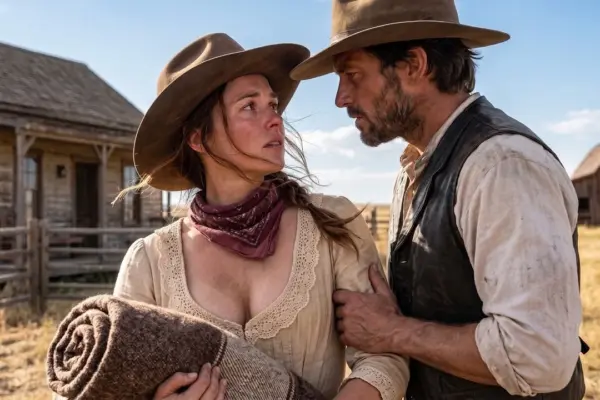
Abandoned Mail-Order Bride Sat on a Crate at the Station, Unaware the Cowboy Was Coming for Her
The train let out one last long, hiss of steam, its heavy wheels grinding against the iron tracks before it slowly rattled off down the line.
It left behind a swirling cloud of grey dust and the soft, rhythmic clunk of wooden boots on the platform.
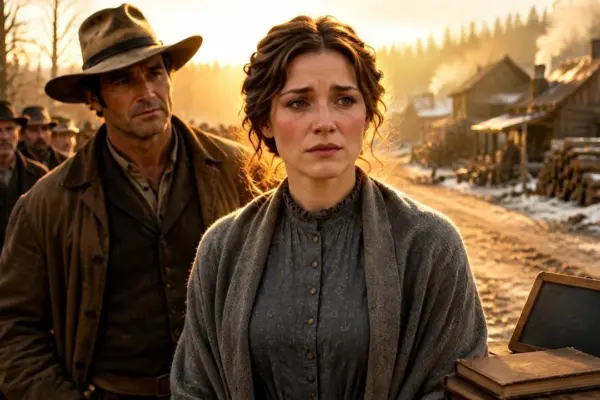
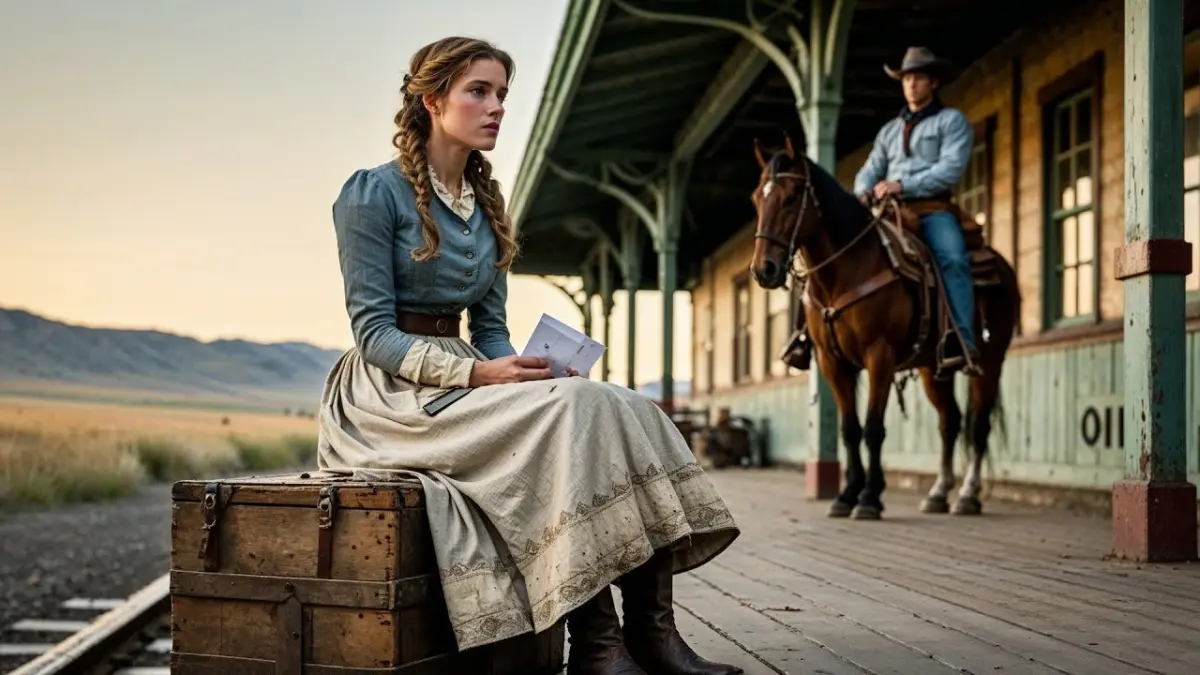
Francis Kesler sat motionless on a weathered pine crate just beside the small wooden depot.
Her gloved hands were neatly folded in her lap, a frayed carpet bag resting at her feet, and a creased letter crumpled deep inside her skirt pocket.
At twenty-three, her eyes carried a heavy, quiet weariness as they scanned the empty platform for the fourth time.
He was not there.
The letter in her pocket had promised with absolute certainty that he would be.
She had spent two long weeks on the train memorizing every single word written in that neat, slanted ink.
“I will meet you myself. Look for a tall man in a brown felt hat by the station wall. You will know me by my boots, black with silver toes. Signed, Everett Collins.”
Everett was to be her husband, the man who had bought her train ticket all the way from Kansas City.
Yet, looking around the glaring sunlit platform of the Montana territory in July 1880, there were no brown hats.
There were no silver-toed boots.
There was only a tired freight clerk hauling heavy wooden crates, a young boy dragging a broom through the dirt, and the station agent who had already glanced at her three times like she was a stray dog with nowhere to go.
The mid-day heat pressed down hard on the station roof, and Francis shifted her weight uncomfortably on the rough crate.
She had not eaten since a dry biscuit the night before, and her travel corset pinched painfully against her ribs.
Her mouth was completely dry, but she refused to stand up.
She knew that if she stood, it would be an admission that she had nowhere left to go in this wide, untamed wilderness.
If she stayed sitting, perhaps there was still a chance someone might come riding down the dirt road.
She reached into her travel dress, pulled out the letter, and smoothed its deep creases over her knee.
The paper was dated two months back.
Had he changed his mind after sending for her?
Had he fallen ill, or simply chosen another woman who didn’t come with a carpet bag full of old clothes?
A dry throat cleared near the open depot office window.
“Ma’am?” the station agent called out, leaning his elbows on the wooden sill.
“You still waiting on someone out there?”
Francis raised her head and offered a small, polite nod.
“Yes, sir. My fiancé, Mr. Everett Collins.”
The agent gave a grimace, tilting his hat back to scratch his forehead.
“Everett’s place is a good fifteen miles out west. And the passenger train’s not due again until tomorrow afternoon.”
She swallowed the dryness in her throat and nodded again, slower this time.
“I see. Thank you, sir.”
The agent hesitated, looking at her pale face, then quietly pulled his head back inside the cool shade of his office.
Francis kept her eyes fixed straight down the dusty road that disappeared into the sagebrush hills.
She resolved to wait right there on that crate until the sun went down.
Fifteen miles west, under the blazing Montana sun, Wyatt Ellison pulled hard on the leather reins of his sweat-stained gelding.
He stared down with a dark frown at the shattered front wheel of his wooden supply wagon.
The blasted iron rim had buckled completely when the heavy wheel dropped into a deep rut near the creek crossing.
Wyatt stepped down from his saddle, boots sinking into the dry mud, and crouched beside the axle to wipe the sweat from his brow with his sleeve.
“Damn it, Everett,” Wyatt muttered under his breath, shaking his head in deep frustration.
If his cousin had not taken deathly sick last week, Wyatt would be at his own ranch tending to his cattle.
Instead, he was stranded on a dirt trail with an unfixable wagon.
Everett had been bedridden for six days, coughing up blood in a rented room in Helena, and had practically wept as he begged Wyatt to ride to the depot.
“She’s expecting someone, Wyatt,” Everett had wheezed out between ragged breaths, clutching Wyatt’s forearm.
“She sold everything she owned to take that train. You have to go in my stead. Explain it to her. Make sure she’s safe.”
Wyatt had hated the idea from the start, but he couldn’t leave a helpless woman stranded in a frontier town.
It was simply the decent thing to do.
He had fully planned to reach the station two hours before the train arrived, but the wagon wheel had settled that matter.
He walked around to the back of the wagon and inspected the spare wheel tied to the bed, only to find the wood cracked right through the hub.
There was no way to repair it out here without proper blacksmith tools.
Wyatt cursed aloud into the empty valley, his voice echoing off the pine trees, before turning back to his horse.
“Looks like we ride, boy,” Wyatt whispered to the gelding.
The sun was already dropping fast behind the western peaks, painting the sky in deep shades of gold and orange.
He knew he would not reach the depot before dark fell over the valley, but he was determined to get there regardless.
He swung his long legs over the saddle and kicked the gelding into a steady, swift gallop, watching the shadows lengthen across the dusty trail.
Back at the depot, the twilight air began to turn cool.
Francis pulled her wool shawl tighter around her narrow shoulders, though the ground still radiated the lingering heat of the day.
The platform was entirely empty now, and the station agent had locked the heavy oak doors of the depot for the night.
She was completely alone under the darkening sky.
No one was coming for her.
She pressed her gloved hand against her chest, feeling the fast beat of her heart beneath her tight bodice.
She had sacrificed every safety net she had left back in Kansas City just to take this leap into the unknown.
She had given up her steady job folding fabric at the dry goods store, turned in the keys to her small boarding house room, and said a tearful goodbye to her sister.
She had even sold her mother’s gold locket to afford the train ticket west.
She had genuinely believed in the humble, honest promises Everett had written in his letters.
He had written about needing a good, steady woman to help him build a life on his homestead.
He had written about his strong wooden fences, his two milk cows, and his desire for a peaceful home.
She had believed with all her heart that he needed her.
The absolute silence of the empty train platform now proved how wrong she had been.
Standing up slowly, her knees trembling from hours of sitting, she picked up her heavy carpet bag.
She stepped carefully off the wooden platform onto the dirt ground, utterly unsure of where her feet should carry her.
She knew there was a small hotel down the dusty main street, but she had precisely two dollars left in her purse.
Two dollars would not last more than a couple of days out here.
“Miss Kesler?”
The voice came suddenly from behind her, low, rough, and sounding like gravel sliding over hard wood.
Francis turned around fast, her fingers clutching the handle of her carpet bag so tightly her knuckles turned white.
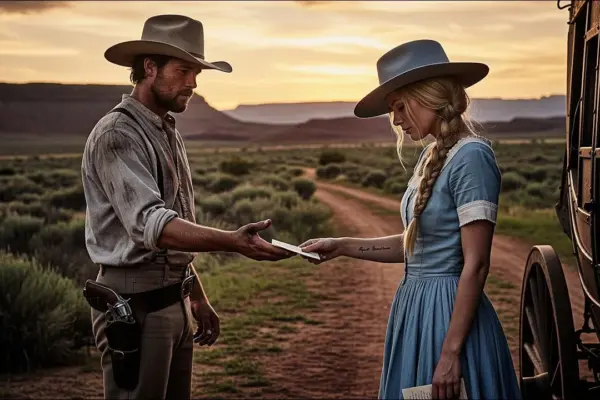
A tall man was stepping down from his sweat-covered horse near the edge of the platform.
He was broad-shouldered, his dark trail clothes caked in white dust from a long, hard ride.
His wide-brimmed hat was a dark gray, not brown, and his leather boots were plain, sturdy, and lacked any silver trim.
This was not Everett.
Yet, as he raised his head, she saw that his dark eyes were remarkably gentle amidst the dust on his face.
“I am Wyatt Ellison,” he said softly, taking a careful step closer so as not to startle her.
“I am Everett’s cousin.”
Francis froze where she stood, her voice trapped in her dry throat.
Wyatt removed his gray hat, holding it respectfully against his chest.
“Everett took ill real bad last week in Helena. High fever. I came in his place as fast as I could.”
He paused, looking down at her pale, exhausted face with a flicker of genuine regret.
“He asked me to meet you. I am truly sorry I am late, ma’am. My wagon axle broke miles back.”
She stared up at him, the harsh reality settling over her like a cold fog.
“He is not coming,” she stated quietly.
Wyatt’s jaw tensed slightly, his expression somber.
“No, ma’am. He is in no state to travel anywhere right now.”
“He thought you would be better off knowing the truth than sitting here wondering.”
Francis swallowed hard, forcing herself not to break down in front of a total stranger.
“So he sent you only to explain his absence… and to make sure I am safe?”
She was torn between the urge to cry from exhaustion and the urge to scream at the sky.
Wyatt looked down at the frayed carpet bag resting by her skirts.
“Do you have a place to stay tonight, Miss Kesler?”
“No,” she answered plainly, her voice barely above a whisper.
Wyatt nodded once, looking away toward the town’s dim lanterns to give her a moment of privacy.
“There is a decent boarding house down the street. I will cover the cost of your room.”
“It is the least I can do on my cousin’s behalf.”
Francis straightened her spine, her posture stiffening immediately.
“I do not take charity from strangers, Mr. Ellison.”
Wyatt brought his gaze back to meet hers, his dark eyes steady and unyielding.
“Then do not call it charity, ma’am. Call it a debt owed to you for wasting your time and bringing you all this way.”
She hesitated, studying the honest lines carved into his sun-darkened face, before finally giving a small, reluctant nod.
“Very well.”
He gently took the heavy carpet bag from her hand, refusing to let her carry it, and walked slowly beside her down the dirt road.
His gelding trailed quietly behind them, its hooves making soft thuds in the earth.
They walked in silence for a long while as the sky turned a deep, bruised violet above the mountain peaks.
Wyatt cleared his throat, breaking the quiet.
“You must be real brave, Miss Kesler.”
Francis glanced up at him in surprise.
“Brave?”
“Coming all this way alone for a man you had never met face to face,” Wyatt explained softly, looking straight ahead.
Francis gave a small, faint shrug beneath her shawl.
“I thought it would be different than what I left behind.”
Wyatt gave a quiet, understanding nod.
“Me, too.”
The innkeeper’s wife, a stern woman with a kind smile, gave Francis a small room on the second floor.
It had a slanted wooden ceiling and a narrow, iron-framed bed.
The ceramic wash basin on the table was chipped at the rim, and the small window was stuck fast and would not open, but the sheets were clean and the room offered complete privacy.
Wyatt paid the woman for three nights in advance, placing the silver coins firmly on the wooden counter.
He tipped his hat once toward Francis without entering her room, and headed back out into the night air.
Francis stood by the small glass window and watched his tall shadow ride away into the darkness until the trail swallowed him whole.
She had only just met him, but there was something about the way he handled her—gentle, steady, with no false words or empty pity—that lingered stubbornly in her chest.
She sat down on the edge of the narrow bed and let her hands fall quietly into her lap.
“Maybe tomorrow will be better,” she whispered into the dark room.
“Maybe this is not the end of everything.”
She closed her tired eyes and forced herself to sleep.
Fifteen miles away, Wyatt did not sleep at all.
He camped out near his broken wagon under a cold sky overflowing with sharp, brilliant stars.
He lay on his blanket, staring up at the cosmos, unable to clear his mind of her eyes.
He couldn’t even name the exact color of them in the dim twilight, but he could not forget the raw look in them when she had asked, “So he sent you.”
He had seen that exact look before in his life.
He had seen it on soldiers in cold winter camps during the war, on desperate mothers with no food left for their children, and on himself once or twice when the world felt entirely hollow.
He pulled his wool coat tighter against the sharp night chill.
He had not expected Everett’s prospective bride to be so proud, so remarkably quiet, or so fiercely strong.
Everett had certainly not deserved a woman like her.
Wyatt found he could not stop thinking about the way she had stood up straight on that platform, refusing to bow her head even as her entire world fell apart around her.
“Tomorrow,” he told himself, turning over on the hard earth.
“I will see her again tomorrow.”
The morning light arrived slow and gold through the slanted window pane of the boarding house.
It glinted off the water in the wash stand and caught the loose, soft strands of Francis’s dark hair.
She stood before the small mirror, pinning her thick braid into a neat crown around her head before pulling her last clean linen collar from her travel bag.
It was creased from weeks of travel, but it was clean and white enough.
Downstairs, the small dining room smelled faintly of freshly brewed coffee and fried cornmeal cakes.
Francis stepped carefully into the room, pausing on the bottom stair, unsure if she would be welcome without a local guide.
The innkeeper’s wife looked up from her stove and waved a wooden spoon toward a small table near the window without any fuss.
Francis sat and ate her meal in total silence, folding each small bite with careful grace, her eyes fixed on the lace edge of the tablecloth.
She had not yet decided what her next step would be, only that she refused to sit idle and feel pity for herself.
Wyatt walked into the inn just as she was finishing her coffee.
He looked tall and dusted from the trail, his work shirt damp at the collar from washing up at the water pump outside.
He carried his dark hat in his broad hand and paused mid-step when his eyes found her at the table.
“I hoped you’d still be here, Miss Kesler,” he said, his gravelly voice kept low out of respect for the quiet room.
Francis carefully folded her cloth napkin and set it beside her plate.
“I have nowhere else to be, Mr. Ellison.”
Wyatt did not sit down until she offered him a subtle nod of permission.
Then, he pulled out the wooden chair across from her and leaned his forearms on the table, being careful not to crowd her space.
“I took another look at my wagon this morning,” he said softly.
“The front axle is cracked completely through. I’ll need to have a new one hauled in by freight from Red Lodge. Could take a full week.”
Francis met his steady gaze without flinching.
“And why are you telling me this?”
Wyatt shifted slightly in his chair, his shoulders squaring.
“Because I thought I might ride out to Everett’s homestead this afternoon.”
“I need to bring back fresh supplies, and I thought I might set up a proper space for you there, if you’d rather not stay cooped up in town.”
Francis watched his face closely, searching for any sign of deceit.
“I was promised a place on that homestead,” she said carefully.
“Yes, ma’am,” Wyatt answered without hesitation.
“And I mean to see that you get what you were promised.”
Francis looked down at her hands resting on the table, then brought her eyes back up to his.
“I am not a charity case, Mr. Ellison.”
“No, you’re not,” he replied instantly, his tone firm and earnest.
“But you were given a solemn promise by a man of my blood. I figure that promise deserves to be honored, even if it isn’t coming to pass the exact way you expected.”
She studied the deep, honest lines around his eyes for a long moment.
“You’re not like your cousin, are you?”
Wyatt’s jaw flexed, a shadow passing over his features.
“No, ma’am. I am not.”
For several quiet breaths, neither of them spoke a word as the morning bustle of the town continued outside the window.
Then, Francis stood up, smoothing the front of her skirt with her palms.
“I’ll come with you.”
Wyatt raised an eyebrow, surprised by her sudden decision.
“To the homestead. I can ride a horse,” she said, her voice firm with resolve.
“And I won’t be left behind in a strange town again.”
Wyatt stood up slowly, a look of profound respect washing over his face.
“All right then.”
They departed the small town by mid-morning.
Wyatt led a gentle bay mare he had borrowed from the local livery stable for her to ride.
He adjusted the leather stirrups to her height without a single complaint, and handed her the leather reins with a respectful nod.
The dirt trail leading west opened wide and quiet before them, dust rising in soft, pale clouds from the horses’ hooves.
They rode for hours without much talk between them, the fresh mountain wind carrying the sweet scent of pine needles and cold river water.
Francis did not ask unnecessary questions, and Wyatt felt no need to fill the wide open silence with empty words.
Midday found them resting beside a narrow, clear mountain stream.
Francis dismounted gracefully without asking for help, walking over to the rocky bank and kneeling down to splash the cold water onto her warm face.
Wyatt stayed back near the horses, giving her plenty of room.
“Were you in the war?” she asked suddenly, her back still turned to him as she dried her fingers on her apron.
Wyatt looked down at his leather reins.
“I was. Cavalry first, then infantry. Missouri regiment.”
She stood up slowly, turning to look at him across the grass.
“You came back whole?”
He looked at her, then down at the dust on his boots.
“Not entirely.”
They did not speak of the war again.
As the sun climbed higher into the bright sky, they remounted and rode deeper into the valley.
By late afternoon, the surrounding landscape began to change dramatically.
There were fewer green cottonwood trees and far more silver-gray sagebrush spreading across the rolling hills.
The homestead fence line appeared first—weathered wooden posts leaning slightly in the wind, strung with tight wire.
Then came the house itself: a modest, sturdy two-room cabin built from thick logs, with a thin curl of blue smoke rising from the stone chimney.
Francis dismounted stiffly, her legs aching from the long ride.
Wyatt led both horses over to the wooden water trough, then walked over to the front cabin door.
“I’ll let you go in first,” he said quietly, stepping back.
Francis took a deep breath and stepped inside alone.
The main room smelled of cold wood ash, dry pine, and aged leather.
A heavy cast-iron stove sat in the corner, cold to the touch but neatly cleaned.
There was a simple pine table with a single chair, a narrow rope-strung cot against the far wooden wall, and a large iron-bound trunk sitting at the foot of it.
There were no lace curtains on the windows, but the glass was clear, letting in the soft, beautiful light of the approaching evening.
She stood in the center of the quiet room for a long moment, feeling the stillness of the space, before turning back to the open doorway.
Wyatt had not moved an inch from his spot on the porch.
“It’s yours now, if you want it,” he said softly.
Francis stepped outside, closing the wooden door gently behind her.
“It’s plain,” she said quietly.
“It’s solid,” he countered, looking at the hand-hewn logs.
She turned her gaze toward the sweeping sunset over the hills, the cool breeze lifting loose dark hairs from her neck.
“I can work, Mr. Ellison. I can sew, cook, and keep laying hens. I am not afraid of hard dirt or long days.”
“I didn’t think you were,” he said softly.
She turned around to face him fully, her eyes searching his.
“Why are you really helping me like this, Wyatt?”
He did not look away or avoid her gaze.
“Because when I saw you standing on that platform yesterday, looking like you’d been torn up inside and stitched back wrong… I knew I couldn’t just ride past and leave you there.”
Her dark eyes narrowed slightly with caution.
“And what do you expect to get in return?”
“I don’t want anything from you that you don’t want to give,” he said simply and firmly.
Francis slowly folded her arms across her chest, not in defiance, but to steady her trembling heart.
“I’ll need time.”
“You can have all the time you need,” Wyatt replied.
The evening wind picked up across the yard, carrying the crisp scent of distant mountain rain.
“I’ll sleep in the barn,” Wyatt added, pointing toward the timber building across the yard.
“Until you decide what comes next for you.”
Francis offered him a single, genuine nod.
“I’d like a hot cup of coffee, if you have any ground.”
Wyatt’s face relaxed, a faint, tired smile touching his lips.
“I’ll start the fire.”
They walked back toward the cabin together, keeping step for step in the fading light.
Neither of them reached for the iron door handle first, but when Wyatt pushed the door open, she stepped inside ahead of him.
Within minutes, the cast-iron stove crackled with low flames as the coffee kettle began to heat up.
Francis sat on a wooden stool near the warm hearth, her hands wrapped tightly around a tin cup, her fingers stiff from holding the leather reins all afternoon.
Wyatt moved quietly behind her in the small space, setting a sack of dry oats onto the pantry shelf, then unlacing his dusty work boots by the threshold.
The quiet hush between them was not cold or awkward.
It held something deeply watchful and quiet, like the wind moving through tall prairie grass.
“I’ll take the cot tonight,” Francis said suddenly, looking down at her cup.
“You said you’d sleep in the barn, but this place is too far out in the wilderness for you to sleep apart from the house.”
Wyatt paused in his movement, then nodded once in agreement.
He fetched an old wool blanket from the corner and settled cross-legged on the floorboards near the far wall, his back resting against the sturdy logs and his arms resting over his knees.
The warm orange firelight flickered across the deep lines at the corners of his dark eyes.
“You built this house?” she asked softly, tapping her fingers against the tin rim of her cup.
“My father built it,” Wyatt answered, his voice low in the quiet room.
“I helped him raise the roof beams and string the fence line, but he set the foundation stones.”
“Is he still living?”
“No,” Wyatt said quietly.
“Died during the hard winter four years back.”
Francis studied the long shadow his boots cast across the pine floorboards.
“And your mother?”
“Buried beside him on the hill,” he replied.
Francis nodded slowly, sipping her warm coffee.
“Mine passed when I was twelve years old. Consumption.”
“My father followed not long after her. Some men simply cannot stand to be left alone in this world.”
Wyatt kept his eyes on the fire, listening to her voice.
“Then you had to manage for yourself from a young age?”
“My older sister took in washing and sewing in town,” Francis explained.
“I joined her at the iron board as soon as I was tall enough to reach the table and count copper change.”
Wyatt shifted his weight slightly against the wall.
“Is your sister still back east in Kansas City?”
“She married a wheelwright three years ago,” Francis said, a small, nostalgic smile touching her lips.
“She has two little boys now. I realized I didn’t want to spend the rest of my life being the unmarried aunt sitting in the corner room.”
The coffee in her tin cup had finally cooled down.
She stood up, walked over to the wash stand, and poured what remained into the chipped basin before setting the cup upside down on the wooden shelf.
“You know,” Wyatt said into the quiet room, “there’s a good patch of ground just north of the cabin that’s been left wild for too long.”
“It would make a fine vegetable garden if the spring rain stays steady.”
Francis turned slightly, looking over her shoulder.
“That sounds like hopeful thinking for October.”
“It’s rich land,” Wyatt said, meeting her eyes.
“It just needs someone who will tend it regular and stick around to see it bloom.”
Francis reached behind her head to unpin her heavy hair, letting the dark braid fall down over her shoulder.
“And you figure that work falls to me?”
“I figure you’ve got your own mind about what you want to do,” he answered softly.
She turned around fully, watching his face in the low glow of the dying embers.
“Would you still want me here if Everett had come on that train instead of you?”
Wyatt met her gaze directly, without the slightest flinch.
“He didn’t come, Francis. And I am not sorry that he didn’t.”
Francis felt a sudden warmth flood her chest.
She crossed the room with slow, measured steps and knelt down to fold the heavy wool quilt at the foot of the cot.
“I don’t know what comes next for me, Wyatt.”
“I’m not asking you to know,” he said gently.
“Not tonight.”
The fire slowly burned down to its last glowing orange coals, painting the cabin in soft, warm shadows.
Francis stood up, pulled the thick quilt up to her chin, and lay back on the cot with her arms crossed comfortably over her chest.
Wyatt stretched out long along the wooden floorboards near the door, using his rolled canvas coat as a pillow.
They lay in total silence for a long time until the mountain wind shifted outside, making a loose wooden shutter tap gently against the outer logs.
“Your boots,” Francis whispered softly into the pitch-dark room.
“What about them?” Wyatt’s voice came through the dark, calm and clear.
“They don’t have silver toes.”
Wyatt let out a low, quiet breath that was almost a soft laugh.
“Never had much care for flash and silver, ma’am.”
Francis smiled to herself in the complete darkness, unseen.
“Neither do I.”
The mountain wind quieted down, and the entire cabin settled into a peaceful stillness once more.
Wyatt’s deep breathing soon evened out into steady sleep, and Francis stared up at the slanted ceiling beam above her head.
Her body was heavy with absolute fatigue, but for the first time in years, her mind felt strangely light and calm.
She had not come to Montana looking for this quiet cabin.
She had not come looking for Wyatt Ellison.
But as she drifted off to sleep, she knew in her heart that she was not sorry to be here.
The next morning brought low, grey clouds and the sharp, clean scent of damp earth.
Rain had fallen softly during the dark hours of the night, just enough to leave shallow puddles along the edge of the timber barn and darken the wooden boards of the front porch.
Francis stood at the open threshold, her arms folded tightly over her apron, watching a pair of black-and-white magpies dart between the fence posts in the yard.
Wyatt stepped out from the side of the barn, his sleeves rolled up to his elbows, his flannel shirt damp at the neck from chopping winter kindling.
He did not speak right away, only offering her a brief, respectful nod toward the newly stacked wood near the door before setting the heavy axe against the log wall.
“I’ll patch the far corner of the hen house today,” he said, wiping his brow with his arm.
“Roof started to sag during the last storm.”
Francis turned slightly to face him.
“Do you have hens to go in it?”
“Not yet,” Wyatt replied, stepping closer to the porch.
“But I figured if the roof was sound and dry, you might want to see about getting a few laying hens from the neighbor next week.”
Francis nodded once, though she remained standing by the door.
Wyatt’s warm gaze lingered on her face for a quiet moment.
“Did you sleep all right last night?”
“I did,” she said softly.
“Woke up only once when the wind picked up around midnight.”
“Thought I heard the sound of a wagon coming up the trail, but it was just the rain dripping into the water trough.”
He stepped up onto the bottom porch step, keeping a respectful distance between them.
“Were you expecting someone?”
“No,” she said simply.
Then, after a small pause, she looked down at the porch boards.
“But I dreamed I was back at the train depot sitting on that crate, completely alone again. Felt like I had never left that platform.”
Wyatt looked out toward the mist-covered horizon.
“Dreams will do that to a person. They pull you right back into the very things you thought you had outrun.”
“I didn’t think I had outrun anything,” she said quietly.
“I just thought life might be a little different out here.”
Wyatt let the quiet silence settle over the yard before he answered her.
“It still could be.”
Francis turned to face him fully, her eyes clear and determined.
“I want to do something useful today, Wyatt. I don’t want to just sit here and wait for the stove to heat up.”
Wyatt smiled faintly, pleased by her spirit.
“Well, I’ve got a supply shed full of old homestead gear that desperately needs sorting.”
“Could use someone who knows how to tell a good needle from a rusted nail.”
“I’ll start right there,” she said firmly.
He stepped aside, letting her pass down the porch steps before following her around to the west side of the cabin.
The small wooden shed leaned slightly to one side, its pine door hanging loosely from a single rusted iron hinge.
Inside, the dim space was a chaotic clutter of rusted farm tools, tangled hemp rope, broken leather harnesses, and a cracked grain grinder.
Francis immediately rolled up her linen sleeves and knelt down beside the tangled pile on the floor.
“You keep every broken piece of iron you’ve ever touched, don’t you?”
Wyatt crouched down on his haunches beside her, picking up a piece of wire.
“It’s hard to throw things away out here when the nearest hardware store is half a day’s ride and money is always scarce.”
She lifted a rusted tin lantern with a cracked glass globe.
“This one is well past fixing, Wyatt.”
“I’ve got two others that work,” he conceded.
She set the lantern in a scrap pile and reached for a neat coil of heavy steel wire.
“This wire is good. It could patch the garden fence.”
They worked together in a comfortable, quiet rhythm, separating what could be salvaged from what was truly worthless scrap.
By noon, Francis had arranged a neat stack of usable tools and wire near the door, and a pile of useless scrap ready to be discarded.
Wyatt leaned his broad shoulder against the wooden doorframe, quietly watching her tie the last bundle of wire together with a strip of canvas cloth.
“You’ve got a real good eye for what’s worth keeping, Francis.”
“I had to learn,” she said, looking up from her knees.
“When you only have one small wooden drawer to keep all your worldly possessions in, you figure out real fast what matters and what doesn’t.”
Wyatt stepped inside the shed, brushing sawdust off the edge of an old oak workbench.
“Did you ever want to leave Kansas City before you answered Everett’s letter?”
Francis sat back on her heels, resting her hands on her apron.
“Yes,” she admitted softly.
Wyatt waited patiently for her to continue.
“I used to stand by the window at the dry goods store and watch the passenger trains roll past,” she said, her voice filled with old memories.
“I wondered where all those people were going. I didn’t care much where the tracks ended, I just desperately wanted to be on one of those cars.”
Wyatt nodded slowly in understanding.
“I rode a troop train once right after the war ended. Slept sitting upright squeezed between two big infantrymen who snored like bulls.”
“Even with all that, it still felt like total freedom.”
Francis offered a faint, warm smile, her eyes resting on the wooden floor.
“It’s funny how much a person will trade just to have that feeling.”
They both stood up at the same time, brushing dirt and sawdust from their hands.
“I’ll go heat the water kettle,” she said.
“We can eat our lunch outside on the porch.”
He followed her back to the cabin, and soon they were sitting side by side on the wooden porch steps with tin plates of warm boiled potatoes and salted pork between them.
The grey clouds above had parted just enough to let a soft, golden warmth flood the valley floor.
Wyatt leaned his back against the thick log porch post, looking out over the open land.
“You ever think about what you’d build if you got the chance to start something from the very beginning?”
Francis traced her finger around the smooth rim of her tin cup.
“A place where nothing was borrowed from someone else,” she said softly.
“A place where the walls belonged to me.”
“I’d plant a big garden of green beans and squash, keep a butter churn on the back porch, and maybe teach reading to the local children if any neighbors lived close enough.”
Wyatt turned his head to look at her, his eyes filled with a quiet intensity.
“That sounds like something that’s truly worth building.”
She met his dark eyes directly.
“Would you help me build it, Wyatt?”
“I would,” he answered without a moment’s hesitation.
They did not speak another word after that.
They simply sat together on the wooden steps as the gentle mountain breeze moved through the tall pasture grass and the sun slowly crept down toward the far mountain ridge.
Neither of them looked away from the wide, beautiful land before them.
Winter came unusually early to the territory that year.
By the very first week of October, heavy white frost clung like delicate lace to the cabin porch railings, and the valley pasture grass had dulled to a brilliant, silvered gold.
Francis pulled her thick wool shawl tight around her shoulders as she stepped outside carrying a wooden basket of laundry, her breath rising in small, white clouds in the freezing air.
The morning sun had barely crested the eastern mountain ridge, but the cabin stove was already radiating warmth, and fresh buttermilk biscuits were rising under a clean cloth on the table.
Wyatt had risen long before her, as he always did.
He was out in the lower field, driving new pine fence posts deep into the dirt before the ground froze solid for the winter.
She could hear the faint, steady rhythm of his iron hammer echoing across the quiet valley.
She set her laundry basket down on a tree stump and began pinning clean work shirts to the line.
Her hand stitches ran neat and straight along the thick cuffs—she had taken to reinforcing the worn seams of his heavy flannel shirts during the long, quiet evenings while he cleaned his leather tools or repaired horse tack by the fire.
They rarely spoke many words during those evening hours, but something profound had grown between them, quiet, solid, and complete.
The laying hens clucked lazily near their wooden coop, pecking at the grain she had scattered before dawn.
The three oldest hens had already stopped laying eggs for the season, but Francis refused to cull them.
They had earned their peace on the homestead.
By mid-morning, Wyatt came walking up the dirt path, his leather work gloves tucked into his belt, his cheeks reddened by the biting mountain wind.
He paused near the porch when he saw her standing by the clothesline, but she did not look up until she felt his steady footsteps stop right behind her.
“How are the fence posts holding?” she asked, reaching into the basket for another wooden clothespin.
“The earth is dry near the cottonwood trees,” Wyatt answered, his voice deep and warm.
“Might need to soak the ground tonight to drive the last three posts.”
Francis nodded, smoothing down the sleeve of his shirt on the line.
“I boiled the last of the black beans with salt pork. They’ll keep hot on the stove until noon.”
Wyatt studied her face for a quiet moment, then reached past her shoulder to lift the damp hem of a swinging shirt.
“Are you still thinking about leaving, Francis?”
She turned her face toward his, the canvas clothesline flapping gently between them in the cold breeze.
“I did at first, Wyatt.”
“When I first arrived, I woke up every morning feeling like an intruder.”
“I tend a stove I didn’t build, I feed hens I didn’t buy, and I sleep on a cot that creaks under my weight.”
She rested her hands gently on her hips, her eyes shining with quiet sincerity.
“But I don’t feel like I’m borrowing anymore.”
Wyatt nodded slowly, a deep look of relief washing over his features.
“You’re not borrowing, Francis. It’s yours.”
They stood quietly together in the cold air.
Francis pulled the very last shirt from the basket and pinned it firmly to the line beside the others.
The long line swayed gently in the wind, cloth brushing against cloth.
“I got a letter yesterday when I rode into town for salt,” Wyatt said after a long pause.
Francis looked up from her basket, her posture shifting.
“From Everett?”
“Yes,” Wyatt said quietly.
“He’s back on his feet now. Staying with some of his mother’s kin near Butte.”
Francis did not answer right away, waiting for him to finish.
“He asked about you in the letter,” Wyatt added.
Francis wiped her hands on her apron, her gaze unwavering.
“Did you write him back?”
“Not yet,” Wyatt replied.
She met his eyes fully, her voice dropping to a low, firm whisper.
“Don’t tell him anything more than he needs to know, Wyatt.”
“I won’t,” he promised.
The cold mountain wind picked up suddenly, threatening to knock over the empty wooden laundry basket.
Wyatt reached down to steady the basket, and Francis caught his hand without a second thought.
His skin was rough and warm, heavily calloused from years of hard manual labor, but his grip softened instantly as his thick fingers laced through hers.
“I didn’t expect to ever feel at home again in my life,” she whispered, her throat tight with emotion.
“But I do, Wyatt. Right here with you.”
Wyatt took a step closer, their hands still tightly joined between them.
“I didn’t expect to want anything more out of life than what I already had,” he said softly, his voice full of emotion.
“But I want more now.”
Francis felt a lump form in her throat as she looked up into his honest, rugged face.
“Can I ask you something, Wyatt?”
“Anything,” he answered immediately.
“Would you build another room onto this house?” she asked softly.
“A small room… with enough space for a cradle beside the stove?”
Wyatt’s broad chest lifted with the deep breath he drew, and something entirely unguarded, wide, and beautiful washed across his face, answering her long before his voice could.
“I already drew up the timber plans last week,” he whispered.
Francis laughed—a bright, beautiful sound she had not made in years—and pressed her forehead gently against the solid center of his chest.
Wyatt wrapped his arms around her, holding her tight against the cold wind.
They stood together like that in the middle of the yard until the morning sun climbed high above the tall pine trees.
That winter settled deep, cold, and quiet over the Montana hills.
Heavy snow stacked up against the log walls, but inside, the cabin remained warm and filled with life.
They spent the long, dark winter months side by side, stitching heavy wool curtains for the windows, sealing drafty cracks in the log walls with fresh clay, and watching the stove fire die down to glowing embers before rising together at dawn.
They spoke endlessly of the coming spring—of planting rows of green beans and squash in the rich soil, of buying a good milk cow from a rancher due north, and of finding a name that would suit a child raised among sturdy pine trees and wooden fences.
By March, as the heavy ice began to melt from the roof, the new room stood complete.
It was small, but perfectly warm, built with sturdy cedar logs and featuring a small glass window that caught the golden morning light just right.
Francis moved her wooden mending basket to a low bench beside the small hand-carved cradle and began stitching a colorful baby quilt made from scraps of old flannel shirts and floral flour sacks.
Wyatt spent his evenings sitting near the hearth, carefully carving small wooden toys from leftover pieces of aromatic cedar, smoothing down every sharp edge by hand until the wood was soft as silk.
The baby arrived just after the final mountain thaw in late spring.
She was a healthy, strong-lunged girl with wide, dark eyes that took in the world with quiet wonder.
They named her Lily, for the wild yellow flowers that bloomed in endless fields along the creek bank as soon as the winter snow melted away.
Francis held the tiny bundle close against her chest on that first quiet night, resting back against the soft pillows.
Wyatt sat on a wooden stool right beside the bed, his broad, calloused hand resting gently on the curve of her knee.
“I never thought I would be needed like this,” Francis whispered, tears of absolute happiness shining in her eyes as she looked down at their daughter.
Wyatt leaned in close, brushing his lips softly against her warm temple.
“You’re not just needed, Francis,” he whispered, his voice trembling with deep love.
“You’re home.”
The small oil lamp on the bedside table burned low and warm in the quiet room.
Outside the cabin, the gentle night wind shifted through the tall pine trees, soft, steady, and sure.
And inside the sturdy house they had built together—slowly, honestly, and with endless care—all three of them breathed as one.
(Descargo de responsabilidad: Este contenido puede haber sido generado por IA con fines de entretenimiento. Cualquier parecido con personas, eventos o lugares reales es pura coincidencia.)