She Bought an Ox for Farm Work — The Auction Sent One Worth Hundreds of Thousands of Dollars
Emma stood on the porch of her grandfather’s farmhouse, watching the dust settling over the gravel lane.
The air in western Virginia was thick with the early humidity of the season, smelling faintly of damp pine and dry dirt.
Across the yard, the old John Deere tractor sat with its hood propped open like the jaws of a rusted iron beast.
It had given up the previous Tuesday with a wet, metallic clunk that signaled the death of its transmission.
The repair estimate resting on her kitchen table read $6,400, a number that might as well have been a million.
At thirty-eight, Emma was no stranger to harsh financial realities.
After her divorce nineteen months ago, she had loaded her pickup with a few pieces of sturdy furniture, her laptop, and whatever savings remained, driving back to the thirty-one acres her father—and his father before him—had farmed.
The land was rich in memories, steep wood lots, and dry-rotted porch steps.
It was poor in cash flow.
She kept afloat by doing twice-weekly bookkeeping for a local plumbing supplier, selling firewood, and taking on occasional freelance auditing jobs.
She had a plan to clear twenty-three storm-felled oak logs from the upper lot to sell to a local sawmill, but without a working tractor, the timber lay rotting on the mountain.
That was why she had attended the dispersal sale of a retired woodsman forty miles south.
She hadn’t bought an ox because she held romantic notions about antique farming methods.
She had bought an ox because her budget allowed for an eighteen-hundred-dollar working animal, and because she knew how to handle one.
Her grandfather had worked cattle in these same woods when she was a little girl, and she had spent three consecutive Saturdays training with the old man and his nine-year-old draft ox, Amos.
Amos was slow, steady, red-coated, and accustomed to gentle commands.
He was scheduled for delivery this very morning, and the sawmill’s transport truck was coming on Thursday.
The heavy rumble of a diesel engine shook the quiet lane, breaking her train of thought.
A commercial livestock transport truck, its white paint splattered with highway mud, backed clumsily into the gravel turnaround near the old receiving pen.
The air brakes let out a sharp, deafening hiss.
The driver, a young man with a faded ballcap pulled low over his eyes, hopped out without shutting off the engine.
He unlatched the heavy rear door, dropped the aluminum ramp with a loud metallic crash, and unclipped a clipboard from his sun visor.
“Emma Miller?” the driver shouted over the idle of the engine.
“That’s me,” Emma said, stepping down the porch stairs, mindful of the soft spot on the third step.
“One red steer, lot forty-two,” the driver said, thrusting the clipboard toward her. “Sign at the bottom, ma’am. I’m running an hour behind on my route.”
“Is he alright in there?” she asked, walking toward the rear of the trailer.
“Fine, fine. Just eager to get off.” The driver rattled a lead rope against the metal side of the truck.
A moment later, heavy hooves clattered down the aluminum ramp.
The animal hit the dirt pen with a solid thud, tossing his broad head and letting out a deep, echoing snort.
The driver slammed the trailer gate shut, latched it securely, shoved a carbon-copy delivery slip into Emma’s hand, and climbed back into his cab.
Before Emma could even walk around to the front of the receiving pen, the truck was already pulling away, churning up a thick cloud of yellow dust that hung heavy in the morning air.
Emma walked to the wooden fence and looked through the rails.
She froze.
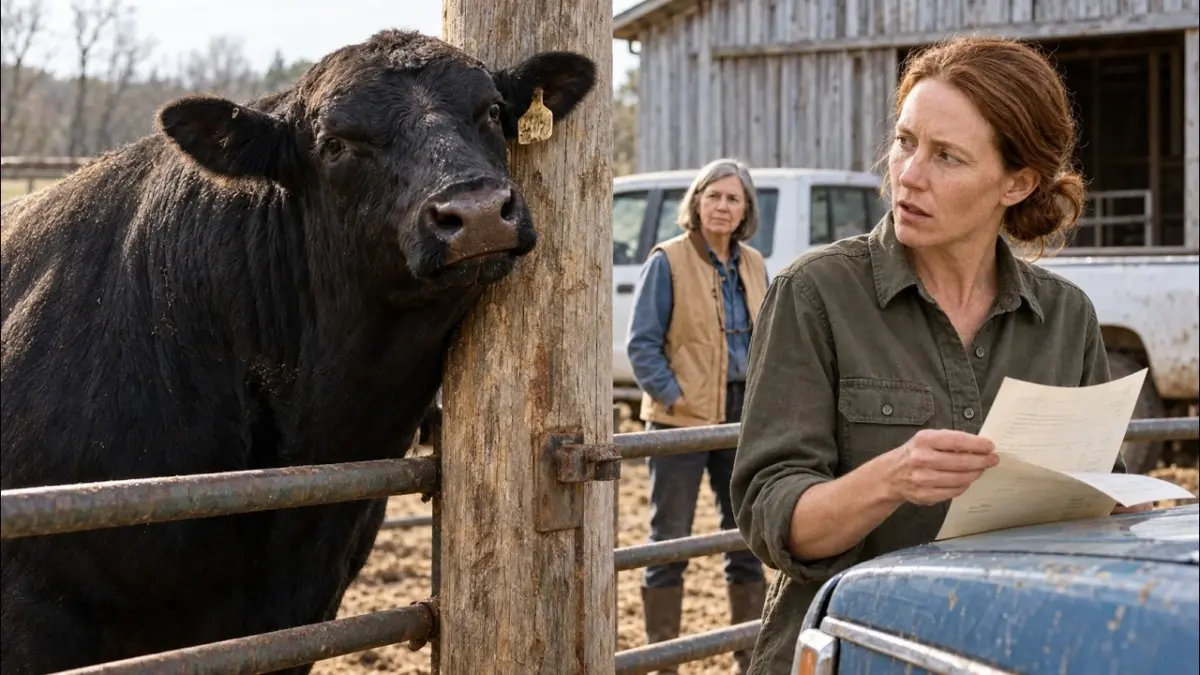
The animal standing by the water trough was massive, broad-chested, and entirely black as coal, with a thick, muscular crest over his neck and a bright yellow ear tag stamped in his left ear.
He lifted his broad muzzle from the water, droplets glinting in the morning sun, and stared at her with calm, heavy eyes.
Amos was a red steer with a distinct white blaze below his right eye.
This was a fully intact, black breeding bull.
Emma did not panic.
Years of untangling accounting discrepancies for stubborn business owners had trained her to treat unexpected mistakes with methodical silence.
She kept the pen gate firmly latched, stepped back three feet, and pulled her phone from her pocket.
First, she photographed the yellow tag in the bull’s ear, making sure the numbers were crisp and legible.
Then she photographed the carbon-copy delivery slip, her original auction receipt, and the photograph of Amos from the sale catalog.
As she flipped through the paperwork the driver had left behind, her thumb caught on a second document tucked neatly behind the delivery slip.
It was a high-grade parchment certificate, bearing the seal of a national cattle association.
Near the top, a name had been underlined with red ink: *Mercer Fieldstone*.
Beneath it was a registration number, a list of genetic markers, and a pedigree chain stretching back three generations.
Emma dialed the number printed at the top of the auction house receipt.
The phone rang four times before a harried clerk answered.
“Tri-County Livestock, this is Gary.”
“Good morning, Gary. This is Emma Miller. A transport truck just dropped off an animal at my farm on Ridge Road, but there’s been a mistake.”
“Mistake with the count, ma’am?”
“No, a mistake with the animal. I bought lot forty-two, a nine-year-old working ox named Amos. Red with a white face mark. The driver just left a black bull in my receiving pen.”
“Let me pull up the dispatch sheet,” Gary said, the sound of rapid computer keys clattering in the background. “What’s the tag number on the animal in your pen?”
“Yellow tag, entry zero-four-nine,” Emma read off her phone. “And there’s a pedigree sheet attached to my delivery slip. The name underlined is Mercer Fieldstone.”
The clattering of keys stopped instantly.
The line went dead silent for three long seconds.
“Ma’am,” Gary said, his voice dropping an octave, all the routine annoyance gone. “Did you say Mercer Fieldstone?”
“I did.”
“Is the pen secure?”
“It’s an old oak receiving pen. High rails, heavy latch. Water trough is full. He’s drinking quietly.”
“Do not go into that pen,” Gary said, his voice tight. “Stay outside the fence. Do not try to move him. I am getting the general manager right now. Hold the line.”
Emma stood by the wooden rail, watching the massive bull.
He didn’t seem aggressive.
He walked slowly to the edge of the fence, lowered his heavy head, and rubbed his neck against a corner post thick enough to support the roof of a barn.
The timber groaned under his weight, but held.
A new voice came on the line, sharp, breathless, and intensely focused.
“Miss Miller? My name is Martin Bell, General Manager at Tri-County. Gary just gave me the tag number. Is that bull completely contained?”
“He is in an oak receiving pen by himself, Mr. Bell. Gates are locked.”
“Are there any other cattle on your property? Any cows in season nearby?”
“No other cattle. Just twenty-three fallen oak logs and a broken tractor.”
Martin let out a long, audible sigh through the receiver.
“Thank God for small favors. Miss Miller, there has been an atrocious mix-up at the dispatch depot. That bull was supposed to be delivered under special private transport to a veterinary receiving facility in Culpeper this morning. We’ve already contacted the owner, Mrs. Ruth Mercer. She is heading your way now with her stockman and a specialized trailer. Please, I beg you, just keep the gate locked.”
“I intend to,” Emma said calmly. “Where is my ox, Mr. Bell? I have timber to haul on Thursday.”
“We’re locating him right now,” Martin replied hastily. “We believe he was loaded onto the regional route truck by mistake. We will have him on your property before the afternoon is out, I promise you.”
“Please do,” Emma said. “He cost eighteen hundred dollars, and I have a deadline.”
Eleven minutes after she hung up, a white heavy-duty pickup pulling a gooseneck livestock trailer pulled onto the gravel driveway.
The truck bore no fancy commercial logos, just a simple brass plate on the bumper.
A woman stepped out from the driver’s side.
She appeared to be in her early sixties, wearing a faded canvas work vest over a crisp blue button-down shirt, her gray hair cut in a neat, jaw-length bob.
A pair of reading glasses hung from a black cord around her neck.
A tall, weathered man with mud-stained boots climbed out from the passenger side and walked directly toward the pen without saying a word.
“Miss Miller?” the woman asked, walking toward the porch. “I’m Ruth Mercer.”
“Emma Miller. Thank you for coming so quickly.”
“This is Luis,” Ruth said, gesturing toward the man at the pen. “He manages our herd.”
Luis didn’t call to the bull or make any sudden movements.
He stood three feet back from the fence, his arms folded, watching the bull’s posture, his eyes tracking the animal’s breathing and movement.
Ruth walked over to Emma’s truck, where Emma had laid out her phone, the delivery slip, the receipt, and the pedigree paper on the hood.
Ruth picked up her reading glasses, put them on, and looked down at the documents.
A faint, tired smile touched the corners of her mouth.
“Well,” Ruth said softly, looking over toward the pen. “There you are, Fieldstone.”
“You know him?” Emma asked.
“I ought to. My late husband bred his grandfather,” Ruth said. She looked at the photos Emma had taken on her phone. “You documented the arrival time and the paperwork before calling?”
“I used to manage inventory control for an equipment distributor,” Emma explained. “When paperwork goes wrong, the first version of the mistake is always the easiest to trace. After people start calling each other, they start remembering what *should* have happened instead of what *did*.”
Ruth looked at Emma, her gray eyes sharp and appreciative behind her lenses.
“That is a very rare kind of wisdom in the farming business, Miss Miller.”
“How much bull is he, Mrs. Mercer?” Emma asked directly. “The clerk sounded like he was about to have a heart attack.”
Ruth hesitated, then reached into her vest pocket, pulled out a folded folder, and laid a purchase agreement on the hood of the truck.
She turned it so Emma could read the figures.
Near the bottom of the page, printed beside a buyer’s syndicate signature block, was the total price: *$240,000*.
Emma looked at the number.
She didn’t gasp, nor did her eyes widen.
She simply read the fine print beneath the figure.
“This says the purchase is subject to genetic verification, health documentation, and buyer inspection prior to final wire transfer,” Emma noted aloud.
“It does,” Ruth nodded. “Which means right now, if that bull is injured, misidentified, or missing his paperwork, that contract isn’t worth the paper it’s printed on. He’s a two-hundred-and-forty-thousand-dollar asset until a mistake turns him into a lawsuit.”
“Well,” Emma said, folding her eighteen-hundred-dollar receipt and placing it into her jeans pocket. “He isn’t injured. He’s drunk his fill of water, and he’s resting. But he isn’t mine, and I’d like my ox back.”
“We’ll get you your ox, Miss Miller,” Ruth said gently. “I assure you.”
By noon, the veterinarian had arrived, accompanied by Martin Bell in a Tri-County company truck.
The atmosphere around the receiving pen was tense and precise.
Luis operated the trailer’s side chute while the veterinarian carefully verified the tattoo inside the bull’s ear against Ruth’s registry records.
Emma stayed outside the working perimeter, watching quietly with her hands in her pockets.
“Tattoo matches,” Luis called out, his voice flat and steady. “Right ear, zero-nine-nine-B.”
“Verified,” the veterinarian confirmed, checking her clipboard.
Ruth let out a slow breath, her shoulders visibly dropping an inch.
Martin Bell wiped sweat from his forehead with a handkerchief and held out a transport route sheet in front of Emma and Ruth.
“Here’s what happened,” Martin explained, pointing to two lines printed on the dispatch sheet. “Miss Miller’s customer account number is sixty-one. Mrs. Mercer’s private transport booking ended in sixteen. The dispatch clerk attached the destination label for sixty-one onto trailer sixteen. The drivers didn’t check the breed—they just followed the delivery tags on the manifest.”
“They didn’t notice that a draft ox doesn’t look like a Angus breeding bull?” Emma asked mildly.
Martin flushed red. “They were rushing to complete six deliveries before noon. It’s indefensible, Miss Miller. Your ox, Amos, is currently at the Culpeper holding facility. He’s fed, watered, and completely calm. We have a fresh trailer coming to bring him directly here by four o’clock.”
“And you’ll waive the delivery fee,” Emma added.
“Consider it done,” Martin said immediately. “I’ll also call the sawmill and explain that any delay on your log delivery was entirely our fault.”
“There won’t be a delay,” Emma said. “If Amos gets here by four, I’ll have him working the lower lot first thing tomorrow morning.”
By two in the afternoon, Mercer Fieldstone was securely loaded into Ruth’s specialized trailer.
Before getting into her truck, Ruth walked over to where Emma was standing by the porch.
She looked at the house, noting the unfinished lumber on the broken porch step and the propped-open hood of the idle John Deere tractor in the yard.
“You handle records with remarkable clarity, Miss Miller,” Ruth said. “Did you say you do accounting?”
“Two days a week for a plumbing supply company in town,” Emma replied. “The rest of the time, I’m trying to keep thirty-one acres from swallowing me whole.”
“Would you be interested in taking on a short freelance job?” Ruth asked. “I need someone to put together a complete, bulletproof incident file for this transport mix-up—times, photographs, statement copies, identification checks. The buying syndicate’s attorney is going to ask questions, and I want an objective file they can’t pick apart. I’ll pay your standard hourly rate.”
Emma considered it for a moment.
“Send me what documents you have,” Emma said. “I’ll look them over tonight.”
Ruth pulled a business card from her pocket, wrote a direct cell phone number on the back, and handed it over.
“I appreciate it, Emma.”
At 4:17 PM, a smaller stock trailer pulled into the driveway.
The door opened, and a large, red-and-white steer stepped calmly down the ramp.
He had dark, gentle eyes, a massive white patch below his right eye, and a familiar, slow tread.
He looked around the yard, lowered his nose to the dirt, and let out a soft, lowing sound.
“Hello, Amos,” Emma said softly, walking up to him.
She checked his hooves, checked his ears, and carefully inspected the leather harness and yoke equipment the driver unloaded from the truck bed.
Everything was in order.
That evening, after feeding Amos a double portion of fresh hay, Emma sat at her kitchen table.
The table was cluttered with unpaid property tax notices, utility bills, and insurance statements.
Rather than disturbing the precarious piles, she carried her laptop out to the porch, balancing it on a wide wooden board laid across two folding chairs.
She opened her email.
Ruth Mercer had sent nineteen separate attachments.
Emma opened them one by one.
Her trained eye immediately caught three files with identical file names, a missing departure timestamp from the Tri-County depot, and a transport log that referenced a completely different license plate.
For two hours, while the crickets chirped in the dark woods surrounding the farm, Emma built a clean, chronological timeline:
*06:30 AM – Dispatch booking generated at Tri-County Depot.*
*07:15 AM – Incorrect route tag applied (Customer #61 transposed with #16).*
*08:45 AM – Unauthorized animal delivered to Ridge Road property.*
*08:52 AM – Photographic documentation secured by property owner.*
*08:58 AM – First notification call placed to Tri-County dispatch.*
*11:15 AM – On-site physical identification verified by licensed veterinarian.*
*02:00 PM – Corrective transport executed.*
She didn’t fill in missing gaps with assumptions or guesses.
Where a time was unverified, she wrote *[Timestamp Unconfirmed by Carrier]*.
At the bottom of the summary, she typed a single, decisive sentence:
*Animal identification verified via ear tattoo matching Registry Certificate #9902-B by attending veterinarian prior to onward transport.*
She exported the file as a clean PDF and emailed it back to Ruth Mercer.
Across the yard, inside the dark barn, she heard Amos shift his weight in his stall, the rhythmic crunch of hay echoing in the quiet night.
Emma leaned back against the porch rail, staring out into the dark.
This farm had belonged to her father, and before him, her grandfather.
Thirty-one acres of timber, pasture, and old stone walls.
It was a home she refused to lose, but the margin for error was razor-thin.
The plumbing company job paid reliably, but it wasn’t enough to repair the tractor or fix the roof.
She needed this land to produce.
The next morning at dawn, Emma harnessed Amos.
She walked him up to the upper wood lot where twenty-three heavy oak logs lay scattered across the hillside.
She attached the iron skidding chain to the first log, stood to the side, and gave the command her grandfather had taught her decades ago.
“Get up, Amos. Come boss.”
The old ox leaned his broad shoulders into the wooden yoke, his powerful legs driving into the soil.
The heavy oak log groaned, dislodged from the mud, and began to slide smoothly along the skid path toward the gravel lane.
By noon, four massive logs were lined up neatly by the road.
By Thursday afternoon, the sawmill truck had arrived, loaded nine logs, and handed Emma a check for $740.
It was enough to cover feed, groceries, and the electric bill.
It didn’t fix the tractor, but it was progress.
While Emma was coiling her skidding chains on Friday afternoon, her phone rang.
“Emma? It’s Ruth Mercer.”
“Good afternoon, Mrs. Mercer. Did the report work for your attorneys?”
“It didn’t just work,” Ruth said over the line. “Their legal counsel called it the cleanest, most indisputable incident summary they’ve received all year. Which brings me to why I’m calling. I have a much larger problem at my farm, Emma, and I’d like you to take a look at it before you say no.”
The following afternoon, Emma drove forty miles north to Mercer Farm.
She had expected high ornamental gates and a manicured estate.
Instead, she found a practical, working cattle operation spread across a sweeping, green valley.
The entry gate was simple galvanized steel, and the gravel driveway was in desperate need of grading.
Ruth met her outside a low concrete-block building attached to a large machinery shed.
Inside the small office, four heavy cardboard banker boxes sat on the floor, with a fifth sitting open on an old office chair.
“My husband, Arthur, passed away last November,” Ruth said, setting down two mugs of black coffee. “Arthur kept the breeding records in his head and on scraps of paper. I kept the financial books. He was brilliant at cattle genetics, but he never felt the need to label a file for anyone else.”
Emma set her bag down and looked at the boxes.
“I’m sorry for your loss, Mrs. Mercer.”
“Thank you,” Ruth said softly. “The buying syndicate for Fieldstone wants a complete, five-year historical record—herd performance, dam history, offspring birth weights, and veterinary health logs—before they execute the final wire transfer for the two hundred and forty thousand dollars. The data is all here in these boxes, but finding it and cross-referencing it has become an impossible nightmare. I don’t have the time, and I don’t have the stomach to sit in this room alone.”
Emma reached into the open box and pulled out a binder.
It contained handwritten ledger entries, printed laboratory DNA sheets, handwritten receipts, and yellowed envelopes marked with faded dates.
“I can organize this,” Emma said, looking up. “But I need to be clear about my boundaries. I am an accountant, not a livestock expert. I can organize your records, flag missing documents, and reconcile discrepancies. I cannot tell you if a bull is genetically superior or worth two hundred thousand dollars.”
“I have veterinarians and breeding consultants for the cattle decisions,” Ruth said firmly. “I need an auditor for the paperwork. Someone who doesn’t guess, doesn’t make assumptions, and doesn’t get flustered by a mess.”
They agreed on an hourly rate of thirty-five dollars, with a cap of twenty hours for the first phase.
Emma wrote the terms on a sheet of notebook paper, and Ruth signed it without hesitation.
For the next two weeks, Emma split her life into two distinct rhythms.
Mornings were spent at her own farm, working Amos in the wood lot, dragging two or three logs down to the lane before the heat of the day set in.
Three afternoons a week, she drove north to Mercer Farm.
She didn’t try to force Ruth’s chaotic files into a complicated new software program right away.
Instead, she brought physical order to the chaos.
She established a strict inventory system: every physical folder received a coded label, every scanned sheet was cross-referenced to its original box, and whenever two records disagreed, Emma left both visible, tagging the entry with a bright orange flag.
Ruth worked nearby, answering questions between her farm chores.
At four o’clock every afternoon, Luis would walk into the office, his boots caked with barnyard mud, offering sharp, surprisingly precise memories.
“That calf with tag ninety-two?” Luis would say, leaning against the doorframe. “He wasn’t born in the North Pasture. We moved his mother during the April snowstorm. That’s why his birth weight was logged three days late.”
Emma would type Luis’s exact explanation into the master log, noting his name as the source.
On her ninth afternoon at Mercer Farm, Emma uncovered the discrepancy that threatened to kill the entire sale.
She was cross-referencing Fieldstone’s bloodline certifications when she laid two separate laboratory reports side-by-side on the desk.
“Mrs. Mercer,” Emma called out quietly. “Could you look at these?”
Ruth walked over, setting down a pair of fencing pliers. “What did you find?”
“These are two blood analysis reports from the state university lab, dated sixteen months apart,” Emma said, pointing with her pen. “The second report matches Fieldstone’s registration number and ear tag precisely. But the first report—the one establishing his sire’s baseline markers—lists a farm ear tag belonging to a completely different bull in your herd, tag zero-four-four.”
Ruth put on her glasses and stared at the two sheets.
Her face paled slightly.
“Zero-four-four was a steer we sold to a commercial feeder two years ago,” Ruth whispered. “If the syndicate’s legal team sees this, they’ll claim Fieldstone’s pedigree is unverified. They’ll pull the offer immediately.”
“Which report is correct?” Emma asked.
“Fieldstone is definitely Arthur’s prime line,” Ruth said fiercely. “I watched him perform the breeding myself! The lab must have typed the wrong farm tag on the initial submission sheet.”
“We can’t just tell them it was a typo,” Emma said calmly. “We need the original submission form from the vet who pulled the sample.”
They spent two hours digging through Box Four until they found the veterinarian’s carbon-copy submission log from three years prior.
Sure enough, the veterinarian’s handwritten note clearly showed tag zero-nine-nine-B, but the lab technician who processed the sample had misread the faded handwriting as zero-four-four.
Ruth let out a long breath of relief. “Thank God. We can just send this to the buyer.”
“No,” Emma corrected gently. “The buyer’s advisor already knows about the delivery truck mix-up at my farm. If we send them a corrected paper with a clerk’s error, they’ll suspect we forged it to save the sale. The only way to resolve this cleanly is to order a fresh, expedited DNA verification sample drawn by your vet today, with official chain-of-custody tracking.”
Ruth sat down heavily in her office chair, rubbing the bridge of her nose.
“A fresh DNA panel takes three weeks to process through the association lab, Emma. The buyer might walk away.”
“They might,” Emma agreed quietly. “But if you try to patch it over with an old clerical error, they will *definitely* walk away, and your farm’s reputation will take the hit. Clean data takes time, Mrs. Mercer. There are no shortcuts.”
Ruth looked at Emma for a long moment, then reached for her desk phone.
“Call the vet,” Ruth said. “Tell her to bring a blood collection kit.”
While the state laboratory processed the fresh DNA sample over the next four weeks, life on Emma’s farm continued its quiet, demanding march.
On a hot Saturday morning, Emma’s washing machine stopped draining, flooding her small utility room floor.
She unplugged the machine, baled the soapy water out with a five-gallon bucket, ordered a thirty-dollar pump replacement part online, and hung her wet laundry on a clothesline behind the barn.
Shortly after noon, her neighbor, Daniel Price, pulled his pickup into her yard to return a heavy hydraulic jack he had borrowed.
He found Emma sitting on an inverted crate near the barn, cleaning the leather collar of Amos’s harness with saddle soap.
“Afternoon, Emma,” Daniel said, leaning the jack against his truck bed. “Word around the supply store is you had a quarter-million-dollar bull delivered to your barn by mistake last month.”
“Two hundred and forty thousand,” Emma corrected without looking up from her scrubbing. “And he was only here for four hours.”
“People are talking like you won the lottery or something,” Daniel chuckled, leaning against the fence.
“He belonged to Ruth Mercer,” Emma said, setting down her rag. “I hired out to audit her herd records to make sure his sale goes through legally. That’s all.”
Daniel smiled, shaking his head. “Sorting paperwork for rich cattle folks. Sounds like you.”
He looked over at the idle John Deere tractor under the shed, its hood still propped open like a monument to broken machinery.
“Still waiting on that transmission fix?”
“Saving up for it,” Emma said. “One log and one invoice at a time.”
“Well, let me know when you get the parts,” Daniel offered kindly. “I’ve got a flatbed trailer. I’ll help you haul it to the repair shop in town for free.”
“I appreciate that, Daniel. I really do.”
By the fourth week of June, the certified laboratory results finally arrived via certified mail.
The fresh DNA profile matched Mercer Fieldstone’s pedigree records with 99.9% statistical certainty.
The misplaced report was formally expunged from his file, and the syndicate’s legal team signed the final purchase contract.
On the day the wire transfer cleared, Ruth invited Emma to Mercer Farm to watch Fieldstone being loaded onto a high-end, air-conditioned transport vehicle bound for his new home in Texas.
Luis checked the bull’s ear tattoo one last time, matching it against the final legal transfer sheet.
The transport driver checked it, too.
Nobody rushed.
Nobody made light of the protocol.
The massive black bull walked up the rubber-matted ramp, paused to look back at the green Virginia valley one last time, and stepped into the trailer.
Ruth stood beside Emma, holding a clean leather binder containing the complete, thirty-two-page audited history of her farm’s prime breeding line.
Every page was flagged, verified, and cross-referenced with Emma’s precise handwriting.
“The wire transfer just hit my bank,” Ruth said quietly, staring at the departing trailer. “Two hundred and forty thousand dollars.”
“Congratulations, Ruth,” Emma said sincerely. “You built a remarkable herd.”
Ruth turned to Emma and pulled a business checkbook from her vest pocket.
“You logged sixty-eight hours on this disaster, Emma. At thirty-five dollars an hour, that comes to two thousand three hundred and eighty dollars.”
She wrote the check, signed it with a flourish, and handed it to Emma.
Emma looked at the check.
It wasn’t a fortune.
It wouldn’t buy a new truck or pay off her farm’s mortgage.
But it was honest money, earned through accuracy and patience.
“Thank you, Ruth,” Emma said, folding the check neatly into her wallet.
“I have a proposal for you,” Ruth said, leaning against the office doorframe. “I don’t ever want my farm records to fall into chaos again. I want to keep you on a monthly retainer—ten hours a month to keep my herd books, sales receipts, and tax logs current. And if any of my neighbors need their books cleaned up before a sale, I’m sending them straight to you.”
Emma smiled. “I can handle ten hours a month.”
“One more thing,” Ruth added, looking at Emma thoughtfully. “What are you doing with that lower ten-acre pasture at your place? The one by the creek?”
“Right now? Growing weeds and letting Amos graze,” Emma replied.
“The fences look solid, and the creek is running clean,” Ruth said. “I have twelve young heifers that need summer pasture before they’re bred next spring. I’ll pay you fifty dollars a head per month to board them from May through August, provided you have the grass.”
Emma didn’t answer right away.
In her head, she immediately ran the numbers: twelve heifers at fifty dollars a head was six hundred dollars a month.
Four months meant twenty-four hundred dollars of steady income.
“I’ll need to check the fencing along the south boundary first,” Emma said carefully. “And we’ll need a written agreement that says if a dry spell hits and the grass fails, you move the herd early so my pasture isn’t ruined.”
Ruth threw her head back and laughed aloud, a warm, booming sound that filled the gravel yard.
“Deal, Emma Miller. Deal.”
Two months later, in late August, Daniel Price’s flatbed truck pulled into Emma’s driveway.
On the back sat her John Deere tractor, its transmission completely rebuilt, its engine purring with a smooth, deep hum.
Emma paid the mechanic’s bill with the money earned from her record-keeping retainer and her wood lot timber sales.
She drove the tractor off the flatbed, parked it under the shed, and turned off the ignition.
Across the fence, Amos stood under the shade of an old oak tree, chewing his cud with calm, rhythmic devotion.
Beyond him, in the lower pasture, Ruth’s twelve Angus heifers grazed peacefully along the green bank of the creek.
That evening, Emma sat at her spare room desk—a workspace she had recently furnished with a sturdy, second-hand metal filing cabinet bought at a yard sale.
Pinned to the corkboard above her desk were the identification templates for four local farm clients whose books she now maintained.
She opened the top drawer of the cabinet, pulled out a thick folder labeled *Mercer Transport Incident – Historical*, and slipped a single photograph inside.
It was a picture Ruth had brought her earlier that week—a photo sent by Fieldstone’s new owners in Texas, showing the great black bull standing in a lush pasture under a vast southern sky.
Tucked right behind that photograph was a faded, carbon-copy receipt for $1,800, stamped *Paid in Full – One Red Draft Ox Named Amos*.
Emma looked at the two papers side-by-side.
She knew how easy it would be for someone looking from the outside to tell her story as a fairy tale: a struggling woman on a broken farm, a quarter-million-dollar mistake delivered to her barn, and a sudden stroke of wild fortune.
But the money from the bull had gone to Ruth, who had spent forty years building the genetics to earn it.
Emma’s fortune had come in smaller, quieter increments—thirty-five dollars at a time, earned through late nights, tedious verification, attention to detail, and hard physical labor in the woods.
It was enough to repair the tractor.
It was enough to replace the porch step.
It was enough to pay her property insurance on time.
It was enough to stay.
Emma closed the filing cabinet drawer with a firm, satisfying click.
She walked out onto the porch, carrying a wooden bucket of fresh well water down to the barn.
The evening air was cooling down, smelling of sweet grass and cured hay.
She poured the water into the trough near the pen.
A few heavy splashes spilled over the wooden rim, darkening the dry earth in the exact spot where a black bull had stood four months ago.
Amos walked over, lowered his broad, white-blazed face to the water, and began to drink.
Emma leaned against the solid oak rail, rested her arm on the wood, and watched her farm settle into the quiet of the night.
(Descargo de responsabilidad: Este contenido puede haber sido generado por IA con fines de entretenimiento. Cualquier parecido con personas, eventos o lugares reales es pura coincidencia.)