“There’s A Spare Room At My Mill,” He Told The Shamed Teacher “I Don’t Answer To This Town”

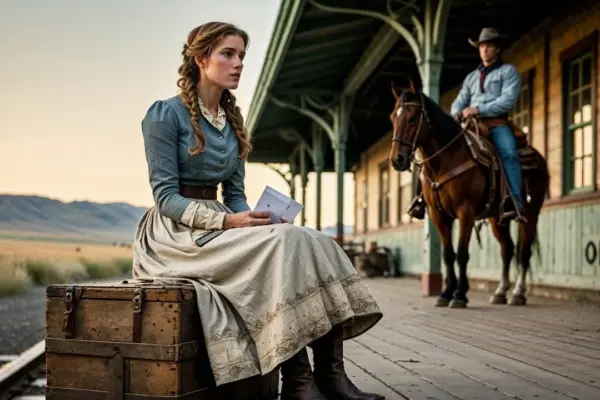
The icy autumn wind whipped off the platform at Cedar Falls, stinging Fiona Quaid’s cheeks as the heavy iron train groaned to a halt.
She stepped onto the timber planking, clutching a worn leather satchel to her ribs with both hands.
Her wool coat was thin, faded at the cuffs, and offered precious little defense against the raw northern cold.
Inside her coat pocket lay a signed teaching contract, its paper folded and unfolded so many times that the creased lines had worn stark white.
Fiona had come north from the city of G. to teach the children of the local mill workers.
The school board had promised her a quiet life: a room at the town boarding house, a steady wage, and a classroom stocked with fresh readers by the first of November.
The platform was nearly deserted, save for a group of local men standing near the dark wood of the station house.
They kept their hands shoved deep into their coat pockets, watching her approach with cold, measuring eyes.
Before Fiona could reach the end of the platform, a broad-shouldered man stepped directly into her path.
He wore a dark wool coat with a stiff collar that squeezed too tightly around his fleshy neck, and a gray mustache trimmed with rigid precision.
“Miss Quaid, I presume?” the man said, his voice ringing out loud and authoritative across the quiet station.
“I am Fiona Quaid,” she replied, standing as tall as her slender frame allowed.
“I am Clement Hair, chairman of the Cedar Falls school board,” he announced, raising his chin slightly.
“I have a matter of some delicacy to address before you make any attempt to settle in our town.”
Fiona gripped her satchel tighter, feeling a familiar, heavy dread settle in the pit of her stomach.
She had spent too many difficult years facing cold men in formal coats not to recognize the posture of a sentence being delivered.
“Is there an issue with my papers, Mr. Hair?” she asked carefully.
“We received a letter yesterday evening,” Clement Hair said, taking a step forward and speaking loudly enough for every watching man on the platform to hear every word.
“It came from a trusted contact of mine in G.”
He paused, letting the silence stretch until the wind rustled the dead leaves along the tracks.
“It seems you spent the last three years employed at the Homewood Sanatorium.”
“Not as a nurse, mind you,” Clement continued, his lips curling into a thin, contemptuous line.
“As a common ward attendant.”
Fiona felt the blood drain from her face, but she forced her chin to remain steady.
“My mother was a patient in the infirmary ward there, Mr. Hair,” Fiona said, keeping her voice low and even.
“She had a lingering illness that drained her savings.”
“I took the job as an attendant so I could pay for her care and stay by her side until she passed.”
Clement Hair turned his gaze slowly toward the men standing by the station house, ensuring they were taking in the scene, before looking back at her.
“A schoolteacher who has lived and worked among lunatics for three years is not a woman this town can trust with its children,” Clement declared firmly.
“The board cannot risk the moral and mental welfare of our youth.”
“I am afraid your contract is voided.”
The word landed like a heavy stone dropped into frozen water.
Around them, the watching men remained motionless and silent.
Near the station window, an elderly woman pulled her knitted shawl tighter around her shoulders and deliberately averted her eyes.
Fiona carefully unbuttoned her coat, reached into her pocket, and pulled out the folded paper.
She unfolded it slowly, displaying the crisp ink.
“This contract bears your personal signature, Mr. Hair, as well as the official seal of the Cedar Falls school board,” she said, her voice trembling slightly despite her best efforts.
“Circumstances have changed, Miss Quaid,” Clement snapped.
“My mother’s illness did not change my qualifications, nor does it change your school’s need for a teacher,” Fiona countered, stepping closer.
Without asking, Clement Hair reached out and snatched the paper straight from her fingers.
He folded it roughly and tucked it beneath his heavy arm.
“I will arrange your return fare on the southbound train in the morning,” Clement said dismissively.
“Tonight, you may wait inside the unheated freight shed or sit here on the platform.”
“The boarding house will not take you.”
A thick, suffocating silence descended over the platform.
The afternoon light was rapidly fading into a harsh, twilight gray, and the northern breeze carried a biting dampness that promised heavy frost before midnight.
Fiona stood utterly alone on the timber planks.
She had no contract, no money, no room, and nowhere to go.
Not a single person on the platform was willing to meet her gaze.
Then, a man’s voice broke through the stillness from the far end of the station steps.
“She cannot wait on an open platform in this cold, Clement,” the voice said, unhurried, deep, and completely plain.
“That much is not up for debate.”
The crowd parted slightly as a tall, broad-shouldered man walked forward.
A thick length of work rope was coiled over one of his heavy shoulders, and fine yellow sawdust dusted the front of his canvas work coat.
He had a lean, weathered face, dark eyes, and a quiet stillness about him that spoke of long years spent working in silence.
Fiona recognized him instantly from the descriptions she had heard on the train.
He was Hugh Farren, the owner and operator of the Ference Sawmill on the northern edge of town.
Hugh had lived in Cedar Falls since before the railway tracks were laid.
Most people regarded him like a permanent feature of the landscape—fixed, reliable, and entirely set apart from the petty politics of the village.
Four years ago, his wife, Marian, had died of pneumonia during a brutal winter, a season when the town council had been slow to offer any aid to the isolated mill house.
Since then, Hugh had lived alone, asking nothing from the town and giving nothing extra in return.
Clement Hair turned, his jaw thrusting out aggressively.
“This is official school board business, Farren,” Clement barked.
“She is standing on a public platform in freezing temperatures with no shelter and no ticket home,” Hugh replied calmly, stopping a few paces away.
“That is not school board business.”
“That is a complete lack of common decency.”
Hugh turned his eyes to Fiona.
There was no pity in his gaze, and Fiona was profoundly grateful for it.
She had experienced enough pity in the sanatorium wards to last a lifetime.
Instead, Hugh looked at her with a calm, practical assessment, as if evaluating a straightforward problem that simply required an immediate solution.
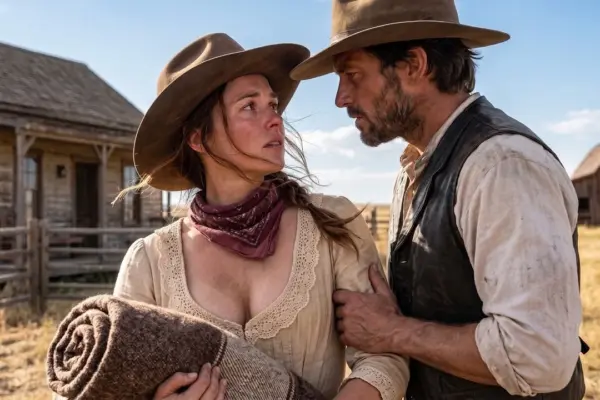
“There is a spare room at the mill house, Miss Quaid,” Hugh said, his tone even and direct.
“It has a warm stove and a clean bed.”
“You are welcome to use it until morning, or longer if you need time to make your plans.”
Clement Hair’s face flushed a dark, angry red.
“Have you lost your senses, Farren?” Clement shouted.
“Think of what the people of this town will say about such an arrangement!”
“A disgraced woman living under the roof of a widower?”
Hugh shifted the rope on his shoulder and looked directly at the chairman.
“I do not answer to this town’s gossip, Clement,” Hugh said quietly.
“I never have.”
Without another word, Hugh turned and began walking down the timber steps toward the north road.
Fiona did not hesitate.
She lifted her heavy satchel, adjusted her worn coat, and followed him off the platform into the gathering dark.
The sky above Cedar Falls was closing in with heavy, dark clouds as the first true bite of winter descended from the surrounding hills.
Fiona kept a careful distance of three paces behind Hugh as they walked along the rutted dirt road.
She kept her eyes fixed on the steady set of his broad shoulders, watching his movements carefully.
In her three years at the sanatorium, she had learned that unexpected kindness often came with a hidden price tag attached.
Yet as they walked, Hugh never turned around to urge her to hurry.
He never made a sudden move toward her satchel without asking first.
When the road began to steepen and the frozen mud formed jagged ridges underfoot, he simply slowed his long stride.
“Watch your step on the left there,” Hugh called back quietly over his shoulder.
“The ice holds water in those wagon ruts.”
“Thank you,” Fiona said, carefully navigating around the frozen mud.
After twenty minutes of steady walking, the trees cleared, revealing the mill property.
The mill house was a square, sturdy structure built of thick pine timber, featuring a broad covered porch.
A massive stack of split firewood was neatly piled clear to the eaves, and a warm, golden light glowed steadily through the kitchen window.
The air smelled rich and heavy with pine resin, dry sawdust, wood smoke, and the faint scent of fresh bread.
Hugh pushed open the heavy front door and stepped aside to let Fiona enter first.
Inside, the kitchen was spotless and warm.
Sitting at a long oak table near the iron stove was a young girl of perhaps twelve or thirteen.
She was thin, with sharp, watchful features and striking dark eyes that seemed to take in the entire room at a single glance.
Propped against a tin sugar bowl on the table was a small slate chalkboard.
The girl held a stub of white chalk in her fingers, gripping it with practiced ease.
As they walked in, Hugh raised his right hand, touched two fingers to his chin, and then opened his palm toward Fiona.
The girl watched his hands intently, her gaze shifting rapidly between her uncle and the visitor.
She immediately picked up her chalk, scribbled furiously across the slate, and turned it toward Fiona.
Written in neat, white block letters were the words: *ARE YOU STAYING?*
“Her name is Polly,” Hugh said, his voice softening noticeably.
“She is my late brother’s daughter.”
“She has been living with me since he passed away last spring.”
Hugh paused, looking down at the girl with quiet affection.
“She cannot hear,” he explained to Fiona.
“She reads lips when the light is good, and she reads everything else better than anyone I have ever met.”
Fiona immediately set her satchel on the floor and crouched down until her eyes were level with Polly’s.
She made sure the warm lamplight fell clearly across her face.
“Hello, Polly,” Fiona said, speaking slowly, distinctly, and gently.
“My name is Fiona.”
“I hope I am staying for a little while.”
Polly watched Fiona’s lips intently.
A tiny flicker of understanding crossed the girl’s face.
She took a piece of rag, wiped the slate clean in one swift motion, and wrote a new message.
*I WILL SHOW YOU THE ROOM.*
Polly stood up and led Fiona down a narrow hallway to a small, immaculate bedroom at the back of the house.
It contained a narrow iron bed frame, a small washstand, a hook screwed into the door, and a heavy quilt that had been painstakingly mended with colorful scraps of wool.
Polly set a small brass oil lamp on the wooden windowsill and hovered near the doorway.
Her dark eyes held a cautious, guarded look—the unmistakable expression of a child who had learned not to expect people to stay for long.
Fiona turned around to face her, taking care to position herself in the lamplight.
“Thank you, Polly,” Fiona said clearly, smiling gently.
“This is the kindest thing anyone has done for me in a very long time.”
Polly’s chin dipped in a quick, decisive nod.
She raised her chalkboard one last time before slipping out into the hallway.
*UNCLE HUGH IS LIKE THAT. HE DOES NOT MAKE A SHOW OF THINGS.*
By the end of her second morning at the mill house, Fiona had come to understand the quiet, disciplined rhythm of Hugh Farren’s home.
Hugh rose long before the first light of dawn.
By the time Fiona awoke, he had already built up the fire in the kitchen stove, brewed a fresh pot of dark coffee, and head out to the saw pit.
Polly woke later, moving through her morning chores with a quiet, self-contained efficiency that required no adult supervision.
She fed the chickens, swept the hearth, and set out the porridge.
However, as the morning wore on, Fiona noticed what the young girl lacked.
Polly had no way to fill the long, empty hours between her morning chores and her uncle’s return at dusk.
On a small shelf in the corner sat her entire educational library: a collection of damaged school readers that stopped at a third-grade level, a worn primer on basic arithmetic, and a dog-eared Bible with passages marked in faint lead pencil.
Polly was clearly, desperately starved for knowledge.
After the breakfast dishes were washed, Fiona sat down across from Polly at the long kitchen table.
She pulled a clean sheet of paper from her satchel, dipped a pen in ink, and wrote: *WHAT DO YOU WANT TO LEARN?*
Polly stared at the paper for a long time, her dark eyes wide.
She picked up her chalk and wrote on her slate: *I WANT TO READ THE MILL ACCOUNTS SO I CAN HELP UNCLE HUGH.*
Fiona felt a warmth bloom in her chest.
She reached across the table and gently pulled the arithmetic primer toward them.
“Then we will start right here,” Fiona said, ensuring her face was fully visible to the girl.
By noon, Polly was leaning over the table, rapidly working through long multiplication problems on her slate with fierce concentration.
By the time evening arrived, Hugh walked into the warm kitchen, his heavy wool coat cold to the touch and fine pine dust clinging to his dark hair.
Polly immediately leaped up from her chair and held her chalkboard high, displaying a perfectly added column of four-digit figures.
Hugh stopped in his tracks, studying the slate in silence.
Then, he looked up over Polly’s head and met Fiona’s gaze.
For a brief moment, the deep, lingering shadow of grief that usually sat behind his eyes seemed to lift, replaced by a quiet, profound gratitude.
“She did all of this today,” Fiona said softly.
“She is remarkably sharp, Mr. Farren.”
“She takes after her mother’s side,” Hugh replied, a faint trace of warmth in his voice.
“Thank you, Miss Quaid.”
The mill house had been orderly and clean before Fiona’s arrival, but over the next week, it transformed into a place of warmth, learning, and life.
However, the town of Cedar Falls did not ignore her presence for long.
The first quiet whispers began at the town boarding house within three days.
By the middle of the second week, those whispers had hardened into malicious gossip.
The story swept through the small, isolated town: an unmarried schoolteacher, her contract stripped away for moral unfitness, was now living under the roof of a widowed mill operator.
The rumors spread the way such stories always do in closed communities—spoken in hushed tones behind raised hands, disguised as righteous concern for public morality.
On a chilly Thursday evening, Clement Hair brought the matter before the Cedar Falls Women’s Temperance and Moral Welfare Society.
He did not use the word “scandal” outright.
Instead, he spoke gravely of an “unfortunate and improper arrangement,” leaving the gathered townspeople to fill in the dark details for themselves.
The following afternoon, a woman named Mrs. Agnes Howell, who led the local Methodist ladies’ auxiliary, marched up the north road to the mill house.
Fiona opened the door to find Mrs. Howell standing on the porch, her hands tightly clasped inside a velvet muff.
“Miss Quaid,” Mrs. Howell began, her voice tight and formal.
“I have come to deliver a friendly warning.”
“The entire town is talking about your presence in this house.”
“Your continued stay here is doing severe damage to Mr. Farren’s standing as a respectable businessman.”
“Furthermore, you are completely destroying any lingering chance you might have of finding decent employment in this district.”
Fiona stood straight on the threshold, her expression calm and unreadable.
“I appreciate you taking the time to walk up the hill to tell me this, Mrs. Howell,” Fiona replied politely.
“Good day.”
She closed the door gently before the woman could say another word.
That evening, after Polly had finished her lessons and gone to bed, Fiona sat at the kitchen table across from Hugh.
As he drank his tea, she laid out everything Mrs. Howell had said, hiding nothing.
Fiona watched his face, fully expecting him to look troubled or burdened.
She braced herself for him to weigh the financial costs, express his regrets, and offer a polite, reasonable request for her to leave.
Instead, Hugh set his tin mug down onto the wood table with a firm, solid thud.
“Clement Hair voided a legal contract simply to protect his own inflated pride,” Hugh said, his voice deep and steady.
“Now he wants to make you homeless a second time to satisfy his malice.”
“Let him try.”
Hugh leaned back in his chair, looking directly at Fiona.
“My reputation in this valley has survived four brutal winters alone, a devastating mill fire, and every piece of cruel gossip this town ever generated about a grieving man who did not perform his sorrow the way they thought he should.”
“It will survive Clement Hair.”
He spoke without anger, heat, or dramatic flair.
He stated it simply as an unshakeable fact—a truth he had made his peace with long ago.
Fiona looked at him in the soft glow of the oil lamp.
That was the exact moment she stopped waiting for the hidden price of his kindness to arrive.
Winter set in with harsh finality during the first week of November.
Along with the freezing winds came a deadly outbreak of diphtheria, carried into Cedar Falls on a supply wagon arriving from the eastern settlements.
The disease settled first in the crowded, drafty homes of the mill row, striking down the youngest children.
Within four days, three children were dangerously ill before the town leadership even recognized the threat they faced.
The nearest trained physician resided in Port Arthur—a full day’s journey over roads that were rapidly turning into sheets of dangerous ice.
Fiona had seen diphtheria sweep through the infirmary wards at the Homewood Sanatorium.
She knew its terrible symptoms, its rapid progression, and the precise, grueling care required to give a child a chance at survival.
She did not wait for the school board or the town council to give her permission to act.
Early the next morning, Fiona packed a satchel with clean linen rags, a large tin of bicarbonate of soda, and sharp scalpel blades from her mother’s old medical kit.
She walked straight down to the mill row.
“Isolate the sick children immediately!” Fiona instructed the frightened mothers who gathered in the doorways.
“Boil every blanket, sheet, and cup that touches their lips!”
“Keep the air moving in the sickrooms, and keep the children warm, but do not let them sweat!”
“Do not let the healthy children anywhere near the bedding!”
A man standing near the edge of the street called out defensively, “And on whose authority are you ordering us around, Miss Quaid?”
Before Fiona could respond, three local mothers—women who had pointedly ignored her at the general store only days before—swung around and glaring fiercely at the man.
“Hold your tongue and let her work!” one of the mothers shouted.
For two endless days and nights, Fiona moved tirelessly from house to house along the mill row.
She cooled roaring fevers with cold, wet cloths, carefully cleared obstructed airways, and gently coaxed thin broths down swollen, painful throats.
Hugh stayed right beside her through the ordeal.
He hauled heavy buckets of fresh well water, split extra firewood for the freezing homes, and stood guard outside the sickroom doors.
When exhaustion nearly claimed her, he walked her back to the mill house through the dark, made sure she slept for two hours, and then walked her back down the hill without uttering a single word of complaint.
On the third afternoon, Clement Hair’s six-year-old grandson fell dangerously ill with a soaring fever and a choked throat.
Fiona went to the chairman’s house without a moment’s hesitation, treating his family with the exact same care she gave the mill workers.
She remained at the boy’s bedside for five hours, working tirelessly until his fever broke and his breathing became soft and steady.
By the end of the week, every single child Fiona had nursed was on the road to recovery.
She sat quietly with the two grieving families whose children had succumbed to the illness before her arrival, holding their hands in the dark, offering no empty platitudes, simply sharing their pain.
After that terrible week, the town of Cedar Falls grew noticeably quieter around Fiona Quaid.
They were not openly welcoming—not yet—but the harsh, cruel whispers died away.
It was Polly who first noticed the danger on the river.
By mid-December, the Kaministiquia River had frozen solid, as it did every winter.
However, the cold had arrived so rapidly and unevenly that a massive, dangerous pressure ridge had formed two miles above the town, right where the river took a sharp bend.
Polly had been monitoring the river from the high ground of the mill yard, carefully sketching its features in the margins of her arithmetic notebook.
She drew the way the blue ice had buckled upward, stacking in jagged, towering plates, and how the dark water churned violently underneath the obstruction.
One morning, she placed her chalkboard directly in front of Fiona.
*THE RIVER IS WRONG,* Polly had written. *I HAVE WATCHED IT FOR THREE WINTERS. IT DOES NOT LOOK LIKE THIS.*
Fiona took the young girl’s observation seriously.
She put on her heavy coat and walked up the river road with Polly to inspect the bend.
What she saw chilled her blood.
The pressure ridge was immense—taller than a man in some places—and the rising water behind it was backing up rapidly, forming an artificial lake behind a fragile wall of ice.
If a sudden thaw occurred, that massive ice dam would burst, sending a wall of freezing water and crushed ice straight down into the lower section of Cedar Falls.
Fiona immediately brought the information to Hugh.
Hugh summoned Morris, an elderly Ojibwe riverman who had worked the lumber drives on the Kaministiquia for over thirty years.
Morris walked up to the bend, examined the ice for two minutes, and spat into the snow.
“The ridge must be broken with black powder above the bend before the next thaw,” Morris stated flatly.
“If it breaks on its own, the lower quarter of this town will be washed away.”
Hugh immediately brought Morris’s warning to Clement Hair and the town council.
He presented the facts calmly, laying out the exact danger without exaggeration.
Clement Hair scoffed, leaning back in his leather chair.
“Cedar Falls has survived every freeze for twenty years, Farren,” Clement dismissed casually.
“I see no reason to disrupt town commerce or spend public funds based on the fears of an old river hand and a woman of questionable character.”
Hugh stared at the chairman for a long moment.
“Then at least permit me to warn the families living along the lower road,” Hugh said, his voice dangerously quiet.
“Let them decide for themselves.”
Clement shrugged carelessly.
“The council will not sponsor panic, but do as you please.”
For the next two days, Hugh and Fiona went door-to-door through the lower town.
They explained what Polly had drawn and what Morris had confirmed.
They did not urge people to panic; instead, they showed them the quickest paths to high ground and strongly advised every family to keep a bag of essential supplies packed by their front doors.
The ice dam burst eleven days later, on a Thursday afternoon, when an unseasonably warm air mass swept up from the south far faster than anyone had anticipated.
Fiona was standing in the mill yard when she heard the initial break.
It sounded like a cannon shot echoing through the valley, followed by a continuous, deafening roar.
By the time she reached the edge of the road, the river was bursting violently through the cracked ice shelf, surging over the banks and spreading rapidly toward the lower houses.
Hugh, Morris, and four robust mill workers were already rushing down the river road carrying long pikes and heavy hemp ropes, fighting to clear floating timber from the main channel to give the raging water an outlet.
Polly stood beside Fiona on the porch, her chalkboard clutched to her chest, her sharp eyes scanning the lower valley.
Suddenly, Polly grabbed Fiona’s sleeve and pointed frantically down the road.
On the far side of the rising water, a family that had ignored the warnings was now trapped on their wooden porch.
The icy current was surging up the steps, threatening to sweep the structure away.
Fiona grabbed a heavy coil of rope that Morris had left near the mill gate.
Without a moment’s hesitation, she waded straight into the rushing, freezing water.
The shock of the cold hit her chest like a physical blow, stealing her breath away, but she forced her feet forward through the current.
She threw the rope to the father on the porch, who caught it and secured it to a main post.
Working methodically, Fiona helped the man’s terrified wife and two small children navigate along the lifeline, pulling them through the shallows to the safety of the mill yard.
Seeing her actions, two mill workers rushed into the floodwaters to assist.
Together, moving in pairs, they worked their way down the lower road, pulling family after family out of the rising waters and guiding them to the high ground behind the mill house.
The floodwaters crested at knee-depth in the lowest structures before the cleared channel began to carry the main torrent away.
The massive ice plates ground against each other with terrifying force, slowly drifting southward down the main riverbed.
An hour later, Hugh found Fiona sitting on the timber steps of the mill.
She was soaked to the waist, shivering uncontrollably, gently wrapping a dry woolen blanket around a small girl who had lost her boots in the flood.
Hugh sat down beside Fiona without saying a word.
He unbuttoned his heavy, dry wool coat and wrapped it wide around both of their shoulders, pulling her close to share his body warmth.
Together, in the dim, gray light of late December, they watched the river gradually settle back into its banks.
Two days later, an emergency town meeting was convened inside the heated hall of the schoolhouse.
Half the residents of Cedar Falls were still drying out their salvaged belongings, but the room was packed to capacity.
Morris stood at the front of the hall and explained the mechanical behavior of the river ice in simple, unmistakable terms.
Then, one by one, the residents of the lower road stood up.
They testified openly that Hugh Farren and Fiona Quaid had come to their homes, warned them of the disaster, and saved their lives.
A woman sitting near the back stood up, her face red with shame, and publicly apologized to Fiona for believing the malicious gossip that had circulated weeks prior.
Then, Clement Hair’s daughter-in-law—the mother of the young boy Fiona had saved from diphtheria—rose from her bench.
Her voice was strong, though tears filled her eyes.
“I have no words to express the deep shame I feel for how this town has treated Miss Quaid,” she declared, her voice echoing through the silent hall.
“She saved my son’s life when no doctor was here.”
“She warned our neighbors about the flood when our own council refused to listen.”
“And yet we voided her contract and left her standing on a freezing train platform in November because of spiteful lies manufactured in this very town!”
She turned and glared directly at her father-in-law.
Clement Hair sat near the iron stove, his face pale, staring fixedly at the floor, unable to utter a single word in his defense.
The school board met in a special session the following week.
They formally reinstated Fiona Quaid’s teaching contract, awarded her full back pay for the months she had lost, and prepared the schoolhouse classroom for her arrival.
Fiona accepted the position without grand speech or ceremony; there was work to be done, and the children needed to learn.
On the evening following her official reinstatement, Hugh walked into the mill house kitchen later than usual.
He washed his hands and face at the basin with meticulous, deliberate care.
Then he walked over and sat down across from Fiona at the long oak table, where Polly was diligently working on her algebra problems.
Hugh was not a man inclined toward grand speeches, and he did not attempt one now.
“The mill house has been warmer this autumn than it has been in four long years, Fiona,” Hugh said, his deep voice filling the quiet room.
“And not just because I banked the kitchen stove better.”
Fiona kept her eyes lowered, her hands clasped tightly around her warm coffee mug.
“I am not asking you this because the town expects it now,” Hugh continued, his gaze steady and unwavering.
“I want that entirely clear between us.”
“It is clear,” Fiona said softly, looking up to meet his eyes.
“And I am not asking to fix anything that was broken, or to satisfy anyone’s idea of propriety,” Hugh said.
“I am asking because this is where you belong.”
“I think you know it, and I would far rather state it plainly than leave it as something we both pretend not to feel.”
Sitting beside them, Polly set her chalk down onto the slate with a deliberate tap.
Without looking up from her work, she raised her chalkboard and held it across the table for them both to read.
*I ALREADY SAID YES. YOU ARE VERY SLOW, FIONA.*
Fiona burst into laughter—a bright, genuine laugh that welled up from the deepest, most hidden corners of her heart.
Hugh’s mouth twitched, his lips curving into a rare, genuine smile that transformed his weathered face.
Fiona looked at him, her mind racing back through the hard months that had brought her to this place.
She thought of the freezing train platform, the contract snatched from her fingers, the deafening roar of the river ice breaking apart in the valley, and Polly sketching pressure ridges in the margins of her schoolbooks, trusting that someone would finally listen.
She realized then how a spare room and a warm stove had, through the trial of a bitter northern winter, transformed into the truest, safest home she had ever known.
“Yes, Hugh,” Fiona said, her voice clear and sure.
“Yes.”
They were married in the town schoolhouse on a crisp Saturday afternoon in January.
It was a practical choice, as the schoolhouse was already well-heated and large enough to accommodate all the families from the lower town who came to celebrate.
Polly stood proudly at Fiona’s side, wearing a fine new dress with a crisp white collar that Fiona had sewn by hand.
In her hands, Polly held a small chalkboard with a single word written in massive, bold letters for the entire room to see: *FINALLY.*
Fiona did not marry Hugh to undo the cruel wrongs Cedar Falls had inflicted upon her.
She married him because she had found the rare, precious gift she had spent years of painful struggle believing she did not deserve: a place that held her without condition, a man whose quiet decency was a way of life rather than a public performance, and a child who had seen through pretense from the very first evening and simply decided to love her.
The Cedar Falls school flourished through that long winter and for many years that followed.
In the autumn of her third year as the town’s schoolteacher, a passenger train pulled into the station, and a young woman stepped off onto the timber platform.
She carried a small satchel, wore a thin coat, and held a letter of recommendation in her trembling hands.
In her eyes was an expression Fiona recognized instantly—the deep, guarded exhaustion of someone braced to find out what an unexpected act of kindness was going to cost her.
Fiona walked right up the platform to meet her.
Without asking, Fiona reached out and gently took the heavy satchel from the young woman’s hand.
“There is a warm room ready at the schoolhouse, my dear,” Fiona said, offering a warm, reassuring smile.
“The stove is already burning bright.”
“Come in out of the cold.”
The young woman stared at her in utter disbelief, her eyes wide with caution.
“What… what do I owe you for this?” the girl whispered softly.
Fiona thought of Hugh waiting at the mill, of Polly’s chalkboard, and of the heavy rope she had tied around a flooding porch while a redeemed town watched from the high ground.
“Not a single thing,” Fiona answered gently, turning to guide her down the steps.
“Just pass it on when it is your turn.”
(Descargo de responsabilidad: Este contenido puede haber sido generado por IA con fines de entretenimiento. Cualquier parecido con personas, eventos o lugares reales es pura coincidencia.)