For Ten Years, the Duke Wanted Only Solitude — Then One Woman Made Him Afraid She Might Leave
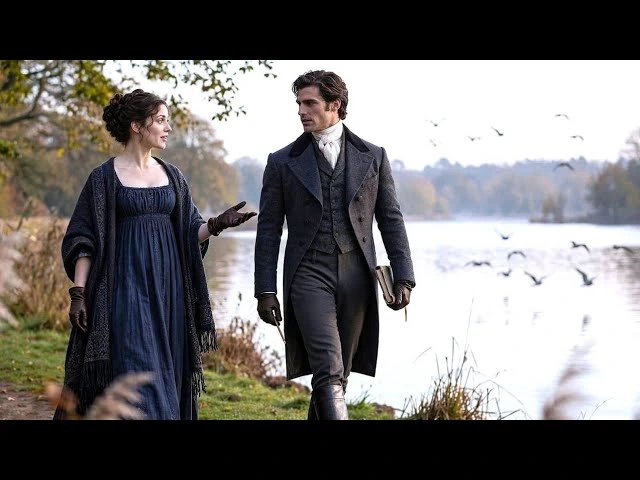
The morning fog lay thick over the valley, clinging to the towering grey stone and tall, narrow windows of Ashbourne Hall.
Inside the vast entrance hall, silence reigned as it had for ten long years.
The Duke of Ashbourne stood at the top of the grand staircase, his hand resting on the polished oak balustrade.
He was dressed entirely in dark tailored wool, his immaculate appearance contrasting sharply with the bleak, frozen demeanor he carried like heavy armor.
At thirty-four, he possessed the handsome, sharp features of his line, but his eyes were like winter frost, devoid of warmth or expectation.
He looked down at the entrance hall, where a heavy oak carriage trunk had just been set down by two panting footmen.
Beside the trunk stood a young woman, her simple traveling cloak showing signs of the dusty, two-day journey from the south.
“Is this the companion my aunt insisted upon engaging?”
The Duke’s voice cut through the cavernous space, smooth as ice and completely devoid of welcome.
He descended the stairs slowly, his boots clicking in a measured rhythm against the marble floor.
The butler, Mr. Jennings, stepped forward nervously, adjusting his cravat.
“Yes, Your Grace. This is Miss Eleanor Hart, sent by the agency in London to attend Lady Margaret.”
The Duke stopped three steps from the bottom, placing him slightly above the newcomer so he could look down at her.
“You are Miss Hart?”
“I am, Your Grace,” Eleanor replied, stepping forward into the morning light that filtered through the high stained-glass windows.
She did not curtsy with the frantic desperation typical of those meeting a Duke for the first time.
Instead, she offered a polite, measured nod, her clear blue eyes meeting his gaze directly without a trace of flinching.
The Duke folded his hands behind his back, his sharp eyes taking in her modest wool dress and the steady, calm posture she maintained.
“You will attend my aunt,” he said coldly, his tone leaving no room for discussion.
“She is old, frail, and prone to sudden melancholies. You will see to her comfort, read her the morning papers, and ensure her tea is taken at four.”
“You will remain in her wing of the house.”
“Nothing more.”
Eleanor raised an eyebrow, a slight, amused curve touching her lips.
“I assure you, Your Grace, I had no plans to attend you.”
A sharp gasp echoed across the hall.
Jennings froze where he stood, his hand lingering near his collar, while a housemaid carrying a brass tea tray stumbled, nearly dropping the heavy service onto the marble floor.
For ten years, no servant, tenant, or noble visitor had dared speak to the Duke of Ashbourne with anything less than trembling reverence.
The Duke stared at her, his dark brows drawing together in quiet astonishment.
For the first time in a decade, the impenetrable mask he wore showed a hairline fracture.
“Most people are remarkably careful with their words around me, Miss Hart,” he said, his voice dropping an octave, carrying a subtle threat.
“Perhaps most people do not know what to say to a man who greets them with a checklist of prohibitions,” Eleanor replied coolly.
“And you do?”
“No,” Eleanor said, folding her hands neatly over her satchel.
“I simply do not see why I should pretend to be frightened of a host who merely wishes to be left alone.”
The Duke stared at her for a long, drawn-out moment, the heavy silence stretches across the wide hall.
Then, unexpectedly, the corner of his firm mouth twitched slightly upward.
It was not a full smile, but it was the closest thing to human warmth Ashbourne Hall had witnessed in ten years.
“You are very bold, Miss Hart.”
“I am practical, Your Grace.”
“We shall see how long your practicality lasts in this house,” the Duke murmured, turning his back on her as he prepared to ascend the stairs once more.
“You will likely be gone within a week.”
Eleanor watched his retreating shoulders, her voice carrying up the sweeping stairwell with soft, unyielding clarity.
“Perhaps, Your Grace.”
“But you may find you are the one who asks me to stay.”
The Duke paused on the landing, let out a short, scoffing laugh that echoed hollowly against the high ceiling, and walked away without looking back.
He should never have laughed.
Ten years earlier, the Duke of Ashbourne had been an entirely different man.
As a young marquess before inheriting the duchy, Julian Ashbourne had been the vibrant heart of every room he entered.
He had loved the theatricality of London society, the thrill of riding across open fields with his younger brother, Thomas, and the warm, boisterous laughter that once filled the grand dining halls of his family’s ancestral estate.
He had believed implicitly in the future, convinced that wealth and status were merely background decorations to a life that would be rich with family, purpose, and genuine love.
Then, in a single horrific year, his entire world collapsed.
It began on a bitter November afternoon when Thomas, reckless and full of youthful spirit, took a jump over a stone wall during a hunt.
The horse stumbled, and Thomas broke his neck, dying instantly in the cold mud before Julian could reach him.
The grief crushed their father, the old Duke, whose heart gave out six months later under the weight of unbearable sorrow.
Inheriting the title at twenty-four, Julian turned to the woman he loved for comfort—a gentle baronet’s daughter to whom he had been secretly devoted for two years.
But when he sought her solace, he found only hesitation.
Unnerved by the sudden darkness that settled over him and terrified of a life bound to a grieving man, she quietly broke their engagement and married an Earl’s son within three months.
Three losses in less than twelve months had burned Julian’s youth to ash.
The lesson he drew from the agony was brutal, absolute, and permanent: love was a liability, affection was a weakness, and anyone allowed inside his heart would eventually be ripped away by death or betrayal.
To protect himself from ever feeling that shattering agony again, the Duke shut the heavy iron gates of Ashbourne Hall and locked his heart behind them.
He dismissed half the household staff, closed off three wings of the manor, stopped attending Parliament, and ignored every invitation that arrived from London.
Years turned into a decade, and society eventually learned to leave the “Ghost Duke” to his solitude.
He convinced himself that isolation was not merely a defense, but the only noble, sensible way to live.
He needed no one, expected nothing, and allowed no one close enough to matter.
Until Eleanor Hart arrived.
Eleanor had not sought out Ashbourne Hall out of a desire for adventure.
The daughter of a modest country vicar who had passed away two years prior, she had been forced to earn her own living as a companion to noble ladies.
She was neither wealthy nor titled, but her upbringing had given her a quiet, unshakable dignity and an uncanny ability to see through the artificial grandiosity of the aristocracy.
When she accepted the position to care for the Duke’s elderly, ailing aunt, Lady Margaret, she had expected to find a gloomy estate governed by rigid, oppressive decorum.
She had not expected to find a young, brilliant man voluntarily burying himself alive inside a tomb of his own making.
In the weeks that followed her arrival, the atmospheric weight of Ashbourne Hall began to shift in subtle, undeniable ways.
Eleanor did not conform to the quiet, ghostly routine of the house.
She opened the heavy velvet drapes in Lady Margaret’s sitting room, allowing bright, golden sunlight to flood rooms that had smelled of stale dust for years.
She sang softly in a clear, sweet voice as she helped the old woman with her embroidery near the garden terrace.
One morning, her melodic laugh echoed clearly across the quiet courtyard, causing three groundskeepers to stop their work in sheer astonishment.
She even ventured into the vast, dark kitchens, politely but firmly arguing with the crotchety old cook that the evening soup contained far too much salt and not nearly enough fresh parsley.
The Duke noticed every single change.
At first, he told himself he was thoroughly irritated by her intrusiveness.
He told Jennings that Miss Hart was taking entirely too many liberties with the household arrangements.
Yet, curiously, he did not order her termination.
Instead, he found himself inventing increasingly absurd excuses to leave his private study and walk through the very rooms where Eleanor happened to be working.
If she was dusting old volumes in the grand library, he suddenly discovered an urgent need to consult a dusty treatise on land management.
If she was taking fresh air on the stone terrace, he found it necessary to personally inspect the health of the climbing roses.
If she was sitting by the fire sharing tea with Lady Margaret, he would quietly enter, bow stiffly, and sit in a wingback chair nearby, pretending to read the morning broadsheet while hanging on every word that left her lips.
Eleanor observed his silent, brooding presence with silent amusement, but she said nothing to call him out.
Until a rainy Tuesday afternoon three weeks after her arrival.
The rain was beating rhythmically against the tall, diamond-paned windows of the library, filling the room with a cold, grey light.
The Duke stood by the high glass, a half-empty glass of brandy held loosely in his hand, staring out at the mist-shrouded lawns.
Eleanor entered carrying a freshly mended throw blanket for Lady Margaret, who was sleeping in the adjacent room.
She stopped when she saw him, observing the rigid line of his shoulders and the deep, dark shadows beneath his eyes.
“You are very unhappy, Your Grace,” she said softly, breaking the quiet patter of the rain.
The Duke did not turn around immediately, though his hand tightened slightly on the crystal glass.
“I am perfectly content, Miss Hart.”
“Contentment does not require a man to stare at a wet lawn as though he wishes the ground would swallow him,” she replied, setting the blanket over a velvet sofa.
The Duke turned around slowly, his dark eyes narrowing as he looked at her.
“You seem remarkably comfortable telling a Duke what he feels.”
“Someone ought to,” Eleanor said calmly, meeting his glare without stepping back.
“No one in this house speaks to you as a human being.”
“They speak to a title, a wallet, or a ghost.”
“I prefer to address the man.”
The Duke stared at her, feeling an unfamiliar warmth bloom in his chest, fighting against his instinct to push her away.
“You are extraordinarily bold.”
“And you are extraordinarily lonely.”
The word hit the room like a physical blow.
The Duke’s composure cracked completely.
The sharp, defensive mask vanished, replaced for a single, raw second by the profound, agonizing grief he had buried ten years ago.
His eyes darkened, and his jaw set in a hard line.
“Loneliness, Miss Hart,” he said, his voice dropping to a low, icy whisper that trembled with repressed emotion, “is far preferable to the agony of losing someone you love.”
In that single sentence, Eleanor understood everything.
The Duke of Ashbourne was not an arrogant, heartless aristocrat who considered himself above the rest of humanity.
He was a terrified, wounded soul who had convinced himself that distance was safety and that isolation was the only way to survive a cruel world.
He did not push people away because he hated them; he pushed them away because he was terrified that if he allowed himself to care, they would inevitably be ripped from his life.
Eleanor felt a deep, overwhelming wave of compassion wash over her heart.
She did not scold him, nor did she offer hollow, condescending platitudes.
Instead, she took two deliberate steps forward, closing the space between them until she was standing within arm’s reach of his towering frame.
“Then perhaps, Julian,” she whispered softly, using his Christian name for the very first time, “you should stop treating every goodbye as an absolute certainty.”
The Duke froze at the sound of his name on her lips.
He looked down into her clear, compassionate eyes, his breath hitching slightly in his throat.
For a long, motionless moment, neither of them spoke.
The heavy rain continued to drum against the glass, but inside the library, something fundamental had cracked wide open.
Something changed inside the Duke that afternoon.
The thick, impenetrable walls he had spent ten long years building began to crumble, brick by brick.
He began allowing himself to step out of the dark shadow of his past.
He started taking his evening meals downstairs in the grand dining room with Lady Margaret and Eleanor, replacing the grim silence of his private study with quiet, thoughtful conversation.
He joined Eleanor on long morning walks through the vast, wild gardens of the estate, listening intently as she spoke about her simple childhood in her father’s country vicarage.
He found himself captivated by her practical wisdom, her sharp humor, and the unpretentious warmth she brought into every room she entered.
Slowly, hesitatingly, the Duke began to offer pieces of himself in return.
He spoke to her about his childhood spent roaming the hills of the estate.
He spoke of Thomas, remembering for the first time in ten years not just the bloody horror of his death, but the joyous, booming sound of his laughter.
He told her about his father’s fierce pride, and the crushing betrayal of the woman who had abandoned him when his world fell apart.
He confessed the deep, secret shame he had carried for a decade—the shame of believing he was cursed to bring misfortune to anyone he dared to care about.
“I thought if I kept my heart behind locked doors, no one else would have to suffer for being near me,” he confessed one evening as they sat near the hearth in the drawing room.
“You were not protecting others, Julian,” Eleanor said gently, her fingers gently hovering near his hand on the velvet armrest.
“You were merely hiding from life.”
“Perhaps,” he murmured, his dark eyes locking onto hers with an intensity that made her breath catch.
“But I did not know there was anything left in this world worth coming out of hiding for.”
A week later, a violent winter thunderstorm battered the estate, howling through the stone chimneys and rattling the heavy oak window frames.
Eleanor, unable to sleep amidst the roaring wind, walked down to the library to fetch a book.
She found the room lit only by the dying embers of the hearth fire.
The Duke was standing before the large fireplace, staring up at a gilded portrait of a handsome, dark-haired youth in a riding coat.
“You still miss him terribly,” Eleanor said quietly, stepping onto the thick rug.
The Duke did not jump at her voice.
He simply nodded, his eyes fixed on his late brother’s image.
“Every single day.”
“Then do not hide your tears from the dark, Julian,” she said softly, stopping beside him.
“It is not a crime to miss someone you loved.”
The Duke turned to look at her, the firelight casting soft, golden shadows across his striking profile.
“You make everything sound so remarkably simple, Eleanor.”
“No,” Eleanor said, raising her eyes to meet his.
“I simply believe that pain becomes an impossible burden when you insist on carrying it alone.”
The Duke stepped closer to her, his shadow falling over her small frame.
The distance between them evaporated, leaving only the sound of their quiet breathing above the roaring wind outside.
“And what if I no longer wish to carry anything alone?” he asked, his voice raw, deep, and thick with unspoken desire.
“What if I want you to carry it with me?”
Eleanor’s heart skipped a violent beat.
She parted her lips to answer, her soul reaching out toward the vulnerability in his dark eyes.
But before she could speak the words burning in her throat, the Duke suddenly drew back, his posture stiffening as panic flared in his expression.
He had exposed too much.
He had let the wall fall too far, and the instinctual, deeply ingrained fear of loss slammed back into him like a cold wave.
“Forgive me,” he said abruptly, turning his face toward the fire.
“It is late. You should return to your chambers.”
Eleanor looked at his tense back, understanding the sudden retreat for what it was—not a rejection of her, but a desperate, final flinch of a man terrified of his own rising hope.
She did not force the issue that night.
She offered a gentle, quiet goodnight and returned to her room.
Fate, however, was about to test the fragile bridge they had built between their hearts.
The very next morning, a breathless courier arrived at Ashbourne Hall carrying an urgent, mud-stained letter from Yorkshire.
Eleanor opened it in the morning room, her face paling as she read the hurried script of her cousin.
Her elderly aunt, her only remaining living relative who had raised her after her father’s death, had fallen dangerously ill with lung fever.
The local apothecary feared she would not survive the fortnight.
Eleanor did not hesitate.
She immediately requested the housekeeper’s aid in packing her modest trunk, intending to take the afternoon stagecoach north.
She planned to be away for several weeks, perhaps longer, depending on her aunt’s recovery.
She sought to inform the Duke privately, but he was away inspecting a damaged timber mill on the northern edge of the estate.
When the Duke finally returned to the hall late that afternoon, cold, wet, and tired from his ride through the damp woods, he stepped into the entrance hall expecting the quiet, comforting warmth that had filled the house for the past two months.
Instead, he stopped dead in his tracks.
Standing near the main doors was Eleanor’s leather trunk, fully packed and strapped tight.
Eleanor herself stood near the cloak rack, carefully pulling on her thick woolen traveling gloves.
A cold, suffocating dread, far worse than any winter storm, instantly seized the Duke’s chest.
His blood ran cold, his breath locking tightly in his throat.
“What is the meaning of this?” his voice came out harsher than he intended, echoing violently against the marble walls.
“You are leaving?”
Eleanor turned around, her eyes soft with concern when she saw the pale, desperate look on his face.
“Yes, Julian. I must.”
“For how long?” he demanded, taking three rapid, aggressive steps toward her.
“I do not know,” Eleanor replied softly.
“A month, perhaps two. It depends entirely on my aunt’s health.”
The Duke stared at her, his mind reeling back into the dark, terrifying place it had inhabited for ten years.
The old, agonizing script played instantly in his mind: She is leaving. Everyone leaves. You were a fool to believe otherwise.
“You did not tell me,” he said, his voice rising in panic.
“I returned to find your luggage packed as though you were a thief slipping out in the night!”
“I left a letter in your study, Julian,” Eleanor explained gently, stepping toward him.
“I did not wish to disturb your work, and the carriage leaves from the village in less than an hour.”
“I thought… I assumed you preferred your solitude.”
The Duke stood frozen, his chest heaving as he fought for breath.
He had no answer to her words.
He had spent ten years preaching the virtues of solitude to anyone who would listen, yet now, the mere sight of her traveling trunk felt like a blade being driven directly into his heart.
Eleanor reached for her satchel, her expression clouded with sadness.
“I will return if Lady Margaret still requires my companionship when my aunt recovers,” she said softly.
“That is not what I am asking!” the Duke snapped, his voice echoing loudly off the high ceiling.
Eleanor paused, her hand hovering over her bag.
She looked up into his eyes, her gaze clear, searching, and entirely calm.
“What are you asking, Julian?”
The Duke’s voice dropped, stripped of all aristocratic authority, leaving only raw, exposed vulnerability.
“How long will you be gone?”
Eleanor offered a faint, melancholy smile.
“Why does it matter so much to you?”
The question hung in the vast hall, heavy and demanding.
The Duke of Ashbourne—a man who had faced political ruin, massive estate crises, financial pressure, and ten agonizing years of isolated grief without ever bowing his head or showing weakness—suddenly found himself utterly paralyzed.
He could not speak.
The three simple words that were clawing at his throat threatened to tear through his remaining pride.
Don’t leave me.
He squeezed his eyes shut, his fists clenching tightly at his sides.
Eleanor waited for a long, silent moment.
When no answer came, she let out a quiet, resigned sigh and turned slowly toward the heavy double doors where the footman stood waiting with her coat.
She reached for the brass door handle.
As the cold latch clicked beneath her fingers, something inside the Duke broke completely.
The realization hit him with the force of a thunderbolt.
Solitude had never been a shield.
It had never protected him from pain.
It had merely been a coward’s surrender—a slow, miserable death that made him accustomed to losing people before they even had the chance to leave him.
Isolation was not strength; it was an empty, frozen tomb.
And the woman holding the door handle was the only light he had seen in ten agonizing years.
“Eleanor!”
The command tore from his throat, raw and desperate.
Eleanor stopped, her hand lingering on the brass handle.
She turned around slowly to face him.
The Duke discarded every shred of his pride, his rank, and his long-cherished defenses.
He walked rapidly across the grand marble hall, stopping only when he was standing directly in front of her, his tall frame trembling slightly.
“I spent ten years convincing myself that if I never allowed anyone close, I could never be hurt again,” he said, his voice shaking with an emotion he no longer tried to hide.
Eleanor remained silent, watching the dark intensity in his eyes.
“I thought living like a ghost was the only way to survive,” he continued, taking a shaky breath.
“I thought this house was meant to be a tomb.”
“But you walked through those doors, and you opened the curtains.”
“You laughed in the garden, you argued with the cook, you spoke to me as if I were a man worth saving, and you made this terrible, hollow place feel like a home.”
Tears welled in Eleanor’s clear blue eyes, shining softly under the hall’s chandeliers.
“And now you are packing your trunk,” Julian said, his eyes locking onto hers with terrifying honesty.
“And for the first time in ten agonizing years, I am terrified.”
“Afraid of what, Julian?” she whispered softly.
“I am afraid that I have finally found the one person in this world worth keeping,” he said, his voice breaking on the final word, “only to lose her the moment I realize how much I love her.”
Eleanor took a soft, hitching breath.
She stepped away from the door, closing the remaining distance between them, and looked up into his handsome, tormented face.
“You do not get to keep people, Your Grace,” she said softly, a tender smile breaking through her tears.
“I know,” Julian swallowed hard, his throat tight.
“You can only ask them to stay.”
A deep, trembling silence descended over the vast hall.
Julian looked at her, his dark eyes wide with an unspoken, desperate plea.
“Then I am asking you,” he whispered, his hands hovering near her arms, afraid to touch her without permission.
“Please. Do not leave me.”
Eleanor looked at him for a long, quiet moment, letting the weight of his confession settle between them.
Then, she raised her hand and gently placed her soft palm against his cold, sharp cheek.
“I was never planning to stay forever when I first came here, Julian,” she said softly.
Julian’s face fell instantly, a fresh wave of despair washing over his features.
Eleanor smiled gently, her thumb caressing his cheekbone.
“But I was never planning to leave forever, either.”
“My aunt is ill, and I must care for her in Yorkshire for a few weeks.”
“But I will come back to you.”
“I will always come back to you.”
For the first time in ten long, dark years, the Duke of Ashbourne laughed.
It was not the short, dismissive scoff he had offered on her first morning at the estate.
It was a real, deep, booming laugh—warm, utterly relieved, and vibrant with life.
He reached out and gathered her into his broad arms, pulling her tightly against his chest as if holding onto life itself.
Eleanor wrapped her arms around his neck, burying her face into the warm wool of his coat as he held her close.
“Perhaps solitude was never what you truly wanted, my lord,” she murmured against his shoulder.
Julian pulled back slightly, framing her face with his warm hands, looking down at her with an expression of profound, unshakeable devotion.
“No,” he whispered softly, leaning down to press a gentle, reverent kiss against her lips.
“I think I was simply waiting for the woman who made leaving impossible.”
Months passed, and the bitter winter gradually gave way to a radiant, golden spring.
Ashbourne Hall was no longer known throughout the county as the gloomy, silent estate of the Ghost Duke.
The high iron gates stood open wide, welcoming guests, neighbors, and long-lost friends back to the estate.
Music drifted through the open windows of the ballroom on warm evenings as Lady Margaret, her health remarkably restored, hosted lively dinners and tea parties once more.
The Duke still loved his quiet mornings.
He still enjoyed long, solitary rides through the green hills of his estate, and he still needed moments of quiet contemplation in his vast library.
But he no longer confused isolation with peace, nor did he mistake solitude for safety.
Because every single evening, when the sun began to set over the rolling valley, there was one person waiting for him on the stone terrace.
Whenever Eleanor teased him about the cold, brooding man he used to be when she first arrived with her leather trunk, the Duke would simply pull her close, wrap his arms around her waist, and smile into her hair.
“I spent ten long years learning how to live entirely alone,” he would say softly, kissing her temple.
“And then one extraordinary woman came along and taught me why I never want to live that way again.”
(Descargo de responsabilidad: Este contenido puede haber sido generado por IA con fines de entretenimiento. Cualquier parecido con personas, eventos o lugares reales es pura coincidencia.)