THE MAN SHE LOVED PROPOSED TO HER SISTER — BUT THE DUKE HAD ALREADY CHOSEN HER
PART 2 — THE WOMAN HE CHOSE
Ten days earlier, Ashkam Park had been overflowing with flowers, silver, wealthy guests, and carefully disguised desperation.
Sir Reginald Harkort owed twenty-eight thousand pounds, and with a major payment due within weeks, he had transformed his estate into a twelve-day house party designed less for pleasure than for securing advantageous marriages for his daughters.
Levvenia received elegant new gowns.
Cesily received dancing lessons.
Beatatrice received the household accounts.
At twenty-two, Beatatrice had learned that in her father’s house, usefulness was rarely rewarded with affection, but she still worked tirelessly to protect the estate servants and tenants from decisions made by men who cared more about appearances than consequences.
She reduced wasteful food orders, protected servants whose wages were already late, and discovered that the income from her late mother’s trust had mysteriously disappeared into the family accounts.
When the elderly clerk, Mr. Finch, pointed out the discrepancy, Sir Reginald dismissed him immediately.
“Keep your own copies safe, Miss Harkort,” Finch whispered before leaving.
Beatatrice did not yet understand how important those words would become.
That same evening, Thomas Bellamy arrived at Ashkam.
He was wealthy now, having inherited his uncle’s fortune only six months earlier, but he still treated Beatatrice with the familiar warmth that had once made her believe she might secretly occupy a special place in his heart.
“You have ink on your finger,” he teased.
“A grave social offense.”
“One of your lesser crimes.”
She smiled despite herself.
Then Thomas looked across the entrance hall toward Levvenia.
“What flowers does your sister favor?”
The answer should have warned her.
“White roses,” Beatatrice said quietly. “Not violets, unless white roses are unavailable.”
Thomas smiled.
“You remember everything.”
She mistook the tenderness in his voice for affection.
An hour later, Julian Wickliffe, Duke of Rothmir, arrived.
Unlike the other gentlemen, Julian had not come to Ashkam searching for a bride. He needed an easement for a drainage channel on land bordering the Harkort estate, and Sir Reginald immediately treated his practical business as an opportunity to arrange a marriage.
At dinner, Levvenia was seated beside Julian.
Beatatrice was placed halfway down the table beside a deaf colonel.
Yet when a young footman accidentally transposed two place cards, Sir Reginald’s anger fell upon the servant.
“I arranged it,” Beatatrice said.
Julian looked directly at her.
“Was the error yours, Miss Harkort?”
“No.”
“Then why claim it?”
“The table is correct now, Your Grace.”
His eyes briefly moved toward the frightened footman.
Then he inclined his head.
He had noticed.
Later that night, Beatatrice was working alone in the estate office when Julian entered carrying a lamp. He examined the accounts and the drainage survey she had been studying.
“You believe the proposed channel is wrong.”
“I know it is wrong.”
He raised an eyebrow.
She explained the terrain, the clay depth, the water flow, and the cottages that would flood if the engineer’s plan were followed.
Julian challenged every point.
She answered every question.
By the end of the conversation, he was no longer looking at her as Sir Reginald’s youngest daughter.
He was looking at her as an equal.
“I intend to inspect the land tomorrow,” he said. “I would like you present.”
“My father may object.”
“Then he may explain why he values my agreement less than your absence.”
The following morning, they rode together along the eastern boundary.
There they found Mrs. Ren, a tenant widow facing eviction over a debt that Beatatrice knew was false.
She examined the records, questioned the steward, reconstructed the account, and discovered that the widow’s son had already worked enough hours to reduce the supposed debt considerably.
Julian watched her carefully.
“Would you have the steward dismissed?”
Beatatrice hesitated.
“That would not correct Mrs. Ren’s account. Cancel the eviction, enter the labor credit, and divide the remaining balance across three payments.”
“You prefer repayment to charity?”
“I prefer that she retain both her home and her dignity.”
Julian said nothing.
But something changed in him that day.
He had spent years meeting women who had been trained to become beautiful ornaments beside powerful men. Beatatrice had not tried to impress him.
She had protected someone who could offer her nothing.
She had chosen seed grain over silver.
She had defended truth without turning another person’s suffering into an opportunity for revenge.
That afternoon, Julian summoned his solicitor.
“I require draft terms for a courtship settlement.”
“Whom shall I name?”
“Miss Beatatrice Harkort.”
The settlement would protect her maternal trust, guarantee her independent income, prevent her correspondence from being controlled, and explicitly exclude her father’s debts.
Julian had already decided.
Beatatrice simply did not know.
Then came the final ball.
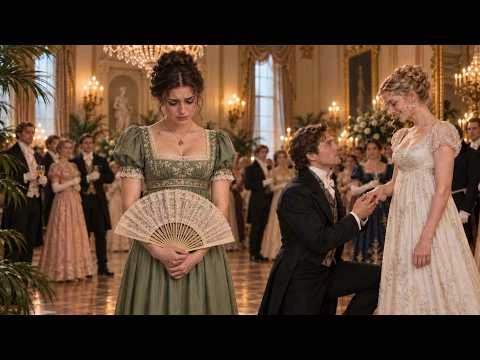
Thomas found her in a quiet corner and asked whether she intended to dance the supper set. His voice was warm, and for one foolish moment, hope returned.
Before she could answer, Sir Reginald called Thomas across the ballroom.
Levvenia stood beneath the chandeliers in white silk.
Thomas crossed the room.
Then he knelt.
Beatatrice understood everything.
She had never been the destination of his attention.
She had been the quiet place where he gathered confidence before approaching someone he considered more advantageous.
She left without haste because she refused to give anyone the spectacle of her heartbreak.
In the dark library, Julian found her.
“You should not be alone,” he said.
“Then you should leave.”
He remained by the door.
“I did not come to offer pity.”
“Fortunately. I would not know where to put it.”
He did not approach her.
“You are not required to perform grace in private,” he said quietly.
Those words nearly broke the control she had fought to maintain.
The next morning, Julian went directly to Sir Reginald.
“I have not come to discuss Lady Cesily.”
Sir Reginald looked surprised.
“Then whom have you come for?”
“Miss Beatatrice.”
The room fell silent.
“I wish to ask permission to court her, if she wishes to receive me.”
Sir Reginald laughed.
“She is unpolished, impractical, and nearly penniless.”
Julian’s expression remained unchanged.
“She prevented your dinner from failing, corrected your drainage survey, and reconstructed a fraudulent tenant account while your steward attempted to evict a widow.”
Then he added the words that made Sir Reginald’s smile disappear.
“As for her finances, that is a matter for her solicitor.”
“My solicitor,” Sir Reginald snapped.
“No.”
Beatatrice was summoned.
She entered expecting another accusation.
Instead, she found the Duke standing beside the window.
“I have asked whether I may court you,” Julian said.
Her heart pounded.
Yesterday she had watched Thomas choose Levvenia.
Today a duke was asking for her.
She could not tell whether she was being valued or merely rescued.
“Why?”
“Because I value your judgment, because I respect your conduct, and because I wish to know you better.”
Sir Reginald interrupted.
“Beatatrice, you will accept.”
Julian turned toward him.
“She will do nothing of the kind unless she chooses it.”
For the first time in her life, Beatatrice heard a powerful man defend her right to say no.
“I choose to ask for time,” she said.
Julian bowed.
“You shall have it.”
Sir Reginald did not forgive either of them.
He confiscated Beatatrice’s correspondence, threatened the servants who helped her, and demanded that she sign a letter refusing Julian unless the Duke agreed to assume the family’s mortgage.
Beatatrice refused.
Then Thomas appeared.
He told her she should accept Rothmir’s offer because a duke capable of saving her family was not a man one refused.
Beatatrice stared at him.
“You took my thoughts to court Levvenia,” she said. “Now you bring my father’s calculations to court me on another man’s behalf.”
Thomas had no answer.
Two days later, Beatatrice’s aunt Agnes arrived with Julian’s solicitor.
They confronted Sir Reginald with evidence that Beatatrice’s trust income had been diverted into the family accounts.
Her dependence had been manufactured.
Julian gave her a choice.
“You may leave with your aunt. Her London home is open to you. Your trust can be restored through the court.”
Sir Reginald demanded to know what Julian wanted in exchange.
“Nothing.”
Julian looked only at Beatatrice.
“You do not owe me marriage because I protect your freedom.”
Beatatrice left Ashkam with Agnes.
Three days later, she wrote to Julian.
“I am willing to receive you, provided you understand that gratitude is not consent, and protection is not courtship.”
His reply arrived that afternoon.
“Agreed.”
For six weeks, Julian courted her without jewels or theatrical declarations.
He brought estate accounts.
He answered difficult questions.
He allowed her to investigate his finances.
And when she discovered that Rothmir itself was dangerously close to financial collapse, he did not hide the truth.
“My father believed grandeur could be preserved by borrowing against the future,” he told her. “For three years I have been trying to prevent the future from presenting its account.”
Beatatrice studied him.
“You could have concealed this.”
“I could also conceal rot beneath new boards. It would remain rot.”
When Julian finally proposed, the settlement placed her independence in writing.
Her trust would remain hers.
Her correspondence could not be withheld.
She would receive her own income.
She would have a formal right to advise on estate matters.
And none of Sir Reginald’s debts would become hers.
Beatatrice accepted.
Their wedding was quiet.
But Rothmir Abbey was not the grand, prosperous estate everyone imagined.
Its roofs leaked.
Its granaries were depleted.
Its mill was failing.
Its tenants were waiting for repairs.
And the moment Beatatrice arrived, she understood that becoming a duchess had not removed responsibility from her life.
It had multiplied it.
At her first estate council, she discovered suspicious invoices, missing grain, and repeated repair payments for machinery that was supposedly still broken.
The factor, Sloan, smiled politely.
“A difficult harvest, Your Grace.”
Beatatrice opened another ledger.
“The reported grain loss exceeds the weather damage.”
Silence.
She inspected the granaries herself.
She found evidence that good grain had been removed at night and discovered that the same broken mill wheel had been invoiced repeatedly as though it had been repaired several times.
Within weeks, Sloan’s fraud was exposed.
Beatatrice then made decisions that shocked Rothmir society.
The racing stable was sold.
The extravagant conservatory project was suspended.
Wasteful spending was cut.
Seed grain was protected.
Workers were paid.
Tenant agreements became transparent.
Julian never treated her as an ornamental duchess.
At council meetings, he placed the accounts in front of her and asked the same question again and again.
“What is your judgment?”
Their marriage became a partnership built not on rescue, but on responsibility.
Then Sir Reginald struck again.
A banker arrived with a document claiming that Beatatrice had guaranteed her father’s debts and that Julian had agreed to make Rothmir responsible for the Ashkam mortgage.
The document contained Beatatrice’s handwriting.
It contained Julian’s supposed endorsement.
And if it were accepted, Rothmir’s financial recovery could collapse.
Beatatrice studied the paper.
Something was wrong.
The figures had been copied from her old accounts.
Her small blue verification crosses appeared beside them.
And then she noticed a phrase.
“Seed before silver.”
“That is wrong,” she whispered.
Julian leaned closer.
“That phrase meant protecting productive resources from waste. Whoever wrote this copied my records without understanding them.”
Mr. Finch was summoned.
Agnes brought duplicate ledgers.
The investigation began.
Then the rain came.
For three days, the river rose.
On the fourth night, a messenger arrived at Rothmir Abbey.
“The lower bank is failing.”
Julian immediately reached for his coat.
Beatatrice followed.
The river was already flooding the meadow.
The weakened weir groaned under the pressure, and dozens of tenant families were trapped below.
“Open the north granary for shelter,” Beatatrice ordered. “Evacuate by the ridge track. The lower road will flood first.”
Julian led the workers toward the failing bank.
A section of the structure suddenly tore apart.
“Back!” he shouted.
A broken timber struck him across the shoulder and threw him to his knees.
Beatatrice almost ran to him, but she forced herself to continue directing the evacuation.
Only when every household was accounted for did she return to the infirmary.
Julian was conscious.
“You should have left the bank,” she whispered.
“So should you.”
“I was directing the evacuation.”
“I was directing the reinforcement.”
“You were standing where trees were flying.”
A faint smile crossed his face.
“A tactical imperfection.”
Later that night, while rain struck the windows, Julian finally told her the truth about himself.
His mother had been chosen for her dowry.
His father had treated affection as a debt.
Julian had spent his life believing that love was simply another bargain whose hidden price appeared after the contract was signed.
Beatatrice took his uninjured hand.
“You can be alone even inside a marriage.”
He looked at her.
“I know.”
“Then stop choosing it.”
His fingers closed around hers.
Their first kiss was gentle, uncertain, and entirely chosen.
It was not a grand declaration.
It was the first crack in the armor he had worn for years.
At dawn, Agnes arrived with Beatatrice’s duplicate ledgers.
Mr. Finch came with her.
The evidence was finally complete.
Four days later, the formal examination began.
Bankers, trustees, solicitors, and members of both families gathered around Rothmir’s council table.
Beatatrice placed the alleged memorandum before them.
“This document is false.”
Sir Reginald scoffed.
“You recognize your own handwriting.”
“I recognize an imitation.”
She produced the paper records proving that the watermark belonged to stationery purchased weeks after her wedding.
Then she opened her original ledger.
“The small blue crosses indicate entries I personally verified. The forger copied them without understanding their meaning.”
Mr. Finch stepped forward.
“Sir Reginald instructed me to prepare practice copies of Miss Harkort’s handwriting.”
The room became silent.
Sir Reginald turned pale.
Then Thomas placed another packet of letters on the table.
They revealed that Sir Reginald had viewed his daughters as financial routes to different fortunes.
Levvenia read the letters in silence.
Then she removed Thomas’s engagement ring.
“I will not complete a bargain arranged between two frightened men.”
She placed the ring on the table.
By noon, the fraudulent claim had collapsed.
Rothmir’s credit was restored.
Ashkam was placed under controlled receivership.
Sir Reginald surrendered management and signed a confession.
His debts remained his responsibility.
Later, Thomas found Beatatrice alone.
“I owe you an apology.”
“You owe several people honesty.”
He admitted that he had cared for her privately but had chosen Levvenia because he believed ambition and affection could be separated.
Beatatrice listened.
“I hope you become better than the choice you made,” she said. “But I no longer require your regret.”
When he left, she did not watch him go.
Days later, Beatatrice returned the marriage papers to Julian’s study.
As she arranged them, an older draft slipped from beneath the settlement.
Her breath stopped.
The date was from the morning before the Ashkam ball.
Before Thomas proposed to Levvenia.
Before Julian found her in the library.
At the top of the page were the words:
Miss Beatatrice Harkort.
Julian entered the room.
He saw the paper in her hands.
“You had already decided.”
“Yes.”
“Why didn’t you tell me?”
“Because after Bellamy’s proposal, that knowledge could have become a weapon. I would not use your heartbreak to make you accept me.”
She looked at him.
“When did you decide?”
“After Mrs. Ren.”
His voice softened.
“Because you corrected an account. Because you protected a vulnerable woman without using her suffering to punish your father. Because you chose truth over display. Seed over silver. And because you disagreed with me when agreement would have been easier.”
He stepped closer.
“I loved those things before I understood that what I felt was love.”
Beatatrice’s eyes filled with tears.
Julian stopped before touching her.
“If there were no debt, no scandal, no rescue, no title, and no necessity, would you still choose this life with me?”
Beatatrice thought of the woman she had once been, hiding behind winter palms while another woman received the applause she had secretly dreamed of.
She finally understood.
Being noticed was not the greatest gift love could offer.
Being trusted was.
“You did more than see me,” she whispered. “You trusted me with weight.”
Julian’s composure finally broke.
“And in carrying it beside you,” she continued, “I came to love you.”
He reached for her hand.
No chandeliers witnessed their renewed vows.
No guests applauded.
There was only the dated paper between them, his hands around hers, and two people choosing the same marriage again after every bargain had been stripped away.
“I choose you,” Julian whispered.
Beatatrice smiled through her tears.
“And I choose you.”
Two years later, Rothmir was transformed.
The repaired weir powered a profitable mill.
The granaries held secure reserves.
Tenant repayments were transparent and flexible.
The most dangerous bank obligation had been retired.
At council meetings, Julian and Beatatrice sat side by side, disagreed openly, and divided responsibility according to skill rather than title.
Ashkam survived in reduced form under receivership, while Levvenia and Cesily finally learned to manage their own lives without their father’s control.
Beatatrice never sought revenge against Sir Reginald.
She no longer needed it.
His choices had already built the walls around his own life.
At Rothmir’s harvest gathering, music filled the restored great hall.
Tall palms stood beside the windows.
Beatatrice paused beside them.
For one brief moment, she remembered another ballroom, another wall of leaves, and the young woman who had hidden behind them while applause celebrated someone else’s choice.
Then Julian crossed the room.
He did not summon her.
He did not present her.
He simply came to stand beside her.
Before tenants, servants, trustees, and family, he held out his hand.
“What is your judgment, Your Grace?”
Beatatrice smiled.
“On dancing?”
“On sharing the burden.”
She placed her hand in his.
This time, when the room applauded, the sound did not pass through her as though she were invisible.
It rose for the work she had done, the trust she had earned, and the marriage they had built together.
Not upon rescue.
Not upon beauty.
Not upon debt.
But upon the daily courage of being truly known.
Because sometimes the person who breaks your heart is not the person who was meant to keep it.
Sometimes the greatest love story begins when you finally stop asking why someone failed to choose you—and discover that another person has been quietly choosing you all along.
And sometimes, the woman standing unnoticed behind the palms is the very woman a Duke has already decided to make his Duchess.
(Descargo de responsabilidad: Este contenido puede haber sido generado por IA con fines de entretenimiento. Cualquier parecido con personas, eventos o lugares reales es pura coincidencia.)