THE COWBOY WHO BOUGHT HER FREEDOM — BUT BY DAWN, SHE CARRIED HIS NAME
THE COWBOY WHO BOUGHT HER FREEDOM — BUT BY DAWN, SHE CARRIED HIS NAME
PART 1 — THE AUCTION THAT CHANGED EVERYTHING
Jeremiah Stone had ridden into Cinder Creek that morning for salt, nails, fence wire, and enough feed to carry his ranch through winter, with no intention of changing his life before sundown.
Then he heard the auctioneer.
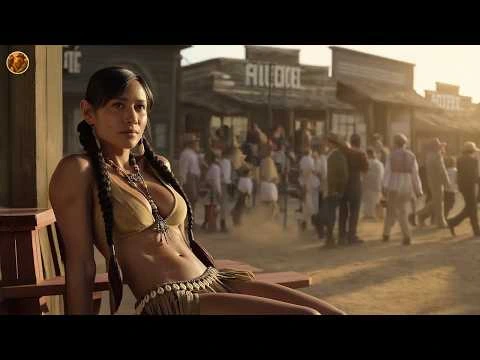
Behind the mercantile, a wooden platform stood in the cold, surrounded by men whose eyes followed the young Apache woman standing beneath them. Her name was not written on the bill of sale. To them, she was only another price to be called aloud.
Ela kept her back straight despite the torn buckskin dress, the rope burns around her wrists, and the humiliation burning beneath her skin. She had learned one thing during the long ride into town: if they could take her freedom, they would still have to fight to take her dignity.
Jeremiah watched her for less than a minute before something inside him settled.
He raised his hand.
The bidding climbed, but Jeremiah answered every offer until the yard fell silent. When the hammer finally dropped, the clerk handed him a bill of sale.
Jeremiah looked at the paper.
Then, without a word, he tore it cleanly in half.
“You owe me nothing,” he said quietly. “Not coin, not work, not company.”
Ela stared at him, uncertain whether this was another trap.
Jeremiah turned toward the road.
“Come with me only if you choose to.”
For the first time that morning, Ela saw a door that might actually open.
But before she could take another step, a man from the auction pushed through the crowd and reached for her arm.
And Jeremiah realized the auction was not over yet.
What would you have done in Ela’s place when the only man offering freedom might still have been another kind of danger?
#WildWest #WesternRomance #CowboyStory #HistoricalFiction #LoveStory #FrontierStories #CowboyRomance #StoryTime #WesternStories #EmotionalStory
PART 2 — THE ROAD HOME
The man stopped when Sheriff Silas stepped forward, but Jeremiah did not wait for another argument. He led his horse toward the hitching rail, untied a spare mare, and left enough distance between himself and Ela that she could decide whether to follow.
She followed.
Not because she trusted him yet, but because she trusted herself enough to recognize an opportunity.
The road away from Cinder Creek was silent at first. Jeremiah rode half a length ahead, watching the horizon while Ela studied every movement he made. She noticed the rifle resting in its scabbard, the revolver at his hip, the old scar across his knuckles, and the careful way he never reached toward her without warning.
At a frozen creek, he stopped.
“Let me see your wrists.”
Ela hesitated, then held them out.
He treated the rope burns without touching anything beyond what was necessary, gave her his coat, and offered food and water before asking a single question about where she had come from.
Finally, Ela asked, “Where will I sleep?”
“North room,” he answered. “The door locks from inside.”
That answer stayed with her.
When the ranch finally appeared beyond the cottonwoods, Jeremiah pointed toward the small house and said, “You can leave tomorrow if you want. I’ll take you to the stage road myself.”
Ela looked at the house, then at the open land behind them.
She had expected another cage.
Instead, she had found a door.
That night, however, she discovered something that made her question everything again: Jeremiah kept an old ledger beneath the table, and on its final page was a name she recognized.
Her own.
Why had Jeremiah written Ela’s name before she ever agreed to stay, and what secret was waiting inside that ledger?
PART 3 — THE NAME SHE CHOSE
Ela stood beside the table with one hand resting on the old ledger, while the fire settled behind her and sent a low orange glow across the kitchen. For several seconds, neither she nor Jeremiah spoke.
The house was quiet enough that she could hear the wind moving through the cottonwoods outside.
She opened the ledger.
There were pages filled with ordinary things: feed purchased in October, nails bought in town, repairs to the north fence, taxes owed, seed reserved for spring, and the names of men Jeremiah had paid for work during previous seasons.
Then she reached the final page.
Her name was there.
Ela.
Nothing more.
No price.
No debt.
No description.
No claim.
Just her name.
She looked at Jeremiah.
“You wrote this before I told you my name.”
Jeremiah’s expression changed.
Only slightly.
“I wrote what the clerk refused to write.”
Ela turned the page toward him.
“Why?”
“Because you were still a person even when everyone in that yard decided you weren’t.”
The words landed harder than she expected.
She closed the ledger.
For the first time since she had arrived in Cinder Creek, Ela allowed herself to sit without watching the door.
Jeremiah remained near the stove, giving her the same distance he had given her since the moment they left the auction. He did not ask what she had decided. He did not remind her that he had spent nearly all the money he had saved for winter. He did not mention the men who might come looking for her.
That silence mattered.
Ela had spent enough time around men who demanded answers before she had time to breathe.
Jeremiah was different.
He waited.
Finally, she said, “I want to know what happens tomorrow.”
“Tomorrow is yours.”
“And the day after?”
“Yours too.”
She studied him carefully.
“And if I stay?”
“Then you stay because you choose it.”
“And if I leave?”
“I saddle the mare.”
The answer was immediate.
No hesitation.
No hidden condition.
No bargain.
Ela looked toward the window. Beyond the glass, the darkness stretched across the ranch, and somewhere beyond those hills was a world that had already decided what she was supposed to be.
Here, for the first time, nobody was deciding for her.
She slept that night with the door unlocked.
Jeremiah kept his word.
He slept in his own room with his door open, just as he had promised, and when the house became silent, the only sounds were the stove ticking, the dog shifting beside the hearth, and the wind brushing against the roof.
At dawn, Ela woke before the sun.
She dressed in the clean shirt Jeremiah had given her, braided her hair, and stepped outside.
Jeremiah was already repairing the broken rail.
The ranch looked different in morning light.
Smaller than it had seemed the night before.
But warmer.
Ela walked toward him.
“That post is going to fall again,” she said.
Jeremiah looked over his shoulder.
“You think so?”
“I know so.”
He handed her the hammer.
“Then show me.”
It was a simple thing.
A hammer.
A post.
A broken fence.
Yet Ela understood what it meant.
He was not giving her work because she owed him.
He was giving her a place beside him because she had chosen to stand there.
Together they repaired the rail.
Neither spoke much.
They did not need to.
By midmorning, a wagon appeared on the distant road.
Jeremiah straightened.
Ela stopped working.
The wagon came closer.
Two riders followed it.
One wore the badge of a deputy.
The other was the ranch hand who had followed them from Cinder Creek.
Jeremiah lowered the hammer.
“Go inside,” he said.
Ela shook her head.
“No.”
His eyes moved toward her.
“They came for me.”
“I know.”
“Then I’m staying here.”
Jeremiah studied her for a moment before nodding.
They waited together at the fence.
The deputy climbed down first.
“I’ve got questions,” he said.
“You can ask them.”
The deputy unfolded a paper.
“This woman was purchased yesterday.”
Jeremiah looked at the document.
Then at Ela.
Then back at the deputy.
“She wasn’t purchased.”
The ranch hand laughed.
“I saw the sale myself.”
“So did I.”
“You paid for her.”
“I paid the clerk.”
“For her.”
“No.”
Jeremiah’s voice remained calm.
“I paid to end the sale.”
The deputy frowned.
“That isn’t how the law works.”
Jeremiah reached into his coat and produced another paper.
“This is the receipt from the clerk. It records the payment. The bill of sale was torn in front of Sheriff Silas.”
The deputy stared at the document.
“And where is Sheriff Silas now?”
“In Cinder Creek.”
The deputy looked uncomfortable.
The ranch hand stepped forward.
“She belongs to—”
Ela interrupted him.
“No.”
Everyone turned.
Her voice was quiet, but it carried.
“I do not belong to you.”
The ranch hand’s face hardened.
“You don’t get to decide that.”
Ela looked at him.
“I do.”
The deputy looked between them.
For several seconds, the only sound was the horses shifting behind the fence.
Then he asked Ela directly, “Are you staying here voluntarily?”
Ela looked at Jeremiah.
He did not nod.
He did not shake his head.
He did not speak.
He simply waited.
That was when she understood the difference between being protected and being controlled.
Jeremiah could stand beside her.
But he could not answer for her.
Ela turned toward the deputy.
“Yes.”
The ranch hand cursed beneath his breath.
The deputy folded the paper.
“Then that’s your statement.”
The man looked furious.
“You’ll regret this.”
Ela’s expression did not change.
“I have regretted enough things that other people chose for me.”
The deputy mounted his horse.
The ranch hand remained for another moment, staring at Jeremiah.
Then he turned away.
When the wagon disappeared beyond the second rise, Jeremiah finally exhaled.
Ela looked at him.
“You were afraid.”
“Of course.”
She almost smiled.
“You didn’t look afraid.”
“Looking afraid doesn’t help a fence post.”
That time, she laughed.
It was a small sound.
A real one.
And Jeremiah smiled too.
Weeks passed.
Winter settled over the ranch.
Ela repaired clothing, learned the rhythm of the property, helped with the horses, and slowly began making decisions that belonged only to her. Jeremiah never called her a servant. Never called her his possession. Never reminded her what he had paid.
When they went into town, she walked beside him.
When people stared, she looked back.
When someone asked whether she was staying, she answered for herself.
“Yes.”
One evening, Jeremiah came home carrying a small parcel.
He placed it on the table.
Ela opened it.
Inside was a new dress.
Not extravagant.
Not expensive.
But carefully chosen.
“You bought this?”
“I bought the cloth.”
“You made it?”
“No.”
She raised an eyebrow.
“Then who did?”
“Mrs. Bell.”
Ela touched the fabric.
“Why?”
Jeremiah leaned against the table.
“You said once that you wanted to choose what you wore.”
She looked at him for a long moment.
“I said that?”
“You did.”
She smiled.
“I don’t remember.”
“I do.”
Outside, snow began falling.
The house was warm.
The dog slept near the stove.
And the ledger sat closed on the shelf.
Months later, when spring came, Ela stood beside the cottonwoods and watched the first green leaves appear.
Jeremiah came to stand beside her.
“I’ve been thinking,” she said.
“That usually gets expensive.”
She smiled.
“I want to stay.”
He waited.
“Because you need another pair of hands?”
“No.”
“Because the ranch needs someone?”
“No.”
“Then why?”
Ela looked across the land.
“Because it is the first place I have ever lived where leaving was always allowed.”
Jeremiah nodded.
He understood.
Then she reached into her pocket and pulled out a small piece of paper.
It was old.
Folded.
Carefully preserved.
The torn half of the bill of sale.
Jeremiah stared at it.
“I kept this.”
“Why?”
“Because I wanted to remember the day a piece of paper tried to decide who I was.”
She folded it once more.
“And the day it failed.”
Jeremiah said nothing.
Ela stepped closer, not because she owed him anything, but because she wanted to.
Then she took his hand.
“My name is Ela,” she said.
“I know.”
“And if I ever take another name, it will be because I choose it.”
Jeremiah looked at her.
“What name would you choose?”
She smiled.
“Stone.”
His expression softened.
Not because he had won her.
Not because he had bought her.
But because she had chosen to stay.
And that was the truth behind the story people later told in Cinder Creek.
They said Jeremiah Stone bought the most beautiful Apache woman anyone had ever seen.
They said that by dawn, she carried his name.
But the people who knew the truth told it differently.
Jeremiah never bought Ela.
He bought a piece of paper that claimed to own her.
Then he tore it apart.
And by dawn, Ela had chosen the name herself.
(Descargo de responsabilidad: Este contenido puede haber sido generado por IA con fines de entretenimiento. Cualquier parecido con personas, eventos o lugares reales es pura coincidencia.)