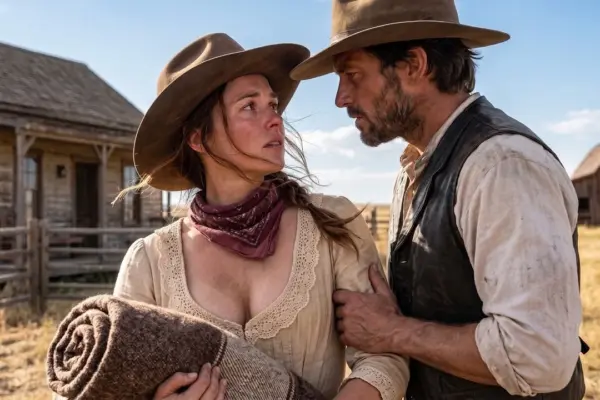
A Laundress Proposed to the Rancher Who Never Spoke — His Note Said “I Was Going to Ask You Tuesday”
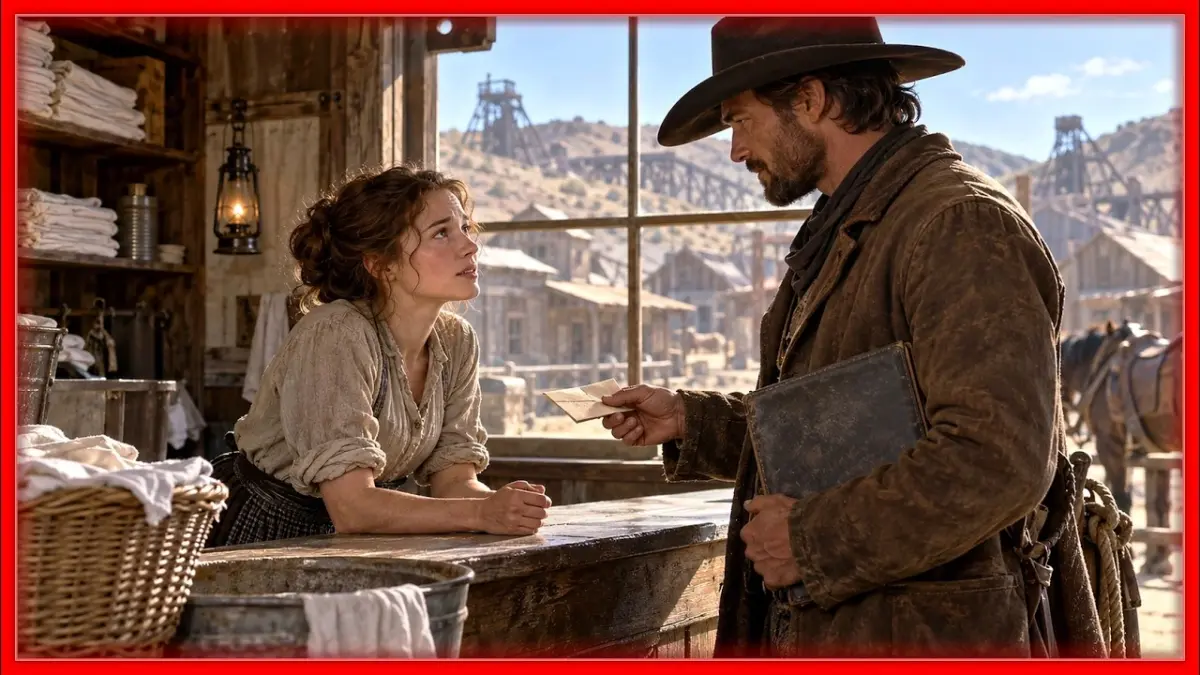
Tess Muldoon set her soap-scalded hands against the rim of the wooden wash tub and watched the gray water settle.
Out on the main dirt strip of Silver Bluff, the afternoon light was turning the color of old tin.
The bell over the door gave a thin, rusted clang.
It was not a customer.
Grub walked in without taking off his hat, his heavy work boots leaving dark, wet clods of alkali mud across the pine boards Tess had scrubbed on her knees only two hours before.
She noticed the mud before she looked at his face, because those pine boards were the only surface in the whole of Elko County she had any true right to be proud of.
“One week, Mrs. Muldoon,” Grub said, not bothering to close the door behind him.
A cold draft swept in, rustling the row of damp flannel shirts hanging overhead like a line of pale ghosts.
“One week, and not a day more.”
Tess wiped her red, swollen knuckles on her canvas apron.
“I paid you on the first of the month, Mr. Grub,” she said, her voice flat, steady, carrying the dry, blunt edge of County Clare that five years in the Nevada territory had failed to smooth away.
“I’ve paid you on the first of every single month for three years, without missing a dime.”
“And I let you stay out of Christian feeling for a widow,” Grub replied, setting his thick thumb into his waistcoat pocket.
“But Christian feeling don’t pay the interest on my mortgage to the bank in Reno.
The Comstock Hotel wants these two ground-floor rooms for storage.
They’re expanding the saloon next door, and they’re paying twice what you give me for a space to stack tinned beans and whisky barrels.
Whole town’s dying out anyway, Mrs. Muldoon.
The lower shaft at the Silver Bluff mine flooded on Friday.
Half the shift is packing their wagons.
There won’t be twenty men left in this valley by November who can afford to pay a woman to wash their dirty collars.”
“I have customers who pay,” Tess said quietly.
“You have six miners who owe you for a month’s starch and a handful of ranchers who come in when their clothes get stiff enough to stand on their own,” Grub said.
He tilted his hat back, looking at her with the comfortable arrogance of a man who held a written deed.
“Next Sunday.
You pack your mangle and your tubs and you hand over the key.
If you’re still here come Monday morning, I’ll have the deputy set your trunks on the boardwalk.”
He turned on his heel and walked out, the door banging hard against the frame.
Tess stood entirely still in the middle of the small room.
She looked at her reflection in the cracked square of mirror hanging by the window.
She looked thirty-five, though she was barely twenty-eight.
Her dark hair was pulled back tight from her temples, threaded with early silver at the sides, and her eyes looked shadowed and sunken from three years of rising at four in the morning to kindle the copper boilers.
She had buried her husband, Thomas, eighteen months after they reached Nevada, buried him in a shallow patch of gravel above the mine tailing piles after a heavy timber gave way in the drift.
She had built this business out of soapy water and lye because it was the only work a respectable woman could do in a town built on silver dust and whisky.
And now it was gone in thirty seconds because of tinned beans.
The bell clinked again.
Tess didn’t turn around right away.
She swallowed hard, pressing the heels of her damp palms into her eyes until the red sparks faded, before she turned to the counter.
Samuel Ashby stood in the doorway.
He came in the way he always came in every Monday at three o’clock—quiet as a drawn breath, stepping around the doorframe so smoothly his boots hardly made a sound on the damp floor.
He was a massive man, broad-shouldered and thick in the chest, his forearms dark and leather-hard from years of sun and stock work.
A pale, puckered scar ran low across the left side of his throat, disappearing down into his wool collar like an old thread.
Under his left arm he carried his weekly bundle of shirts wrapped neatly in brown butcher paper and tied with hemp twine.
From the side pocket of his heavy canvas coat hung a small, framed school slate on a leather cord, with a piece of white chalk tied to the frame by a string.
He set the bundle on the counter.
He did not reach for the slate or the chalk.
Instead, he stood there and looked at her.
It was a long, slow, deliberate look, the kind of steady appraisal Samuel had given her every Monday for a year.
At first, months ago, it had made Tess self-conscious, causing her to tuck stray locks of hair behind her ears or wipe her hands nervously on her apron.
But over time she had grown used to it.
Samuel Ashby never stared with the greasy curiosity of the mine shift bosses or the saloon men.
He looked at her as if she were a landscape he was trying to memorize before the weather changed.
“Rough day, Mr. Ashby,” Tess said, picking up her ledger book because her fingers needed something to hold onto.
“Grub was just here.
He’s raising the rent—doubling it, if you want the plain truth.
Which is his way of telling me I have until Sunday evening to clear out my tubs and disappear.”
Samuel’s jaw tightened.
The muscle along his cheek worked once, twice, hard as an iron hinge.
His blue eyes moved past her, taking in the small room, the copper boiler steaming in the corner, the wooden mangle with its iron crank, the shirts drying overhead, and then came back to rest on her swollen, wet hands resting on the counter.
He did not take out his slate.
He did not write a word.
He simply stood there for five long seconds, his chest rising and falling in a deep, silent breath.
Then he reached up, touched two thick fingers to the brim of his hat, turned around, and walked out into the pale afternoon light.
He left his bundle of dirty shirts sitting on the pine counter behind him.
Tess watched his tall shadow cross the window glass and disappear down the boardwalk.
She let out a dry, tired sigh.
“A silent man’s silence,” she murmured to the empty room, “generally means he’s got nothing to say.”
She was wrong, though it would take her six long days to learn how wrong she was.
By the following Monday morning, the sky over Silver Bluff was the color of slate.
A cold, thin wind was coming down off the mountains, bringing the first sharp smell of high-desert winter.
Tess had spent the entire weekend doing arithmetic on scrap paper at her small kitchen table—arithmetic that refused to yield a miracle.
She made two dollars a week washing clothes for the town’s remaining bachelor clerks and storekeepers.
Grub wanted four dollars for the rooms.
She could not turn two dollars into four, and she could not turn Grub into a compassionate landlord.
Father Doyle had visited her on Saturday evening.
He had offered her a cup of tea, his sincere prayers, and a cot in the damp cellar beneath the Catholic rectory until she could find passage on a stagecoach heading west toward Sacramento.
She had thanked him politely, waited until he walked down the street, and then sat down beside her iron mangle and cried once, hard and silent, where no one could hear her.
Now, on Monday afternoon, the laundry was nearly bare.
Her trunks sat packed by the back door.
Only a few shirts remained hanging on the line.
The bell over the front door clinked.
Samuel Ashby walked in.
He wore the same canvas coat, the same high boots, and carried another small bundle under his arm.
He walked up to the counter and set the fresh bundle down beside the old one he had left six days prior.
Tess looked at the two bundles of clothes, then looked up at his broad, quiet face.
Something inside her gave way—not with a crash, but with the quiet, sudden collapse of a rotten floorboard beneath a heavy weight.
She was tired of being sensible.
She was tired of counting nickels.
She was terrified of going down into Father Doyle’s dark cellar with her single trunk and no future.
“Marry me,” Tess said.
The words left her mouth before her mind could process them.
The silence that followed was so thick that she could hear the water dripping from the copper pipe into the wooden bucket behind her.
Her heart gave a violent, painful thud against her ribs, but once the sentence was out in the air, she realized she couldn’t drag it back.
She squared her shoulders, set her hands flat on the counter, and spoke fast before her nerve deserted her completely.
“I know how that sounds, Mr. Ashby,” she said, her voice shaking slightly before she forced it steady.
“I know you’ve never spoken a single word to me in a whole year of Mondays.
I know you come in here, hand me your slate when you need extra starch, pay your coin, and leave.
But you’ve never spoken an unkind word to me, either.
You’ve never looked at me like I was trash because my husband died in a hole and left me poor.”
Samuel stood motionless.
His eyes were wide, fixed entirely on her face.
“I’ve got no roof over my head after Sunday,” Tess continued, the words tumbling out of her now like water over stones.
“And everyone in this valley knows you’ve got nine hundred head of cattle up on the north ridge and a two-story ranch house that’s far too big for one man and his sister.
I can cook.
I can keep a house clean.
I can mend clothes and I can work harder than any woman you’ll meet between here and Virginia City.
I am asking you plainly because I haven’t got the time or the luxury to ask you any other way.
So, there it is.
If it’s a ridiculous notion, take out that slate of yours, write ‘no’, and I will pack my trunk and never speak of it to you again.”
Samuel Ashby did not reach for the slate hanging from his pocket.
He stood looking at her for three long, agonizing seconds.
Then, slow and deliberate, his hand moved inside his heavy coat.
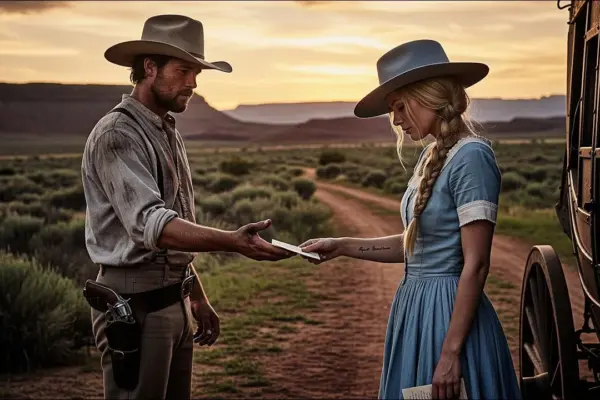
He reached into his breast pocket and pulled out a small piece of white paper.
It was folded into a neat, tight square, the edges softened and grayed from being handled and carried for a long time.
He set the square of paper on the counter, directly between her wet hands and his bundle of shirts.
He extended two sun-browned fingers and pushed it across the pine boards toward her.
Tess looked at the paper, then at him.
His face was unreadable.
She picked up the paper.
Her fingers were trembling so hard she could barely unfold the tight creases.
She flattened it out on the counter.
Inside, written in dark black ink in a firm, precise, copperplate hand, were eight words:
*I was going to ask you Tuesday.*
Tess read the line once.
She read it a second time.
She stared at the ink until the letters blurred together.
When she raised her eyes, Samuel was watching her.
The guarded, stoic look he always carried was completely gone.
In its place was an expression she had never seen on his face in all the months she had known him—he looked raw, utterly exposed, hopeful, and terrified all at once.
He looked like a man who had carried a secret weight in his chest for a year and had suddenly been asked to lay it down.
“Tuesday?” Tess repeated.
A choked, breathless sound—halfway between a sob and a laugh—escaped her throat.
“Tuesday?
You’ve had this paper written and folded in your coat pocket, and you let me stand here all week doubling over Grub and his mortgage?”
Samuel reached down and unhooked the slate from his coat pocket at last.
He picked up the chalk tied to the string and wrote rapidly, the white point scratching loudly against the dark stone.
He turned the slate toward her.
*Wanted to build the new pen first. Didn’t want to ask you into nothing.*
“Samuel Ashby,” Tess said, tears finally spilling over her lower eyelids as a real, ringing laugh broke through the tightness in her chest.
“I would have come into nothing!
I have got nothing right now!”
Samuel looked at her tears, his eyes softening.
He took his sleeve, wiped the slate clean with a single, sweeping motion, and wrote another line.
He wrote slower this time, forming each letter with immense care, as if the words were made of glass.
He held it up.
*Not nothing. Just early.*
Tess laughed outright then, a clear, loud sound that echoed off the damp walls of the laundry.
She didn’t care about Grub, she didn’t care about the Comstock Hotel, and she didn’t care about the mine closing.
She reached right across the pine counter, past the dirty shirts and the slate, and grabbed both of his massive, rough hands.
Samuel did not pull away.
His thick fingers closed around hers, warm and solid and real, and they stood there across the counter for a long, quiet minute while the wind rattled the front window pane and the little bell overhead hung silent on its brass hook.
—
Father Doyle married them three days later, on a chilly Thursday morning, in the small, unpainted clapboard church at the edge of town.
Tess had refused to wait for the following week.
“I’m not waiting for a Tuesday that’s already come and gone once without me,” she had told the priest plainly when he asked if they needed more time to publish the banns.
The pews were mostly empty.
Silver Bluff was draining its population day by day, but a dozen local people had gathered in the front rows, wrapping their heavy shawls and coats tightly around themselves against the drafty church air.
In the very front row sat Ada Ashby.
Samuel’s older sister was a tall, lean woman with sharp bone structure and hair pulled back so tightly into a knot at the nape of her neck that it pulled her eyebrows up.
She wore a dark, severe wool dress and sat with her arms folded tightly across her stomach, watching the altar with a stern, unreadable expression.
When it came time for the exchange of vows, Father Doyle turned toward Samuel.
The old priest held his prayer book open, his posture patient and gentle.
He had served in the territory for twenty years and was accustomed to men broken by war or accident; he had married mute veterans and injured miners before.
“Samuel,” Father Doyle said softly, “do you take this woman to be your lawful wedded wife?”
Samuel did not hesitate.
He reached inside the pocket of his black suit coat—a good wool coat that smelled faintly of cedar and dried sweetgrass—and brought out his slate.
He had brought it to his own wedding.
He took the chalk and wrote across the clean stone surface in front of the priest, the congregation, and his bride.
His hand was solid, though his eyes were shiny with unshed moisture.
He turned the slate toward Tess and held it high enough for the front rows to read.
*I will love her on the days I have no words and the days I have a thousand.*
A woman sitting two rows back pulled out a handkerchief and blew her nose loudly.
Behind her, two other townswomen began to dab at their eyes.
Tess did not cry.
She stood straight in her navy wool dress—the only decent dress she owned—and looked at Samuel holding up a piece of slate with his whole heart written across it in white chalk.
She thought to herself that she was marrying the most eloquent man in the entire Nevada territory.
When Father Doyle turned to her, Tess spoke her reply clearly, her voice reaching every corner of the wooden chapel.
“I will love him,” she said, “on the days he has no words, and I will be glad of the quiet ones, because I have known men who talked plenty and said nothing worth the breath it took to speak it.”
A sudden, sharp sound came from the front row.
It was Ada Ashby.
She had let out a short, surprised bark of a laugh before quickly catching herself and pressing her lips back into a rigid line.
Before Father Doyle could raise his hands to pronounce the final blessing, Samuel quickly lifted his slate again.
He held it low, angled so that only Tess could see what he had just scrawled across the bottom margin.
*Tuesday came.*
Tess had to bite the inside of her cheek so hard she tasted copper to keep from laughing aloud right there at the altar steps.
She didn’t entirely succeed; a smothered giggle escaped her nose.
Father Doyle, mistaking her shaking shoulders and flushed cheeks for tears of overwhelming religious emotion, smiled benignly and pronounced them husband and wife with great satisfaction.
—
The Ashby ranch lay seven miles north of Silver Bluff, nestled in a wide, sweeping basin where the sagebrush gave way to sweet mountain grass watered by deep creek springs.
The ranch house was far larger than Tess had allowed herself to picture during her long nights in the laundry.
It was two full stories of fine, squared timber, painted a clean white with slate-gray trim, surrounded on three sides by a deep wrap-around porch.
When Samuel pulled the wagon up into the dooryard, Tess stood beside her single wooden trunk and looked up at the structure.
For a fleeting second, a cold spike of panic hit her chest.
She felt like an intruder, a penniless laundress who had somehow wandered into a stranger’s wealthy life by trickery.
Ada was already on the porch steps.
She had ridden back from town ahead of the wagon and had already traded her good wedding dress for an apron and a faded calico work gown.
Her arms were folded across her chest in her familiar, defensive posture.
“You’ll take the west bedroom upstairs,” Ada said to Tess without a word of greeting or preamble.
“Mine is the east.
Kitchen’s mine, too, generally speaking, though I expect that arrangement will have to change now that Samuel’s brought a wife home.”
Tess stepped down from the wagon, setting her boot firmly on the gravel.
“I don’t mean to push you out of your own kitchen, Miss Ashby,” she said evenly.
“It isn’t my kitchen,” Ada replied, her sharp eyes scanning Tess from her bonnet to her scuffed boots.
“It’s Samuel’s house.
I only stayed on and kept it running because somebody had to cook his meals, and there wasn’t anybody else fool enough in this county to marry a man who can’t ask for the salt at his own dinner table.”
Ada flicked a quick glance toward her brother, who was stepping down from the driver’s seat.
“No offense intended, Samuel.”
Samuel didn’t look hurt.
He pulled his slate from his coat, wrote three short sentences, and held it up toward his sister.
*None taken. She married me anyway. Ask her why.*
“I already asked myself,” Tess said before Ada could answer.
She looked Ada straight in the eye, letting a dry smile touch the corner of her lips.
“It’s the cheapest housing in the territory.
Free room, free board, and a husband who can’t complain when the mutton stew turns out too salty.”
Ada stared at Tess.
For three seconds, the air between the two women was entirely still.
Then, slowly, the rigid tension in Ada’s shoulders dropped by a fraction of an inch.
“Ten rooms,” Ada said, her voice dropping its combative edge.
“Two of us have been living in four of them.
You’ll want to inspect the rest of the house before you decide you’ve married into a grand estate.
Half the upstairs hasn’t had a lamp lit in it since mother died four years back.”
She turned around and walked inside the house, leaving the front door open behind her.
Tess looked at Samuel.
He gave a slight, quiet shrug of one broad shoulder—a gesture that translated as plainly as any written word: *She’ll come around.*
Before Tess could grab her small carpetbag, Samuel had already lifted her heavy wooden trunk onto his shoulder as if it weighed no more than a sack of oats, and carried it up the porch steps.
—
The Ashby house did not stay cold or dark for long.
Within a month, Tess had gone through the shut-up rooms on the second floor like a spring storm.
She threw open heavy wooden shutters that had been latched tight for years, letting the high-desert sunshine pour into dusty corners, sending golden clouds of dust dancing through the air.
She scrubbed the floorboards with vinegar and hot water, washed the grimy window panes until they shone, and hung fresh linen curtains she had sewn from flour sacks.
And as she worked, she sang.
She sang old, mournful Irish ballads and cheerful dance tunes her mother had taught her over the washing tubs in County Clare.
She sang because a house that size was too vast to be silent, and she knew Samuel was not going to fill it with noise.
Living with a silent man was a language Tess learned not from books, but the way she had learned to iron silk—by practice, patience, and close observation.
Within two months, she knew every gesture Samuel possessed.
A flat, open hand extended palm down meant *wait*.
Two fingers tapped against his lower lip meant he was hungry, though he used that sign sparingly, as if admitting to physical need were a slight weakness.
A hand pressed flat against the center of his chest, right over his heart, was a gesture that puzzled her at first.
He didn’t use it when he was tired or working.
She only saw him do it when he came through the back door in the evening, paused in the doorway, and saw her standing at the stove or mending socks by the lamp.
Once she realized he only made that gesture while looking at her, she realized she didn’t need any spoken words to explain it at all.
Samuel, in turn, learned his wife’s habits with the same quiet intensity.
He learned that she sang loudest when she believed she was completely alone in the house.
He began finding excuses to leave the barn and work near the woodsplitter or the pump house while she was out at the clothesline.
He would stand behind the woodpile, motionless as an old oak tree, holding an axe or a piece of harness, listening to her voice float across the yard, careful not to make a sound that might cause her to stop.
It was Ada who finally exposed him.
One damp November evening, while Samuel was out in the barn tending to a mare that was close to foaling, Ada called Tess into the small office corner off the parlor.
It was where Samuel kept the ranch records—a small oak desk stacked with leather-bound ledgers.
Samuel’s accounting was meticulous; every head of cattle, every bushel of grain, every pound of salt purchased in town was recorded in tidy columns.
“Look here,” Ada said, turning back the heavy pages of the current year’s ledger to entries dated seven months back, long before Grub had threatened the laundry.
She pointed her thin finger at the wide side margin.
There, written small and light in pencil beside a column listing calf births, was a single word:
*Tess*
Ada turned back two more pages, to a ledger entry from the previous winter.
There it was again in the margin, neat and precise: *Tess*.
And again on the next page, and a dozen times scattered throughout the year’s record.
It was the work of a man practicing a name he could not utter out loud, trying the feel and shape of it under his pencil where he thought no one would ever see it.
“He’s done that for near a year,” Ada said softly, her voice unusually gentle in the quiet room.
“Long before you ever stood up in that laundry and proposed to him.”
Tess touched the penciled letters with the tip of her finger.
She closed the heavy leather ledger very gently, as if she were closing a door on something fragile.
She didn’t say anything to Ada, because for the first time since she had arrived at the ranch, her sharp Irish tongue had entirely run out of words.
A week later, Tess was out at the wash line behind the kitchen, wringing out a heavy flannel sheet with more force than the wet cloth required.
The autumn air was crisp, turning her breath into small white clouds.
Ada walked out from the porch and stood nearby, holding a basket of wooden clothespins.
“He wrote you a letter every week,” Ada said, reaching up to pin a corner of the sheet to the hemp rope.
“For near on a full year.
Started maybe two months after he began taking his washing to your shop.”
Tess froze, the wet sheet twisted tight between her hands.
“A letter?”
“He sat at that oak desk every Sunday evening,” Ada said, looking out toward the pasture.
“He’d light the small lamp and write page after page.
I never read them—he’d have taken my hide if I touched his desk—but I watched him do it from the parlor doorway.
Every single Sunday night.
And then, when he finished, he’d fold the pages up, walk over to the woodstove, open the iron door, and throw them into the fire.”
Tess let the sheet drop slightly.
“Why would he write letters if he only meant to burn them?”
Ada looked at her brother’s wife.
Her dark eyes were steady, devoid of the sharp bite she usually carried.
“Because he didn’t believe a bright, handsome woman like you would ever want a letter from a man who couldn’t stand up and say the words out loud to your face.
He thought writing them down and burning them was as close as he’d ever get to talking to you.
I told him he was being a damn fool.”
“What did he say to that?” Tess asked, her voice barely above a whisper.
“He took his slate and wrote that I didn’t understand,” Ada said.
“And maybe I didn’t.
Not until you came up here and opened those upstairs shutters, and started singing over the wash tubs every morning like the sun rose just to hear you.”
Ada set the clothespin basket down on the grass.
She turned her head toward the big timber barn, where Samuel’s tall figure could be seen moving between the open double doors, hauling a bale of hay.
He had no idea that his year of secret, burned letters had just been laid bare in the yard.
“A whole year,” Tess said, looking toward the barn.
“A whole year of Mondays,” Ada agreed softly, “wondering if you’d ever look at him the same way he was already looking at you.
If you ask me, the man is owed a bit of looking back.”
Tess didn’t finish hanging the wash.
She dropped the wet sheet into the wicker basket, turned on her heel, and walked across the frozen grass toward the barn.
When she reached Samuel, she didn’t say a word.
She simply reached out, took his large, calloused hand in hers, and did not let go until long after the sun had gone down and supper was cold on the table.
—
The trouble with the cattle buyer began in early spring, and like most trouble in the high country, it started small before it turned dangerous.
His name was Colton.
He was an agent for a beef company out of Winnemucca, a slick-talking man who wore fine leather boots and a gold watch chain across his vest.
Samuel had dealt with him twice before and had trusted him enough to agree to sell four hundred head of prime steers off the north range.
When the time came to sign the final sale papers, Tess rode into the stockyard office in Silver Bluff beside her husband.
She had come to realize over the past six months that because Samuel could not speak, men in business often assumed he could not read or calculate quickly—a mistake that frequently led them to try cutting corners.
Colton’s office was small, smelling of stale tobacco smoke and damp leather.
The buyer had the contract spread out on his dark wood desk.
He didn’t offer Tess a chair.
“Standard contract, Mr. Ashby,” Colton said rapidly, tapping a finger on the paper without handing it over.
“Same terms I’m offering every outfit in the valley this season.
Twenty-two dollars a head, less the handling fee at the railhead.”
Tess stepped forward before Samuel could even reach for his slate.
She laid her hand flat on the paper and pulled it toward her side of the desk.
“Thirty dollars was the figure you wrote him in your letter back in March, Mr. Colton,” Tess said, her voice cool and steady.
“I saw the letter myself.
I filed it in our ledger.
This contract right here says twenty-two.”
Colton’s pleasant smile stiffened.
He adjusted his collar, looking annoyed.
“Markets have shifted since March, ma’am.
Prices dropped all across the state.”
“Markets shifted the exact amount it takes to rob a man you figure can’t stand here and argue with you,” Tess replied instantly.
“My husband is mute, Mr. Colton.
He is not stupid, and neither am I.”
Colton leaned back in his chair, his face darkening.
“This isn’t a proper conversation for a rancher’s wife to be meddling in.”
“It is precisely a conversation for a rancher’s wife,” Tess snapped, her County Clare accent rising thick and sharp under her growing anger.
“Seeing as the rancher brought his wife along for the express purpose of dealing with men like you.
Twenty-two dollars a head is outright theft, and you know it.”
Colton turned his head toward the door, where his heavy-set yard foreman was standing.
“Get this woman out of my office, Miller,” Colton said coldly, not even looking at Tess.
“We’ll finish this business when she’s sitting in the wagon.”
Before Samuel could move, the foreman stepped forward, grabbed Tess firmly by the upper arm, and steered her briskly out the doorway.
It was not violent, but it was quick, rough, and humiliating.
She was pushed out onto the wooden boardwalk while the door slammed shut.
Through the glass window pane, Tess saw Samuel.
He was standing frozen beside the desk.
His slate was held uselessly in his right hand, his chalk suspended in mid-air.
His jaw was clenched so hard the muscles stood out like cords.
He stood there in utter silence, unable to shout, unable to call out, forced to watch his wife tossed out into the street while he possessed no voice to stop it.
That night, back at the ranch house, Samuel did not come to bed.
Tess woke an hour before dawn.
Seeing his side of the bed empty, she pulled a woolen shawl over her nightdress and walked down the dark stairs.
A thin yellow light was spilling out from beneath the office door.
She opened the door softly.
Samuel was sitting at his writing desk.
The oil lamp was burned down low, throwing long, dark shadows across the timber walls.
A blank page lay beneath his hand, but he hadn’t written on it.
When he heard her footsteps on the floorboards, he didn’t turn around immediately.
When he finally turned his head, his face was devoid of its usual calm strength.
He looked defeated, haunted by a deep, dark bitter shame.
Slowly, he picked up his slate from the desk and slid it across the wood toward her.
Tess picked it up.
Written in harsh, jagged chalk strokes were four lines:
*You deserve a man who can stand up for you.*
*I stood there like a post and let them put you out the door.*
*A whole voice is not worth a stopped throat.*
*You should have married a man who could shout at Colton for you.*
Tess read the chalk lines.
She felt a sudden, sharp sting behind her eyes, but it wasn’t tears of hurt—it was anger at the unfairness of the world that had made him feel small.
She picked up the piece of chalk tied to the cord.
She wetted the tip of her thumb, wiped a corner of the slate completely clean, and wrote directly beneath his last line.
She pressed down hard, making the chalk squeak loudly against the stone.
*You stood up for me every Monday for a year.*
Samuel stared at the slate.
Tess kept writing.
She filled the remaining space on the stone, her hand swift and determined.
*You stood there when Grub would have thrown me into the dirt, and you never said a word, but you brought your wash to my shop every single week when half this town had stopped sending laundry to a poor widow because they thought she was bad luck.*
*You stood up for me by choosing me, Samuel Ashby.*
*A man doesn’t need a throat to do that.*
Samuel took the slate back from her.
He looked at her writing for a long, quiet moment.
Then he took his sleeve, wiped the stone entirely blank, and wrote a single line.
His hand was shaking—the first time she had ever seen his large, steady hand tremble.
*Then help me stand up for you now.*
Tess looked up into his eyes and smiled.
“That,” she said softly, “I can do.”
—
It took Tess eight days of hard riding across the valley.
She didn’t ride alone; Samuel rode beside her on his big bay gelding, but Tess did the talking at every stop.
They visited every ranch between Silver Bluff and the Malheur county line.
By the end of the week, they had gathered four other local ranchers who had entered into cattle agreements with Colton that season.
Every single one of them had received a written letter in March promising thirty dollars a head, and every single one of them had been handed a formal contract in May listing twenty-two.
On Saturday morning, a procession arrived at the county courthouse in the county seat.
Five ranchers, two ranch wives, and Samuel Ashby walked into the county assessor’s office.
Tess carried Samuel’s primary ranch ledger—a heavy, leather-bound volume thick as a church Bible.
Colton had been summoned to the office under the impression that he was finalizing land leases.
When he walked in and saw the room packed with angry, silent men, his confident air vanished.
The county assayer, a stern old man with wire-rimmed spectacles, sat behind his desk, turning the pages of Samuel’s ledger alongside the letters collected from the other ranches.
“These figures, Mr. Colton,” the assayer said, tapping his quill against the page, “do not match the payout figures you filed with the territorial tax office.
Not by a considerable margin.
On any of these five contracts.”
Colton cleared his throat nervously, adjusting his hat.
“There’s clearly been some misunderstanding, sir.
A mere clerical confusion—”
“There has been theft,” Tess interrupted, her voice ringing clear across the timber room.
“That is what there has been, Mr. Assayer.
And there are five honest men standing in this room holding signed letters from Mr. Colton to prove it.
And here is a rancher whose books are kept better and more honestly than the county’s own records.”
Tess stepped right up to the desk, staring Colton directly in the eye.
“And I would think very hard, Mr. Colton, before you use the word ‘confusion’ in this town ever again.”
The resolution was swift.
Word of the attempted fraud spread through cattle country faster than a prairie fire.
Within three weeks, Colton’s company revoked his authority, the county board threatened criminal charges, and Colton sold off his local holdings at a loss and left for the east on a night stagecoach.
Throughout the entire confrontation in the courthouse, Samuel had stood at the back of the room, his slate hanging unused at his belt.
He hadn’t needed it.
Every record required to destroy Colton had been kept perfectly in his steady hand, and his wife had supplied all the voice they needed.
—
The reading lessons began during their second winter together.
It had started as Ada’s idea on a bitter January night when the snow was piled three feet deep against the porch rails and the wind blew so hard from the north that the whole house creaked.
They were sitting near the big parlor stove.
Tess was reading aloud from an old leather-bound novel she had borrowed from Father Doyle.
She paused at the end of a chapter, looked over at Samuel, and gently held the book out toward him.
A doctor in Elko, whom Tess had spoken to months before while buying supplies, had told her that muteness caused by throat trauma was complicated.
He had said that scar tissue sometimes hardened, but if the vocal cords beneath were intact, a man might sometimes regain a fraction of sound if he tried—though it took immense effort and hurt like fire.
Samuel had resisted at first.
He had turned his head away, shaking it firmly, reaching for his slate to write that it was useless.
“Eleven years, Tess,” Ada had said quietly from her knitting chair.
“It’s been eleven years since the timber fell on him at the mill.
Don’t push him.”
But Tess did not give up.
She didn’t nag; she simply set the book on his lap every evening after the ledgers were put away.
She would place her hand over his scar, feel the cold, hard ridge of tissue, and ask him quietly to try making just one sound.
One night in late March, while the wind rattled the same shutters Tess had opened a year prior, Samuel finally tried.
He sat in his chair, his shoulders tense, his knuckles white where he gripped the wooden arms.
He opened his mouth.
His throat worked, the scar pulling tight against his skin.
What came out was not a word.
It was a low, rough, raspy shape of breath—a sound like an old iron gate hinge turning on rusty pins.
It was harsh, but it was unmistakably a human sound.
Tess set the novel down so fast it nearly fell into the open stove door.
She looked at him, her heart leaping into her throat.
They worked at it through the spring.
They worked the way Samuel worked at everything on the ranch—patiently, methodically, stubbornly refusing to be beaten by a physical barrier.
Tess would sit across from him by the lamp, showing him how to shape his lips.
Sounds slowly became single syllables.
Syllables haltingly became short, broken words—thick and strange, pulled with painful effort out of a throat that had forgotten how to construct speech.
It was slow, excruciating progress, unspooling far slower than Tess wished, but far faster than the doctor in Elko would ever have believed possible.
—
It happened on an ordinary Tuesday evening in May.
The spring rain was tapping softly against the glass.
The oil lamp was lit on the desk.
The ledger lay open between their chairs out of habit, though the day’s accounting was already finished.
Ada had gone upstairs to bed an hour before.
The ranch house was quiet—not the cold, dead silence of the past, but the soft, comfortable quiet of a home filled with life.
Samuel sat in his arm chair, looking across the small space at Tess.
She was sitting with her head bent over some mending, sewing a button onto his work shirt.
Something changed in the room.
Tess felt it before she saw it.
She raised her head.
Samuel was looking at her.
His face carried an expression she had learned over two years to recognize—it was the look he got right before an idea took shape, the arrival of something important.
His chest rose in a deep breath.
The scar on his throat tightened.
“Tess,” he said.
It was not a shape of breath.
It was not a rough, rusty hinge sound dragged through grit.
It was her name—whole, clear, soft, and unmistakably resonant.
It was the first real word he had spoken plainly in eleven years.
He said it like a man laying down a massive, heavy iron weight he had carried on his back across a thousand miles, setting it down at last in the exact spot where it belonged.
Tess froze.
The sewing needle slipped from her fingers and fell onto her lap.
She couldn’t speak.
For all her quick wit and Irish talk, she could not manage a single word.
She stood up from her chair, stepped across the small space separating them, and threw her arms around his neck.
She pulled him close, burying her face into the curve of his shoulder, holding onto him with all her strength.
Against her collarbone, she felt his chest vibrate.
Then she heard it—a deep, low laugh.
An actual laugh.
It was still a little raspy around the edges, but it was real, warm, and clear all the way through.
Tess held him tighter, her tears soaking into his woolen shirt, thinking to herself that whatever Tuesday he had originally planned to ask her to marry him, this Tuesday had been worth waiting for a hundred times over.
She pulled back just enough to look into his blue eyes.
“Say it again,” she whispered, her voice thick.
Samuel looked at her, his hands coming up to frame her face, his thumb gently wiping away a tear from her cheek.
“Tess,” he said again.
(Descargo de responsabilidad: Este contenido puede haber sido generado por IA con fines de entretenimiento. Cualquier parecido con personas, eventos o lugares reales es pura coincidencia.)