At 22, She Planted 2,400 Trees Through Her Best Wheat Field Until the Black Wind Came
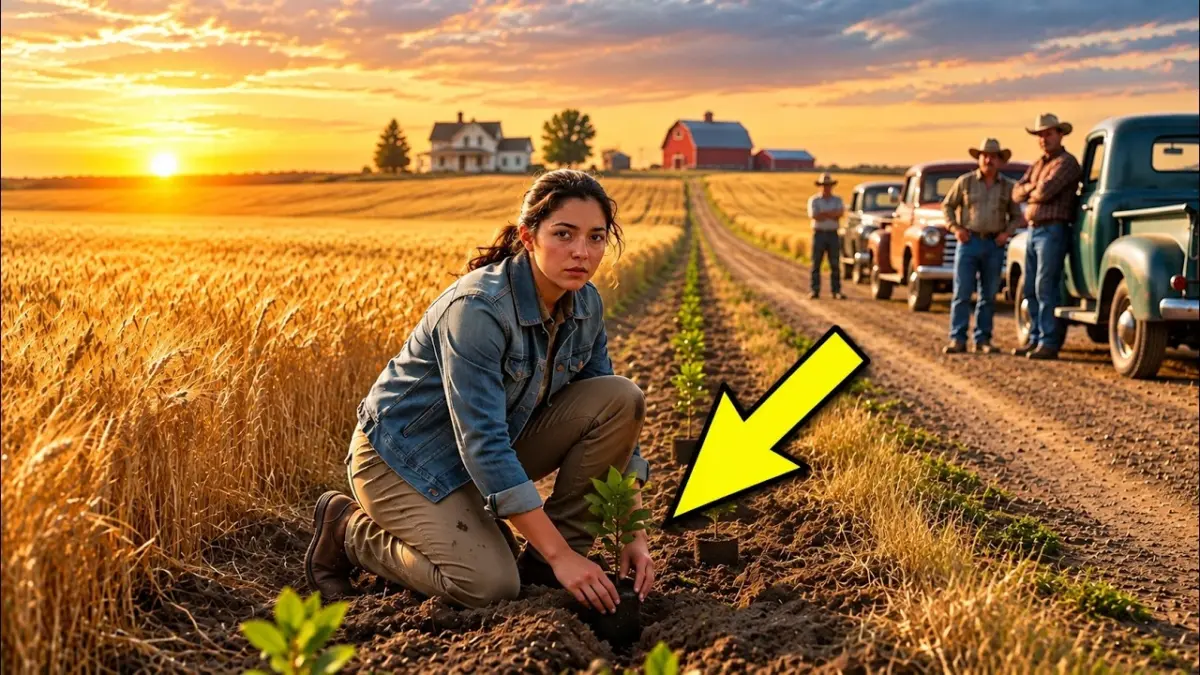
By the second week of April, drivers traveling down the sun-bleached asphalt of the coreless county road had developed a habit of easing their foot off the gas as they approached the Asher place.
There was nothing outwardly spectacular to stop for.
Three hundred and ten acres of dryland wheat ground rolled flat toward a horizon that seemed to retreat forever into the haze.
The farmhouse was a weary, two-story frame structure desperately in need of paint.
A corrugated grain bin sat nearby with its access ladder rusted through completely at the fourth rung.
The wheat crop itself looked thin and pale, having been drilled late the previous fall during a spell of bitter, dry cold.
It was far thinner than it should have been in a county where thin meant a bad harvest, and a bad harvest usually meant an auction sign staked into the ditch by October.
What made the local farmers slow down and stare was the young woman standing out in the absolute middle of it all.
Nell Asher was twenty-two years old.
She worked in a slow, relentless, perfectly straight line across ground that had produced nothing but dryland wheat every single year since her grandfather was a young man.
And she was planting trees directly into it.
She was not placing them along the property lines or framing the house where a sensible person might put a windbreak.
She was driving them straight through the heart of her best quarter, the deep, flat black dirt that had yielded grain when every other acre in the township failed.
She worked with a heavy iron dibble bar in her right hand and a damp canvas bag slung across her left hip.
Her stock consisted of eight-inch bare-root seedlings wrapped tightly in bundles of wet newspaper.
There was green ash, hackberry, eastern red cedar, and low-growing caragana meant for the outside windward row.
Her technique was mechanical, rhythmic, and tireless.
She would drive the sharp edge of the dibble bar into the packed earth with her boot, rock the handle back to force open a narrow slot, drop a moist seedling inside, stomp the wedge closed with her heel, take two precise steps forward, and repeat the motion.
By the end of her first week in the field, her notebook recorded four hundred and twelve trees.
By the second week, the count reached eight hundred and ninety, then fourteen hundred.
Her total target was twenty-four hundred.
On the ninth afternoon, a battered blue pickup truck slowed on the section line and pulled off onto the gravel shoulder.
Cal Rener shifted the truck into park and left the engine idling softly.
Cal farmed the two quarters directly east of Nell’s boundary.
He was sixty-one years old, broad-shouldered, with a thick neck and a permanent band of pale skin across his forehead where his foam cap sat every day of his working life.
He had farmed that soil for thirty-four years, and his father had farmed it for four decades before him.
He was not a stranger to Nell.
When Nell was fifteen, Cal was the one who had taught her how to operate a combine harvester.
He had sat beside her in the buddy seat for three full days during a sweltering July harvest, saying almost nothing, reaching over only once to pull back the ground speed lever when she grew too ambitious in a heavy patch of grain.
When her mother fell ill years later, Cal had cut Nell’s wheat for two consecutive seasons and flatly refused to accept custom cutting fees for his labor.
That history was precisely why his unspoken opinion carried more weight than anyone else’s in the county.
Cal sat behind the steering wheel and watched her move down the long row.
She reached the terrace edge, turned around, and began the long march back toward the road.
He did not get out of the truck.
He looked down at the earth she was piercing with her iron bar, the rich, heavy dirt that a farmer in this region spent his entire lifetime trying to acquire.
Cal shook his head once, very slowly.
Then he put the truck back in gear and drove away.
By suppertime, news of what Nell was doing had spread to the grain elevator.
By Sunday morning, the story had reached the laminate coffee table at the front of the town cafe.
Four older men in grease-stained hats had collectively decided that the young Asher girl had lost her mind, ruining the only ground on the property that actually generated an income.
Cal never participated in the lighthearted teasing.
He did not need to make jokes to express his feelings.
Everyone knew where he stood because the previous November he had formally offered to cash rent those exact nine acres, along with the eighty surrounding them, at a rate higher than anything previously seen in the township.
Nell had not accepted his offer.
Now, she was filling the very ground he had tried to lease with woody saplings.
To Cal, that was not farming.
It was just a grieving young woman keeping her hands busy because the alternative was sitting alone inside a silent house.
The truth was that Nell was far more terrified than any of them could have imagined.
Fourteen months earlier, the entire operation had belonged to her mother, Ruth Asher.
Ruth had managed those three hundred and ten acres entirely on her own for nineteen years after Nell’s father walked out one morning and never returned.
Ruth was not a sentimental woman about land or legacy.
She kept a heavy leather ledger in the top kitchen drawer secured with a thick red rubber band.
She could tell you to the exact fraction of an acre which soil paid for its fertilizer and which soil bled money.
Nell had grown up sitting on the floorboards of the tractor cab with a coloring book balanced on her knees.
She had learned how to read a moisture probe long before she was old enough to get her driver’s license.
When she turned eleven, her mother handed her a yellow clipboard at harvest time.
“Look at that yield monitor every time we turn at the headland,” Ruth had told her, keeping her eyes fixed on the reel ahead.
“Write the numbers down for every single pass.”
“And tonight after we grease the machine, you’ll sit at the table and average them out yourself.”
The cancer diagnosis had arrived in February during Nell’s second year at the community college in Garden City.
Nell finished out her semester only because her mother threatened to sell the cows if she quit mid-term.
She did not enroll for the following term.
For seventeen long months, Nell drove her mother to radiation treatments, planted winter wheat, sprayed weeds, hauled grain to town, and learned to scrutinize insurance benefit statements with the same fierce suspicion her mother applied to grain contracts.
Ruth passed away in early March, just three weeks before the winter wheat broke dormancy and showed its first pale green shoots.
After the funeral, Nell kept waking up at four-forty in the morning out of sheer habit.
She would lie in the dark bedroom, listening to the old rafters creak as the house settled, getting out of bed simply because staying still felt unbearable.
For weeks, she kept her mother’s leather work boots sitting right beside the back door.
They were a half-size too large for Nell, and she never wore them.
One morning in June, she picked them up, carried them out to the machine shop, set them neatly on a wooden shelf above the workbench, and never moved them again.
What her mother had left behind was three hundred and ten acres of land, a 1996 combine with four thousand hours on a rebuilt engine, a grain drill that desperately needed new openers, a farmhouse with a rotted, soft spot in the bathroom floor, and a bank operating note carrying an unpaid balance of one hundred and forty-three thousand dollars.
No banker needed to make threats.
The cold arithmetic of dryland farming made the danger clear enough.
Dryland wheat in their county averaged thirty-eight bushels an acre during a decent rain year.
Two consecutive bad years would cause the interest on the debt to outpace everything the land could produce.
Renting out half the acreage would cover the immediate interest payments.
Selling the north quarter outright would cut the principal debt nearly in half.
Cal Rener’s written cash-rent proposal remained folded neatly in the kitchen drawer, resting right on top of her mother’s ledger.
Nell had not thrown it away, but she had not signed her name to it either.
During that first winter alone, she spent her days cleaning out the machine shop because being inside the empty house was too painful.
Up in the dusty storage loft above the parts bench, hidden underneath a heavy tarp stiffened by age, she discovered a wooden apple crate filled with yellowed papers.
Most of it was routine farm record keeping from decades past: fertilizer receipts from the 1970s, an old hail damage insurance claim, hand-drawn field maps with acreage calculations scrawled in the margins, and a promotional calendar from a local seed dealer that had gone out of business before she was born.
At the very bottom of the crate lay a thick, faded paper folder.
Inside were official receipts from the Soil Conservation Service dated 1954 and 1955 for bare-root nursery stock: twelve hundred green ash, nine hundred hackberry, and six hundred eastern red cedar.
Tucked behind the receipts was a detailed planting diagram drawn carefully on graph paper in her grandfather’s neat handwriting.
It showed eight long rows of trees stretching north to south directly across the home quarter.
They were spaced at precise intervals, with small hand-drawn arrows in the corner indicating the prevailing direction of the bitter spring winds.
Stapled to the back of the diagram was a black-and-white photograph.
It showed the very same field she walked across every day, but in the picture, long, dark lines of mature trees stretched across the landscape.
Between those protective rows, the winter wheat stood remarkably thick, tall, and dense.
Nell sat down on the cold concrete shop floor with the photograph resting in her hands.
She knew every square foot of that ground.
She had operated the drill across it just months ago.
There were no trees on that ground today, nor had there been during her entire childhood.
The final document in the folder explained why.
It was a paid invoice from 1978 for heavy bulldozer contract work.
Her grandfather had hired a crew to tear out every single row of trees to square up the field for a larger, wider grain drill and longer, continuous tractor passes.
He had spent years establishing those shelterbelts, and then he had cleared them away to make room for bigger machinery.
Nobody in her family had ever mentioned that the trees had existed in the first place.
Nell spent the remainder of that long winter reading everything she could get her hands on.
She studied university extension bulletins and county soil conservation surveys dating all the way back to 1938.
She submitted a special request through the small town library for a university dissertation on shelterbelt microclimates in the High Plains, keeping the volume checked out for eleven straight weeks.
The underlying science was straightforward, which was perhaps why local farmers overlooked it.
Wind moving unobstructed across open land causes two distinct types of damage.
It physically lifts topsoil particles, and it strips moisture out of everything in its path.
It pulls water from the ground, from the crops, and from the micro-layer of humid air that clings to leaves and prevents plants from drying out faster than their roots can absorb water.
A row of trees does not act as an impenetrable wall.
Instead, it functions as a buffer, slowing the wind down and breaking its kinetic force.
Downwind of a functional shelterbelt, surface wind speeds drop significantly over a distance equal to roughly ten to fifteen times the height of the mature trees.
Within that sheltered zone, evaporation rates plummet.
Winter snow does not sweep across bare fields into highway ditches miles away.
It drops straight out of the calm air, forming deep, uniform drifts that melt directly into the crop soil come springtime.
In early spring, Nell walked the home quarter holding a pocket compass and her grandfather’s original graph-paper map.
She chose not to copy his layout exactly.
His rows had been designed for a field that drained differently before fifty years of continuous deep tillage and a terrace system constructed in the 1980s altered the flow of runoff.
She shifted the entire planting pattern two hundred feet to the east and eliminated one row entirely.
She calculated the gaps between the rows based on the expected mature height of the species.
She selected low, dense caragana for the windward edge to block ground-level gusts, followed by a row of broad hackberry, then tall green ash, and finally a dense row of eastern red cedar on the leeward side.
The cedar would serve as a winter barrier, retaining its needles in mid-January when every other tree was bare.
When the plan was complete, she sat at the kitchen table with her mother’s ledger to calculate the exact cost.
Nine full acres of crop ground would be taken out of grain production.
Based on an average yield of thirty-eight bushels an acre and current grain prices, that meant sacrificing roughly twenty-four hundred dollars a year in gross revenue for as long as those trees remained in the soil.
She wrote that loss down in red ink.
Then, she submitted the order for the seedling stock.
The land offered no immediate reward for her labor during the first two years.
The first summer took a devastating toll on the young shelterbelt.
She had planted the bare roots during a deceptively mild April, but an intense, dry wind blew out of the southwest in mid-June and persisted for six straight days.
The young green ash on the exposed western edge went from limp to brown, and finally to brittle twigs in less than a week.
Every evening after finishing her field work, Nell hauled water out to the saplings using a two-hundred-gallon plastic tank mounted on a flatbed utility trailer.
She watered them one bucket at a time until dark, but despite her efforts, dozens of saplings withered and died.
Over the following winter, wild jackrabbits stripped the bark off one hundred and forty caragana bushes right at the snowline, girdling the stems in neat rings.
When spring arrived for the second year, Nell spent eight hundred dollars she could ill afford to buy replacement stock, using four full weekends to replant the gaps.
Then in late May, a custom chemical applicator working a neighboring field drifted a heavy dose of broadleaf herbicide across the property line on a breezy afternoon.
Nell discovered the damage four days later.
The young hackberry leaves were curled, distorted, and bleached a pale white, looking like paper held too close to an open flame.
She stood at the end of the damaged row for a long time without moving or speaking.
The commercial applicator was genuinely apologetic when she showed him the damage.
He admitted his mistake without argument and offered to pay for the lost nursery stock.
There was no malice or dishonesty involved, which somehow made the situation feel heavier to Nell.
It was simply what happened to delicate things that required years to grow in a harsh environment.
She sat down on the open tailgate of her pickup, looking at her dirt-stained hands.
She tallied up the numbers in her head: nine lost acres, over four thousand dollars spent on bare roots, replacement saplings, diesel fuel, and water hauling.
All of it stood in stark contrast to Cal’s lease proposal sitting in her kitchen drawer, an offer that would have cleared her debt concerns with a single signed check.
She wondered if her grandfather had been wrong to clear the trees back in 1978, or if he was simply the only person in the family who had ever looked at the financial reality clearly.
Perhaps her insistence on keeping the entire farm intact was not a practical business plan after all.
Perhaps it was merely a desperate attempt to hold onto the last tangible piece of her mother’s life.
That evening, Nell drove into town and used a credit card to purchase another batch of replacement seedlings.
The first real indication of change did not come from the growth of the trees themselves.
It happened in February of the third year, following a severe winter storm that dropped six inches of light, dry snow accompanied by sustained fifty-mile-an-hour winds.
Nell drove out early the next morning to check livestock at a neighboring farm where she earned extra income doing daily chores.
On her return trip, she pulled her truck over at the corner of her home quarter because the landscape looked strikingly unfamiliar.
The open fields belonging to her neighbors were stripped nearly bare down to the soil.
The wind had scoured the high ground clean, packing the snow into four-foot drifts inside the roadside ditches, just as it did every winter.
Her field, however, had captured and held the snowfall.
Between the rows of young saplings, snow lay stretched across the dirt in broad, uniform blankets.
The drifts were deepest directly downwind of each tree line, tapering off smoothly toward the next row.
The snow was trapped in the field where it could do good, rather than piled uselessly in a ditch miles away.
Nell stepped out of her truck and walked into the field.
The snow reached well over the tops of her work boots.
Standing there in the bitter cold, she performed the mental math her mother had taught her years ago with the clipboard.
Six inches of dry snow equated to roughly half an inch of standing moisture held across her crop ground.
It was a modest gain, but it was the very first measurable return her shelterbelt had produced.
By August, the bank operating note came up for its annual renewal.
Nell sat at the kitchen table late that night with the loan documents spread out before her.
A long-awaited rainstorm had been forecasted for the area, but the rain had failed to materialize, leaving the tin roof silent.
The edges of the loan paper were worn soft from handling.
A deep crease ran through the principal balance line where she had folded and unfolded the sheet repeatedly over the past several weeks.
The bottom corner where her thumb rested was smudged gray with dirt.
She knew the financial figures by heart without looking down.
The loan officer at the bank had not been cold or hostile.
He was a careful, decent man who had handled her mother’s agricultural accounts for over twenty years.
He had simply stated the reality of the situation during their meeting.
“Nell, the farm is carrying more debt per acre than this ground can support after two below-average wheat crops,” he had told her gently, setting his pen down.
“We need to see either higher revenue coming in or fewer debt-exposed acres on the ledger.”
Nell pulled open the kitchen drawer beside her chair.
Cal’s cash-rent offer was still sitting there, held together with her mother’s old red rubber band.
She picked up the paper and placed it on the table directly beside the bank’s renewal demand.
Eighty acres leased to Cal would guarantee the annual debt payment and give her room to breathe.
She reached for a pen and held it over the signature line.
For several long seconds, the metal tip hovered just above the paper.
Then, she slowly set the pen back down on the table.
Her choice was not driven by a sudden realization or a surge of confidence.
She was not certain of anything that night.
If anyone had asked her directly whether her shelterbelt experiment was going to work, she would have told them the truth: she simply did not know.
She folded Cal’s offer, placed it back in the drawer, and went to bed.
She woke up before dawn and walked out to the home quarter, seeking clarity in the quiet morning air.
The winter wheat had been drilled three weeks prior.
The young crop had emerged thin and pale, struggling in the dry soil just like every other field in the county.
Yet as Nell walked the land, she noticed subtle differences.
Starting at the western fence line, she walked toward the first row of trees, stopping every fifty paces to kneel down and inspect the soil.
Out in the fully exposed section, the young wheat shoots were bruised and scoured silver by wind-blown dust.
The top layer of dirt was powdery and dry to the depth of her finger, with fine topsoil already beginning to drift.
Twenty paces downwind of the low caragana row, the soil surface looked remarkably different.
It retained a light crust that held it together, and the crop residue from the previous harvest remained anchored in place rather than piling against the eastern fence line.
She pulled a trowel from her pocket, dug three test holes, and checked the ground moisture at a depth of eight inches.
The difference was modest, far from a miracle that would catch the eye of someone driving past at fifty miles an hour.
However, having recorded field data for three years, Nell recognized what the numbers meant.
The field was still losing moisture and soil, but the rate of loss had slowed down.
She walked back to the house, brewed a pot of coffee, and began her morning work.
The following winter brought severe drought conditions to the region.
December passed without a single flake of snow.
January brought a brief half-inch dusting, but two days of bright sun and high winds sublimated the moisture back into the dry air without dampening the soil.
By mid-February, subsoil moisture reports published by the county extension office showed the lowest levels recorded in eleven years.
Across three counties, the winter wheat entered the month of March with almost no moisture beneath the root zone.
March began with unseasonably warm temperatures, and the wind began to build on the fourteenth.
It blew out of the southwest, reaching twenty-five miles an hour by noon and gusting to thirty-five by late afternoon.
The air felt hot and carried a dusty scent reminiscent of a dry machine shop floor.
No one in the county panicked at first.
High winds were a familiar part of life on the plains, and every family in the area had grown up living with them.
However, the wind did not subside at sundown as it normally did.
It blew steadily throughout the night, increasing in strength by daybreak.
By ten o’clock on the morning of March fifteenth, sustained wind speeds reached forty-five miles an hour, and the southwestern horizon turned the color of weak coffee.
Nell stood on her back porch, bracing the heavy wooden door against her shoulder as she watched the soil begin to lift.
It did not resemble a typical rain or snow storm.
To an outsider, it looked as though the surface of the earth had lifted three feet into the air and begun moving sideways.
The finest silt particles blew off the open fields first, followed by heavier sand grains.
Fields that had been tilled clean in the fall suffered the fastest erosion.
Deep banks of fine dirt began building along fence lines, piling up two feet deep like snowdrifts, except it was the top four inches of farm ground blowing away.
By afternoon, county road graders were deployed to clear dirt drifts off the paved highways.
The second day brought even worse conditions.
The wheat crop itself began to fail, destroyed not by lack of water, but by severe mechanical abrasion.
Soil moving at forty miles an hour acted like sand blasting out of a nozzle, shearing delicate leaves off at ground level before carving into the root crowns beneath.
Fields that had looked thin on Monday morning were reduced to bare dirt by Wednesday afternoon.
Local farmers referred to the phenomenon as “blowing out.”
Cal Rener lost his entire south quarter on the second day of the storm, followed by his two eastern eighty-acre plots on the third day.
He drove slowly along the section line in his pickup with the driver’s window cracked open, looking out at ground that had yielded wheat for his father and grandfather.
Not a single green blade remained standing above an inch.
On the morning of the third day, the gale force winds finally began to subside.
By noon, sustained speeds dropped below twenty miles an hour, and by mid-afternoon, the air settled into a strange, dead calm.
The sky remained hazy brown, reducing the sun to a flat orange disc that could be viewed directly without blinking.
Nell had not ventured out to her home quarter for two days.
Visibility had been reduced to less than a quarter-mile, rendering any field work impossible.
At four in the afternoon, she drove her truck out to the field with her headlights on.
The main access gate was buried halfway up the frame in drifted soil.
She cleared the latch by hand, swung the heavy gate back against the dirt bank, and stood looking out across her land.
In the dim light, everything appeared as a uniform shade of tan.
She stepped into the field to assess the damage.
The first forty paces were discouraging.
The western edge of the quarter was entirely exposed to the wind before reaching the first shelterbelt line, and the crop there was gone.
The topsoil was carved into sharp, parallel grooves, and a two-foot drift of fine dirt was piled against the base of the caragana row.
Nell reached the caragana and pressed her hand against the branches.
The outer face of the hedge was packed solid with earth, every branch holding dirt the way a snow fence holds winter drifts.
She passed through a gap in the hedge and kept walking.
As she moved further downwind, the air grew clearer.
Downwind of the second tree row, the airborne dust thinned enough for her to see the ground clearly.
Here, the soil surface was not grooved, and the crop residue remained undisturbed.
She dropped to her knees to inspect the wheat plants closely.
The leaves between the tree rows had been severely beaten by the wind.
The foliage was shredded along the edges and lay flat against the ground, covered in a layer of fine silt.
For a moment, Nell feared that three years of labor and nine sacrificed acres had failed to save her crop.
She reached down, took hold of a plant stem, and carefully scraped away the topsoil with her thumbnail to reach the root crown.
The tissue beneath was bright green.
She walked four rows over and checked another plant: green.
She moved two hundred feet further down the field and checked again.
Plant after plant showed the same result: battered on top, but alive at the crown.
She sat down in the dirt between two rows, resting her hands on her knees in the quiet air beneath the orange sun.
The crown was the key to survival.
A wheat plant that preserves its root crown can recover and grow new leaves, whereas a plant that loses its crown dies completely.
Her shelterbelt had not stopped the wind entirely, but it had reduced its speed by a third across a strip of land fifteen times the height of the trees.
That reduction was the difference between harvesting a crop and filing an insurance total-loss claim.
The trees themselves showed minimal damage.
The ash had lost a few tender shoots, while the red cedars remained completely undamaged.
Cal Rener drove down the section line early the following morning.
Nell was out by the western fence line with a scoop shovel, clearing drifted dirt off the bottom wire so the fence wouldn’t collapse.
She heard his truck approach and slow down, but she continued working without looking up immediately.
Cal brought his vehicle to a stop on the road shoulder.
Nell’s home quarter was the only field within four miles that retained a visible green hue.
It was a dark, bruised green, but it stood out starkly against the surrounding barren landscape.
Cal turned off his engine.
That small detail caught Nell’s attention immediately; in fifteen years, she had never seen Cal shut off his truck engine while stopping beside a field fence.
He stepped out of the cab, walked over to the fence, resting one hand on the wooden corner post, and looked down the long line of trees.
He observed the caragana hedge packed with trapped topsoil, the undamaged ash branches above it, and the dark red cedars standing firm against the wind.
He looked past the shelterbelt at the surviving wheat crop, and then turned to look west across the road at his own scoured field.
He did not apologize or express regret for his past skepticism.
He was not a man given to speeches, and Nell did not require one.
After a long silence, Cal pushed his foam cap back on his forehead and rubbed his brow.
“How far out does the protection hold?” he asked quietly.
It was the very first question anyone in the county had asked her about the shelterbelt.
Nell set her shovel down against the fence post, walked over to her truck, and retrieved her field notebook.
In April, representatives from the county conservation office visited the property.
The district conservationist had spotted the field from the road and later examined aerial photographs of the area.
From an altitude of eight thousand feet, Nell’s home quarter appeared as a distinct textured rectangle in the middle of a hundred square miles of bare dirt.
The technicians brought soil probes, compaction meters, cameras, and a young field technician who had never seen a newly constructed shelterbelt before.
Their tests revealed no unusual soil properties or hidden water sources.
The Asher property rested on the exact same silt loam soil as the surrounding farms, entered the spring with identical subsoil moisture levels, and experienced the exact same three-day windstorm.
The team measured plant residue levels, topsoil retention, and stem counts at precise intervals downwind from each tree row.
When plotted on a graph, the data formed a predictable curve: protection was strongest immediately behind each tree line and gradually declined with distance until the next row picked it up.
The results matched the predictions outlined in the 1950s conservation literature her grandfather had archived.
Nell shared her personal records with the team, displaying four years of meticulously logged data: planting dates, survival rates by species, herbicide recovery notes, snow depth measurements, and soil moisture readings taken at four fixed stakes every spring.
She had also recorded the nine lost acres as a annual financial loss.
The district conservationist spent several minutes studying her expense ledger.
“You’re the only producer I’ve met who kept track of the financial losses right alongside the gains,” he remarked, looking up at her.
“My mother made me calculate our harvest numbers at the kitchen table when I was eleven years old,” Nell replied simply.
“She never let me record only the good numbers.”
When a group of neighboring farmers gathered at her farm later that month, Nell was quick to clarify what her shelterbelt had accomplished.
“I didn’t create rain,” she told the group directly, wanting to temper their praise.
“All I did was slow the wind down over a strip of dirt for three years before I needed it slowed down.”
“That’s all it was, and that was enough.”
That June, Nell harvested twenty-nine bushels an acre off the home quarter.
In a normal rain year, such a yield would have been disappointing, but that season it was the highest yield recorded in the entire township.
With three counties suffering near-total crop failures, grain prices surged.
Nell harvested enough wheat to make her annual bank payment in full.
Her financial situation remained tight through the autumn months, with her bank account balance dropping below four hundred dollars at one point while she waited for a grain settlement check to clear, but she managed to pay her bills without selling land.
For the first time since her mother’s death, the principal balance on the farm operating note decreased instead of growing.
The public attention that followed was uncomfortable for Nell.
For four years, she had worked in complete solitude, hauling water tanks in the dark, replanting rabbit-damaged seedlings, and logging failures in a notebook no one else saw.
Now, visitors pulled their trucks up to her driveway on Saturday mornings to tour the tree rows and discuss her success as if it had been guaranteed from the beginning.
The praise did not erase her memories of the heat wave that had killed her green ash or the frustration of finding her hackberries damaged by herbicide drift.
Cal Rener understood her perspective better than most.
His own farming operation suffered heavy losses that year.
He planted a summer catch crop on his damaged south quarter that produced minimal yield, and he was forced to sell thirty head of cattle he had spent a decade breeding.
He sold the livestock not by choice, but because he could no longer afford the feed bills, using the auction proceeds to settle his immediate debts.
In September, Cal walked up to Nell’s back porch carrying a manila folder.
Inside was his original cash-rent proposal, which he had formally withdrawn.
He also brought two pages of handwritten notes containing questions about shelterbelt spacing, recognizing that his land had different slopes and soil conditions that required a customized design.
“My ground slopes off to the north,” Cal said, pointing to a rough sketch he had drawn.
“If I put cedar on the south side, am I going to trap snow where I can’t get a tractor through in April?”
Nell sat with him at the porch table and helped him analyze his property’s wind patterns and drainage flow.
She offered guidance on layout choices while leaving the final decisions to him.
She preferred that her neighbors plant trees based on a practical understanding of their own land rather than simply copying her field because of local publicity.
Over the next several years, Nell directed the farm’s profits toward practical equipment and building maintenance.
She replaced the worn openers on her grain drill, repaired the damaged floorboard in the bathroom, and installed a new access ladder on the grain bin, completing a repair item her mother had noted back in 2009.
She also maintained a larger grain reserve than her banker recommended, holding wheat in storage even when market analysts advised selling.
She refused to treat the great March windstorm as a once-in-a-lifetime event that could never happen again.
Her operational updates were modest and passed without comment among the locals at the town cafe, which suited Nell well.
She had learned that an agricultural operation is rarely saved by a single dramatic victory; rather, difficult times simply reveal whether thousands of quiet, daily choices were made correctly over time.
(Descargo de responsabilidad: Este contenido puede haber sido generado por IA con fines de entretenimiento. Cualquier parecido con personas, eventos o lugares reales es pura coincidencia.)