A Cowboy Saved a Lost Apache Girl—Then Her “Dead” Mother Walked Out of the Desert Alive
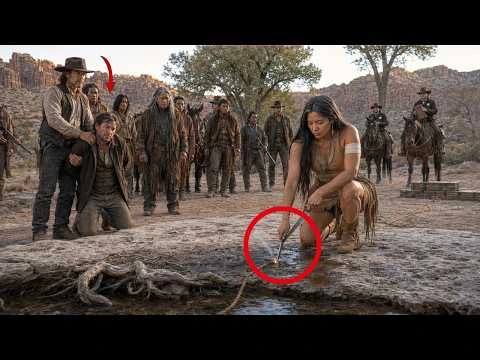
A Cowboy Saved a Lost Apache Girl—Then Her “Dead” Mother Walked Out of the Desert Alive
Part 1 — The Girl Beneath the Mesquite
Arizona Territory, 1889.
Daniel Mercer saw the footprints before he saw the child.
They crossed the open desert in a wavering line, too small to belong to an adult and too uneven to belong to someone who still had strength. For nearly half a mile, the tracks remained deep and steady. Then the stride shortened. The left foot began dragging. Near a dry mesquite bush, the trail disappeared.
Daniel pulled his chestnut gelding to a stop.
The noon sun pressed against his shoulders like a heated iron. Nothing moved across the flats except drifting dust and the shadow of a circling hawk.
He dismounted and approached the bush carefully.
A young Apache girl lay curled beneath its brittle branches. She could not have been older than nine. Her buckskin dress was gray with dust, her black hair covered half her face, and both hands were locked around an empty leather water pouch.
Daniel dropped to one knee.
“Can you hear me?”
Her eyelids moved.
She tried to pull away, but she had no strength left.
Daniel removed his hat and held it above her face, creating a little shade. Then he uncorked his canteen.
The girl reached for it desperately.
“Slowly,” he said. “Too much at once will make you sick.”
She didn’t understand every word, but she understood his voice.
He wet a cloth and pressed it against the back of her neck before giving her a few drops of water at a time.
After several minutes, her breathing steadied.
“My mother told me to keep walking,” she whispered.
Daniel looked toward the southern horizon.
“Where is your mother?”
The girl pointed south.
“She made the men follow her.”
“What men?”
“Three riders. One had a black scarf. Their horses had crow marks.”
Daniel’s expression hardened.
He knew that brand.
It belonged to Silas Ror, a freight and mining operator who owned warehouses, wagons, hired guns, and enough corrupt connections to make trouble disappear from Tucson to the territorial line.
Ror had tried to buy Daniel’s ranch three times.
Daniel gave the girl another careful drink.
“What is your name?”
“Tala.”
“And where are you supposed to go?”
She looked at him.
“A house with a blue door.”
Daniel went still.
His ranch had a blue door.
It had been painted that color by his late wife, Rebecca, before fever took her and their five-year-old daughter, Grace, six years earlier.
“How does your mother know about my house?”
“She knows every water road.”
Daniel studied the girl.
If Tala’s mother had deliberately sent her toward Dry Creek Ranch, then she had trusted a stranger with her daughter’s life.
That was a dangerous kind of trust.
Daniel wrapped Tala in his spare shirt, lifted her into the saddle, and mounted behind her.
“We’re going to the blue door.”
Tala leaned weakly against him.
“My mother will come there.”
Daniel could not promise that.
Instead, he said, “We’ll find out what happened.”
By evening, Tala was resting inside Daniel’s cabin, eating small spoonfuls of broth.
Then she told him everything.
Her mother’s name was Ayana.
Three riders had chased them near the old freight road. Ayana had hidden Tala beneath a rock shelf, given her the last of their water, and ordered her to walk north toward the blue door.
Then Ayana had ridden south, dragging a blanket behind her horse to create a false trail.
She wanted the riders to follow her instead.
Daniel listened in silence.
He knew what that meant.
Ayana had deliberately separated herself from her daughter.
And she might already be dead.
That night, three riders stopped outside Daniel’s cabin.
The man in the black scarf called from the darkness.
“Mercer! We’re looking for a missing child.”
Daniel stepped onto the porch.
“What child?”
“A girl. Nine or ten. Apache.”
“Why would you think she’s here?”
The rider smiled.
“Silas Ror wants her recovered.”
Daniel glanced toward the blue door behind him.
“Nobody under my roof belongs to Silas Ror.”
The smile vanished.
“Move aside.”
Daniel didn’t move.
After a tense silence, the riders turned away.
“Ror will hear about this.”
“I expect he already knows.”
The horses disappeared into the darkness.
Daniel returned inside.
Tala stood at the end of the hallway, clutching a blanket around her shoulders.
“You could have given me to them.”
“I could have.”
“Why didn’t you?”
Daniel looked at her.
“Because you were afraid of them.”
Tala reached beneath her dress and removed a small turquoise bracelet.
“My mother made this.”
Three spaces in the bracelet were empty.
“She lost some beads,” Daniel said.
Tala shook her head.
“She uses them to mark a trail.”
Daniel stared at the bracelet.
Three missing beads.
Three markers.
Ayana hadn’t simply disappeared.
She had left a trail for someone to follow.
And if Tala was right, Daniel had not yet found her mother.
He had only found the beginning of the trail.
Would you have followed the clues into the desert knowing Ayana might already be dead—or would you have stayed at the blue door to protect Tala from the men hunting her?
#WesternStory #CowboyStory #ApacheStory #ArizonaTerritory #FrontierMystery #HistoricalRomance
Part 2 — The Trail of Three Turquoise Beads
At dawn, a dozen Apache riders appeared along the eastern ridge.
Daniel stepped onto the porch with his rifle lowered but ready.
Their leader was an elderly man with silver hair and a weathered face.
“I am Nantan,” he said in careful English. “Ayana is my sister’s daughter. Tala is her child.”
Tala ran toward him.
Nantan dropped to one knee and held her tightly while speaking rapidly in Apache.
When he finally stood, his eyes were wet.
“She says you saved her.”
“I found her near the dry wash.”
Nantan’s expression changed.
“Ayana’s horse was found near Black Tooth Ravine. There was blood on the saddle.”
“Did you find her body?”
“No.”
“Then she’s not dead.”
Nantan studied him.
“You know something?”
Daniel showed him the turquoise bracelet.
“Three beads are missing. Tala says her mother uses them to mark a route.”
Nantan stared at the bracelet.
“Ayana would only do that if she expected someone to follow.”
An hour later, Daniel, Tala, Nantan, and four riders reached the place where Ayana had hidden her daughter.
Beneath a creosote bush, they found the first turquoise bead inside a circle of three stones.
Farther south, beside a dry stream bed, they found the second.
Near it lay a torn piece of buckskin.
Daniel crouched over the tracks.
“One person,” he said. “Walking. Left leg injured.”
The trail continued south.
Near a juniper, Tala found the third bead.
Beyond it stood an abandoned freight station.
Ror’s crow brand had been burned into the wooden wall.
Inside, they discovered medicine crates, stolen food, water jars, maps of wells and ranches, and forged property documents.
Daniel found Dry Creek Ranch circled on one of the maps.
Silas Ror wasn’t merely chasing an Apache woman.
He was deliberately poisoning wells and driving families from their land so he could buy their properties cheaply and control the valley’s only dependable water source.
Then they heard three slow knocks from behind the western wall.
Everyone froze.
The sound came again.
Tala ran forward.
“Mother!”
A weak voice answered from beyond the boards.
“Tala?”
Daniel removed two loose planks and found a collapsed mining passage beneath the station.
Ayana was alive somewhere beyond it.
She had been trapped underground for two days after Ror’s men collapsed the passage, believing they had killed her.
Daniel studied the broken beams.
“This can’t be rushed.”
For three hours, they carefully removed stone and timber while Ayana guided them from the darkness.
Finally, a narrow opening appeared.
Daniel crawled through.
Ayana sat against the tunnel wall, pale and exhausted, one arm wrapped in a bloodstained cloth.
Daniel offered his hand.
“I can carry you.”
Ayana looked toward the opening.
“My daughter is waiting.”
“She is.”
“Then I will walk.”
Together, they brought her into the morning light.
Tala broke free from Nantan’s grasp and ran into her mother’s arms.
For a moment, everyone stood silent.
The woman they had believed dead had walked out of the darkness alive.
But Ayana’s relief lasted only seconds.
“We cannot stay here,” she whispered.
Daniel looked at her.
“Why?”
“Ror’s men are planning something much worse.”
She pointed toward the distant hills.
“They are going to destroy the spring.”
Daniel’s blood ran cold.
His spring.
His ranch.
The water that had kept the valley alive for decades.
And the men who wanted it were preparing to destroy it before sunrise.
If Ayana had survived two days trapped underground, what else had she discovered inside that hidden passage—and could Daniel stop Silas Ror before the explosion destroyed the water that kept the entire valley alive?
Part 3 — The Woman Who Walked Out of the Desert
Ayana could barely stand, but she refused to remain behind.
Daniel wanted to argue.
“You’ve been trapped underground for two days.”
Ayana tightened the bandage around her shoulder.
“I also know the eastern passage into the spring.”
Nantan looked between them.
“She knows the land beneath the hills better than anyone.”
Daniel glanced at Ayana’s injured shoulder.
“You may not survive another ride.”
Ayana met his eyes.
“You saved my daughter. You found me. But this is my fight too.”
Daniel understood then that he had almost made the same mistake as the men who had hunted her.
He had confused concern with authority.
So he stepped aside and handed her the reins.
“Then tell me where you need me.”
Something softened in Ayana’s expression.
“Now you’re listening.”
Before dawn, Daniel, Ayana, Nantan, and several Apache riders returned to Dry Creek Ranch.
They approached from the southern trail.
Lights were moving near the spring.
Silas Ror had already arrived.
Eight armed men stood around several wooden crates filled with blasting powder. A fuse disappeared into a crack above the limestone shelf that fed Daniel’s spring.
If the shelf collapsed, the water channel would be buried.
The entire valley could lose its only reliable source of water.
Daniel rode into the open alone.
Silas turned toward him.
“Mercer.”
“You’ve been busy.”
“I warned you about choosing the wrong side.”
Daniel dismounted.
“You poisoned wells, stole government supplies, forged land deeds, and tried to bury a woman alive.”
Silas smiled.
“You have no proof.”
Daniel looked toward the crates.
“Your men left a ledger at the freight station.”
For the first time, Silas’s expression changed.
“What ledger?”
“The one naming your workers and listing the properties you planned to acquire.”
Daniel paused.
“The forged deeds were there too.”
One of the armed men lowered his rifle slightly.
Silas noticed.
“He’s bluffing.”
A voice came from the ridge.
“He isn’t.”
Nantan and the Apache riders appeared above the spring.
At the same moment, three neighboring ranchers emerged from the western trail.
Daniel had sent word to them before leaving the freight station. Their families had already suffered from contaminated wells.
One rancher raised his rifle.
“My youngest son nearly died from that water.”
Another said, “And you tried to buy my land after my cattle started dying.”
Silas looked around.
For the first time, the men who had worked for him no longer looked certain.
“You’re all making a mistake,” he snapped.
Daniel shook his head.
“No. We’re finally looking at the same evidence.”
Silas’s hand moved toward his revolver.
Nantan raised his rifle.
“Don’t.”
Silas ignored him.
He drew.
The crack of a gunshot echoed across the valley.
But the bullet struck the dirt.
Daniel had already moved.
He tackled Silas away from the spring.
They crashed beside the water channel.
Silas reached for a knife.
Daniel caught his wrist.
For one violent second, Daniel considered ending it.
He remembered Tala lying beneath the mesquite bush.
He remembered the fear in her voice.
He remembered Ayana trapped underground.
And he remembered what it felt like to lose Rebecca and Grace, knowing there was nothing he could do to save them.
Silas had taken everything from people who could not fight back.
Daniel wanted to give him the same terror.
Then he heard Tala’s voice in his memory.
You could have given me to them.
Daniel loosened his grip.
“No.”
Silas stared at him.
“What?”
“You’re going to face a court.”
Daniel forced his arm behind his back and held him down.
“You don’t get to choose how this ends.”
Above them, the fuse was burning.
Ayana had already disappeared toward the eastern passage.
She reached the limestone shelf from below and found the final length of fuse stretched across damp ground.
The flame raced toward the powder.
Ayana pulled her knife and cut the fuse.
The flame reached the wet section.
It sputtered.
Then it died.
Silence fell over Hidden Spring.
A few seconds later, hoofbeats thundered from the north.
Marshall Avery arrived with six territorial deputies.
Behind him rode two men carrying the ledger and forged deeds from the freight station.
Silas looked toward the approaching lawmen.
His face went pale.
By sunrise, he was in restraints.
Five of his men were arrested with him, while the remaining workers agreed to testify about the operation.
The stolen medicine and food were recovered.
The contaminated wells were documented.
And the forged land deeds revealed the larger plan: Silas Ror had intended to make the valley unlivable, buy abandoned properties for almost nothing, and control the water that remained.
For once, the desert itself had preserved the evidence he thought he had buried.
The trial took months.
Silas was eventually convicted of land fraud, theft of government supplies, poisoning public water, attempted murder, and conspiracy.
His company assets were sold to compensate affected families.
The abandoned freight station was turned into a desert rescue post.
But the greatest change happened at Dry Creek Ranch.
Ayana recovered slowly.
Daniel gave her the room Tala had used.
He placed the key in her hand.
“This locks from the inside.”
Ayana turned it over.
“And if I decide to leave?”
“The door opens from both sides.”
She looked at him carefully.
“Many men offer shelter and expect obedience in return.”
“I’m not offering that.”
Daniel glanced toward the blue door.
“I’m offering a room.”
Ayana remained silent.
“And nothing more?”
“Nothing you don’t choose.”
She slipped the key into her belt.
“Then I’ll stay tonight.”
It was not a promise.
Daniel didn’t ask for one.
For the first time in years, he was learning that some things became more meaningful when they were freely chosen.
Over the following weeks, the valley slowly began to recover.
Apache healers treated families who had become sick from contaminated wells.
Neighboring ranchers repaired damaged irrigation channels.
Daniel hauled clean water from the spring.
Nantan helped establish a permanent agreement allowing Apache families and local settlers to reach the water during drought.
Suspicion did not disappear overnight.
But people working beside one another had fewer reasons to believe the stories they had once told about each other.
Tala became a permanent presence at Dry Creek.
She learned to feed chickens, repair leather tack, and recognize clouds that might bring rain.
In return, she taught Daniel which desert plants stored water beneath their roots.
One afternoon, Tala brought something from Daniel’s old bedroom.
Rebecca’s wooden horse.
Daniel froze when he saw it on the kitchen table.
“Where did you find that?”
“On the shelf.”
“It belonged to my daughter.”
Tala looked at him.
“Can I hold it?”
Daniel nodded.
She carefully touched the carved wooden horse.
“Where is she?”
Daniel looked toward the cottonwoods.
“She died a long time ago.”
Tala was quiet.
Then she said, “My mother says people remain where love remembers them.”
Daniel looked at Ayana standing outside beneath the trees.
For six years, he had treated memory like a locked room.
He had believed that if he opened the door, the pain would come rushing back.
But perhaps the pain had never been the only thing inside.
There had also been love.
And maybe love did not disappear simply because someone was gone.
At the end of summer, Ayana prepared to return to her people.
Daniel helped secure her belongings behind the saddle.
Neither spoke about what her departure meant.
Tala climbed onto her pony.
“Will the blue door still be here?”
Daniel smiled.
“Unless the wind carries it away.”
“You should paint it again.”
“Maybe next spring.”
Ayana looked at him.
“You could paint it now.”
“I could.”
“Then why wait?”
Daniel looked toward her.
“Some things are easier to promise when the future feels far away.”
Ayana understood.
“And some things remain unfinished because a person is afraid to begin.”
She turned her horse toward the southern trail.
Daniel did not ask her to stay.
He knew better now.
Ayana did not need another person deciding where she belonged.
She needed to decide for herself.
So she left.
But she did not disappear.
They met again at the rescue station, then again at Dry Creek, then again along the valley trails.
Their affection grew through ordinary things.
Ayana corrected Daniel’s wasteful way of searching for groundwater.
Daniel repaired the wooden case that held her medicines.
They argued about which trail was safest through Dry Bone Canyon.
They laughed when Tala painted the rescue station door an uneven shade of blue.
Nothing between Daniel and Ayana was owed.
Nothing was demanded.
And perhaps that was why it lasted.
One year after Daniel found the footprints, spring rain transformed the valley.
Wildflowers spread across the flats where Tala had nearly died.
The spring ran clear.
Travelers stopped at the rescue station for water.
Apache families and ranchers gathered beneath the cottonwoods during the station’s dedication.
Daniel stood outside his house, looking at the freshly painted blue door.
Then he saw two horses approaching.
Tala rode beside Ayana.
Their horses carried more belongings than a short visit required.
Ayana stopped at the gate.
“Is the room still empty?”
Daniel nodded.
“The key still works.”
“That isn’t what I asked.”
He looked at her.
And this time, he understood.
“The room is yours if you want it.”
Ayana waited.
“And the rest of the house.”
Daniel took a slow breath.
“The rest of my life, too.”
He paused.
“But only if you choose it.”
Ayana’s expression softened.
“I chose before we left last autumn.”
Daniel smiled.
“Then why did you wait a year?”
“Because you needed time to understand that opening a door isn’t the same as losing what was behind it.”
Daniel looked toward the graves of Rebecca and Grace beneath the cottonwoods.
For the first time, remembering them did not feel like betraying the living.
It felt like carrying their love forward.
Tala jumped from her horse and ran toward the house.
She pushed open the blue door.
Ayana followed slowly.
Daniel stood at the threshold.
A year earlier, he had found a lost child beneath a dying mesquite bush and believed he was simply saving her from the desert.
He had been wrong.
Tala had led him to a woman who had fought her way back from the darkness.
She had led him to a family he never expected.
She had forced him to confront the grief he had buried for six years.
And she had taught him that sometimes the people who arrive unexpectedly are not replacing the ones we lost.
They are helping us remember how to live again.
A family appeared along the northern trail that afternoon, their wagon broken and their water nearly gone.
Tala saw them first.
She ran toward the trough with a clay jar.
Daniel brought bread from the kitchen.
Ayana opened the gate.
Together, they welcomed the strangers into the shade.
The blue door remained open behind them.
Not because anyone had forgotten those who were gone.
But because love had finally made room for those who chose to stay.
If you had been Daniel, would you have opened your heart to Ayana after everything the desert had taken from you—or would the fear of losing someone again have kept you behind that blue door?
(Descargo de responsabilidad: Este contenido puede haber sido generado por IA con fines de entretenimiento. Cualquier parecido con personas, eventos o lugares reales es pura coincidencia.)