A Human Woman Gave a Dragon Hatchling a Broken Calculator—Weeks Later, the Dragon Returned With Something Impossible
A Human Woman Gave a Dragon Hatchling a Broken Calculator—Weeks Later, the Dragon Returned With Something Impossible
PART 1 — THE BROKEN CALCULATOR
The ridge smelled of iron and old rain. Riley Cole had been sitting on the same flat boulder for nearly twenty minutes, eating a sandwich with one hand while studying a geological survey report with the other. Her equipment lay scattered around her in the careless arrangement of someone who had worked field surveys for so many years that she no longer worried about every little detail: soil cores, plastic tubes, a battered notebook, and an old pocket calculator hanging dangerously close to the edge of the rock.
The calculator was barely worth keeping. Its casing was cracked, the solar panel worked only when it felt like it, and Riley had been meaning to replace it for almost a year.
She never noticed the small dragon watching her.
Dreva was a young Drafan hatchling, roughly equivalent to a human six-year-old, with golden scales fading into teal at the tips of her wings and enormous amber eyes. She had been secretly visiting the human side of the ridge for weeks, fascinated by the strange soft creatures who carried so many mysterious objects.
That afternoon, curiosity finally won.
Dreva crept toward the boulder, picked up Riley’s calculator, and pressed a button.
A zero appeared.
Her eyes widened.
Another button produced a one.
Then a two.
Dreva sat down immediately.
Riley opened one eye.
She watched the dragon carefully press the buttons again and again, staring at every number as if she had just discovered a doorway into another universe.
When their eyes finally met, Dreva froze.
Riley slowly raised both hands.
“You can have it.”
Dreva stared at her, then at the calculator.
She hugged it against her chest and walked away with extraordinary dignity.
Riley smiled.
“That’s going to become paperwork.”
She was right.
But what Riley did not know was that the broken calculator was about to become the most important gift humanity had ever given the Drafan.
Eleven days later, Dreva was still awake, surrounded by hundreds of stone tablets covered in numbers, symbols, arrows, and strange mathematical patterns.
Then her older sister Sara walked into the chamber and stopped dead.
At the center of the room sat the human calculator.
Around it was the first complete map of human arithmetic ever created by a Drafan hatchling.
And Dreva was still searching for the rules hidden inside it.
What do you think Dreva will discover inside the strange little machine, and how will Riley react when she learns what her “broken calculator” has started? Share your thoughts about the characters and this mysterious discovery in the comments!
#HFY #DragonStory #DragonHatchling #SciFiStory #HumanityFirst #AlienEncounter #SpaceStory #FantasySciFi #UnexpectedGift #StoryTime #ViralStory #HumanIngenuity
PART 2 — THE DRAGON WHO LEARNED HUMAN MATHEMATICS
Sara had expected to find her younger sister playing.
Instead, she found Dreva conducting experiments.
Every stone on the floor represented another discovery. Addition, subtraction, multiplication, division, memory functions, repeated operations, and relationships between numbers were all carefully mapped in Drafan notation.
“The machine follows rules,” Dreva explained. “It never forgets them. It never becomes tired. It does not need to think before giving the correct answer.”
Sara stared at the floor.
“You understood all of this in eleven days?”
“I understood what I could see.”
That answer frightened Sara more than it impressed her.
Three weeks after Riley had given away the calculator, a full-grown Drafan named Sara appeared at the human settlement. She returned every morning, silently watching engineers repair machinery, study instruments, and operate computers.
On the fourth day, Riley approached her.
Neither spoke.
They simply stood several meters apart and watched the engineers work.
Two days later, Dreva returned to the ridge.
She carried the calculator in one claw and a large stone covered in mathematical symbols in the other.
She placed the stone directly in front of Riley.
Riley photographed it and sent the images to Dr. Nell Okapor, the station’s chief scientist.
Nell called back almost immediately.
“Riley, do you understand what you’re looking at?”
“Not really.”
“She mapped the calculator.”
Riley looked at Dreva.
Nell continued, “Not just the numbers. The entire behavioral logic. Input, output, inverse operations, memory functions. She reconstructed the machine’s mathematical structure without ever opening it.”
Riley slowly sat down.
Then Dreva asked her one simple question.
“Are there larger counting machines?”
Riley hesitated.
“There are much larger ones.”
Dreva’s amber eyes became enormous.
And that was the moment Riley realized the broken calculator had not ended the exchange between humans and dragons.
It had only opened the door.
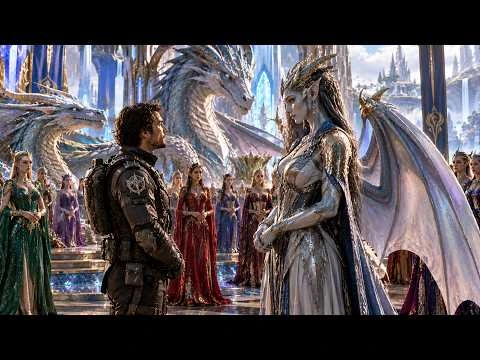
Soon, Riley and Nell received an invitation into the ancient Drafan cliff city of Ath, where Dreva’s mother and elders were waiting.
But when the oldest Drafan elder asked the humans whether their machines could think, Riley discovered that the real mystery was no longer what Dreva had learned from humanity.
It was what humanity had failed to share.
If you were Riley, would you be nervous about entering a civilization that had just discovered the limits of human technology—and what would you expect Dreva to build next? Share your thoughts about Riley, Dreva, and the growing bond between the two civilizations in the comments!
PART 3 — THE MACHINE THE DRAGON BUILT
The city of Ath was carved directly into the face of a colossal cliff, its chambers connected by passages that opened toward the sky. Wind moved through the entire city, carrying distant voices, wingbeats, and the deep echoes of ancient stone. Riley had worked on Veilos for years, yet standing inside Ath felt like stepping into a civilization that had been waiting centuries for someone to finally ask the right question.
Dr. Nell walked beside her, translating carefully as the Drafan elders greeted them.
At the center of the courtyard stood Ireindi, the ancient matriarch of Dreva’s family. Her golden scales had faded at the edges with age, but her eyes remained sharp.
She studied Riley for a long moment before speaking.
Nell translated.
“She wants to know whether human machines think.”
Riley considered the question before answering.
“They calculate extremely quickly. They follow rules. They do not understand what those rules mean, and they do not wonder why the rules exist.”
Ireindi remained silent.
Then she looked toward the young dragons gathered behind her.
“My daughter understood that difference,” she said.
Riley glanced at Dreva.
The hatchling stood proudly beside a stone covered in mathematical notation.
“She says your machine did not teach Dreva how to understand,” Nell translated. “It showed her that understanding was possible.”
Those words stayed with Riley long after the meeting ended.
For forty years, humans and Drafan had lived beside one another on Veilos. They had exchanged food, maps, building materials, and occasional technical assistance. They had respected each other’s boundaries so carefully that neither civilization had thought to ask what knowledge the other might want.
The broken calculator changed that.
The humans began supervised mathematics sessions in Ath three times a week. Riley brought old textbooks from the station. Nell taught arithmetic, algebra, geometry, trigonometry, binary logic, and the foundations of computing.
Dreva absorbed everything.
She never seemed satisfied with an answer.
Whenever Nell solved a problem, Dreva wanted to know why the method worked. When Nell explained the reason, Dreva wanted to know whether the same principle worked under different conditions. When Nell answered that question, Dreva immediately found another question hidden inside it.
Six months later, Dreva stopped attending one of the lessons.
For eleven days, nobody knew where she was.
On the twelfth morning, she returned carrying a package wrapped in woven Drafan fiber.
She placed it on the table in front of Riley.
“I made something.”
Dreva carefully removed the wrapping.
Riley stared.
It was a calculator.
But it was not human.
The device had been constructed from carved stone, polished obsidian, mineral springs, and precisely fitted mechanical registers. Each button could be pressed with a claw tip. When activated, the internal mechanisms moved in carefully controlled sequences, causing carved number wheels to rotate until the answer appeared.
Riley picked it up.
“You built this?”
Dreva nodded.
“It is slower than yours,” she admitted, “but it does not require sunlight, electricity, or human materials.”
Riley pressed a few buttons.
Four plus three.
The stone registers moved.
Seven appeared.
She tried another calculation.
It worked again.
Nell was staring at the exposed mechanism.
“Dreva,” she whispered, “how did you organize the recursive functions?”
Dreva tilted her head.
“I changed the structure.”
She explained that human machines were built around binary logic, where complex calculations were reduced to combinations of two states. The Drafan counting system, however, was based on twelve.
Instead of forcing the machine into two-state logic, Dreva had designed a twelve-state register system.
Each position could hold one of twelve values.
The result was a completely different computational architecture.
Nell went silent.
She grabbed a writing tool and began calculating.
Riley watched her expression change.
“What?”
“There is a known problem in recursive computation,” Nell said. “For decades, engineers have struggled with the way intermediate results accumulate during repeated recursive calls.”
She looked at Dreva.
“You solved it.”
Dreva blinked.
“I did?”
“You didn’t know the problem existed.”
“No.”
“You simply built the system differently.”
Dreva considered that.
“Was I supposed to know?”
Riley laughed.
Nell did not.
She was too busy staring at the machine.
The solution Dreva had created accidentally avoided an efficiency bottleneck that human computer scientists had spent generations trying to improve.
She had not beaten human engineering by copying it.
She had simply approached the problem from a direction humanity had never considered.
That discovery changed Veilos.
Human engineers began studying Drafan twelve-state logic. Drafan scholars began experimenting with positional notation and mechanical computation. The two systems did not replace each other. They grew beside each other, like two rivers flowing through the same valley.
Within a year, three human engineering teams had redesigned climate-control systems using Dreva’s register architecture.
The systems consumed eighteen percent less processing power.
The lead engineer summarized the discovery with a sentence that later became famous across the station.
“We were thinking in the wrong number.”
Dreva became the first Drafan student to publish a mathematical paper with human researchers. The publication system caused several administrative problems because it had no field for species, age, or non-human citizenship.
Counselor Brett Hos invented three forms to solve the problem.
Then he proudly told everyone that the forms had been his idea.
Nell let him believe that.
Meanwhile, Dreva kept learning.
She taught seven other young dragons everything she had discovered.
The original broken calculator was placed in a secure laboratory display beside Dreva’s stone calculator.
A small plaque stood between them.
ON LOAN FROM DREVA OF ATH. YEAR ONE.
Riley had written it herself.
One afternoon, she returned to the old ridge where the entire story had begun.
The same flat boulder was still there.
She sat down with her lunch and looked toward Ath.
After a few minutes, Sara landed beside her.
The enormous dragon folded her wings and settled onto the stone.
“Dreva wants to see the larger machines,” Sara said.
Riley smiled.
“I expected that.”
“She wants to know whether the computers on other worlds are different.”
“They are.”
“Will she understand them?”
Riley looked toward the distant cliffs.
“She’ll probably understand them faster than we do.”
Sara made a strange rumbling sound.
Riley had heard it before.
Nell had eventually confirmed that it was laughter.
“She has always been a problem,” Sara said.
Riley smiled.
“Officially?”
“Always officially.”
They both laughed.
Far away in the cliff city, Dreva was sitting in front of seven younger dragons, teaching them arithmetic.
On the stone before her was a new equation.
She solved it.
Then she stared at the answer.
She frowned.
Something was wrong.
Not with the calculation.
With the question.
Dreva picked up another stone and began writing.
If the rule worked here, would it work beyond the largest number?
And if there was no largest number, what existed beyond the edge of what could be counted?
She continued writing.
Riley packed her equipment and prepared to leave the ridge.
Before she stood, her comm unit chimed.
A message from Nell appeared.
Dreva has another question.
Riley smiled.
Of course she did.
She opened the message.
The question was only one sentence.
What happens when a machine becomes powerful enough to calculate something no living mind can calculate?
Riley stared at it for several seconds.
Then she looked toward Ath.
For forty years, humanity had believed it was bringing technology to Veilos.
Now Riley understood the truth.
Humanity had brought a broken calculator.
The dragons had returned with a new way of thinking.
And somewhere beyond the edge of the known mathematics, a gold-and-teal hatchling was already looking for the next question.
THE END
(Descargo de responsabilidad: Este contenido puede haber sido generado por IA con fines de entretenimiento. Cualquier parecido con personas, eventos o lugares reales es pura coincidencia.)