HE SAVED A LOST APACHE GIRL IN THE DESERT — THEN HER MOTHER WALKED OUT OF THE WILDERNESS
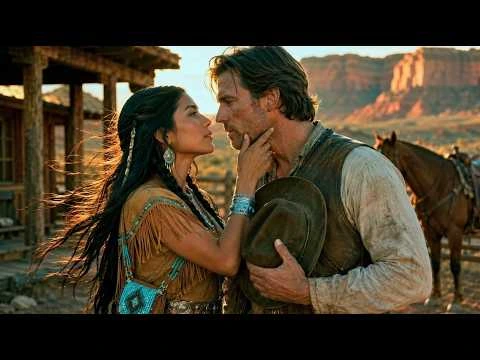
PART 1 — SHE WAS THE ONLY ONE LEFT ALIVE… OR SO HE THOUGHT
HE SAVED A LOST APACHE GIRL IN THE DESERT — THEN HER MOTHER WALKED OUT OF THE WILDERNESS
The smoke had almost disappeared by the time Jonah Pruitt found the girl.
It was early morning in the Arizona Territory, late spring of 1884, and the desert was already beginning to burn beneath the rising sun. Eight miles south of Dry Fork, Jonah followed a thin gray smear toward a dry wash beneath the Sawtooth Ridge, expecting to find the remains of a camp.
Instead, he found a child.
She was sitting alone beneath an eroded bank, her knees pulled tightly against her chest, her torn dress covered in dust, and a dark cut dried above her left ear. She could not have been more than eight years old.
Around her lay the remains of three burned wickiups, broken pottery, a charred cradleboard, and scattered pieces of woven basket.
Jonah understood immediately.
This had not been an accident.
Someone had come before dawn, burned the camp, and left nothing behind but ashes.
He crouched several feet away from the child and kept his hands where she could see them. He told her quietly that he would not hurt her, although he had no idea whether she understood a single word.
For a long moment, she simply stared at him.
Then she slowly crawled out from beneath the bank.
Jonah gave her water and food, and when she finally ate, she did so with the desperation of someone who had not eaten in more than a day.
He brought her home.
He called her Little One until, several mornings later, she pointed at herself and whispered a name.
“Maska.”
Jonah repeated it carefully.
“Maska.”
She nodded.
For the first time in three years, the empty house did not feel completely empty.
But Jonah did not know the truth about the burned camp.
He did not know that someone had survived.
He did not know that a woman had watched the flames from the mountainside, believing her daughter was dead.
And he certainly did not know that, somewhere beyond the desert, that woman had already begun walking toward him.
Weeks later, just as Jonah and Maska had started building a fragile life together, Maska suddenly stopped in the middle of the yard.
She was staring toward the southern horizon.
Jonah followed her gaze.
At first, he saw nothing.
Then a figure appeared between the creosote bushes.
A woman.
Thin, exhausted, covered in dust, and walking as though every step had been purchased with pain.
Maska suddenly screamed her name and ran.
Jonah froze.
Because the woman did not look like a stranger.
She looked like a mother who had crossed the desert believing there was nothing left to find.
And when she dropped to her knees and wrapped both arms around Maska, Jonah realized the story he thought he understood had only just begun.
What would you do if the child you rescued suddenly found the mother everyone believed was dead? And who was really responsible for the fire that destroyed their home?
#WesternStory #ApacheStory #DesertTales #OldWestStories #EmotionalStory #HistoricalFiction #StoryTime #AmericanWest #FamilyStory #FrontierTales
PART 2 — THE WOMAN WHO WALKED FORTY MILES FOR HER DAUGHTER
SHE WALKED FORTY MILES THROUGH THE DESERT FOR HER DAUGHTER — THEN FOUND A MAN WHO HAD NOTHING LEFT TO LOSE
Her name was Itza.
For days after the raid, she had believed Maska was dead.
Itza had been away from the camp before sunrise, gathering sotol stalks along a ridge above the wash, when she saw smoke rising from below. She watched helplessly as armed riders moved through the camp, setting fire to the shelters and disappearing before she could reach them.
When she finally returned, there was almost nothing left.
No husband.
No child.
No certainty that anyone had survived.
She mourned beside a distant spring for several days, but grief could not keep her there forever.
If Maska was alive, Itza would find her.
She began asking travelers, traders, shepherds, and Apache runners whether they had seen a young girl traveling alone.
Then, weeks later, a Tohono O’odham traveler told her about an isolated ranch south of Dry Fork where a white rancher was keeping an Apache child.
Itza walked the final forty miles.
When she reached Jonah’s ranch, she expected to take Maska and leave immediately.
Instead, she found her daughter alive, fed, protected, and standing beside a man who had given the child a room, a candle at night, and enough patience to let her trust the world again.
Itza stayed one night.
Then two.
Soon she was helping around the ranch, repairing canvas, carrying water, preparing food, and teaching Jonah things about horses and the desert that he had never known.
Something quiet began to grow between them.
But the peace could not last.
A man named Decker, one of the ranchers rumored to have been involved in the raid, arrived with armed men and demanded that Jonah surrender Itza and Maska.
Jonah refused.
Then Itza stepped around the corner carrying his Winchester.
She raised the rifle and aimed directly at Decker.
The message was unmistakable.
This was no longer a frightened woman searching for a lost child.
She had found her daughter.
And she had found a place worth defending.
Decker finally turned his horse away, but before he left, he made one promise.
“This isn’t finished.”
That night, Jonah thought the danger had passed.
He was wrong.
After midnight, two riders returned carrying burning torches, heading straight toward the ranch house.
Jonah woke to the sound of horses.
Itza was already awake.
And this time, they were not going to wait for the attackers to reach the door.
Would Jonah and Itza survive the attack, and could two wounded people really build a family while the men who destroyed their old lives were still coming for them?
PART 3 — THE FAMILY THEY BUILT FROM THE ASHES
THEY CAME TO BURN HER AGAIN — BUT THEY DIDN’T KNOW WHAT THIS FAMILY HAD BECOME
The first torch never reached the house.
Jonah fired from the loft of the barn, and the shot struck the ground directly in front of the lead rider, forcing the man to jerk his horse sideways and drop the torch.
The second rider froze.
For several seconds, the only sound was the nervous breathing of the horses and the faint crackle of dry grass beneath the fallen flame.
Then another rifle hammer clicked.
Itza stood beside Jonah in the darkness.
Neither of them spoke.
They did not need to.
The men turned their horses and disappeared into the desert.
By morning, Jonah had already made his decision.
He rode into Dry Fork and went straight to Sheriff Holloway.
He told him everything.
He told him about the burned Apache camp in the wash, about the armed men who had come to his ranch, about Decker’s threats, and finally about the attempt to burn his home.
Holloway listened.
Unlike the men at the army post months earlier, he did not dismiss the story as another frontier disturbance.
He rode out that afternoon.
The investigation was not grand, and justice was not perfect, but it was enough to make Decker understand that the land around Dry Fork was no longer as easy to intimidate as he had believed.
Before winter, Decker sold his grazing rights and left the county.
Jonah never celebrated.
He simply rode home.
When he entered the kitchen, he found Maska sitting at the table with a small slate in front of her.
Itza was teaching her the days of the week.
Monday.
Tuesday.
Wednesday.
The girl carefully copied each word.
Jonah stood in the doorway for a moment and watched them.
Three months earlier, his house had been a collection of empty rooms.
Now someone was writing on his slate.
Someone was cooking at his stove.
Someone was waiting for him to come home.
And a little girl who had once hidden beneath a riverbank was arguing with her mother about how to spell Wednesday.
It was such an ordinary scene that Jonah almost laughed.
He had spent three years believing that grief had permanently changed the shape of his life.
Perhaps it had.
But perhaps grief was not the end of a life.
Perhaps it was simply one room in the house.
One that did not have to remain occupied forever.
That Sunday morning, Maska went down to the creek to gather cattail rushes.
Jonah stayed in the kitchen with Itza.
For a while, neither spoke.
The silence between them was no longer uncomfortable.
It had become familiar.
Finally, Jonah said, “I don’t know what comes next.”
Itza continued drying a tin cup.
He looked down at his hands.
“I haven’t known for three years.”
He paused before adding, “But lately, I’ve noticed something.”
She looked at him.
“I don’t want the house to be quiet anymore.”
Itza said nothing.
Jonah continued.
“I thought silence was what I wanted after Clara died. I thought if nothing changed, nothing else could hurt me.”
He looked toward the window.
“But Maska changed that.”
Itza lowered the cup.
“So did you,” Jonah said.
She watched him carefully.
Then she told him about the forty miles she had walked through the desert.
She told him that she had expected to find Maska and leave.
She had never planned to stay.
She had never imagined living beside a man whose grief was as deep as hers, or waking in a house where her daughter could sleep without fear.
“I did not expect you,” she said.
Jonah smiled faintly.
“I didn’t expect you either.”
Itza looked toward the creek.
Then she said something that stopped him completely.
“Maska calls you father.”
Jonah stared at her.
He had never heard it.
“She does it when she thinks you cannot hear.”
For a moment, he could not find an answer.
Then he asked quietly, “Is that all right?”
Itza nodded.
“She chooses the word herself.”
Jonah looked toward the doorway.
Outside, Maska was singing that old lullaby again, the same melody she had hummed when she first arrived at his ranch.
Only now there was no fear in her voice.
She was simply happy.
Jonah looked back at Itza.
“I think,” he said slowly, “I would like to deserve that name.”
Itza smiled.
“You already do.”
After that, nothing happened quickly.
There was no sudden transformation, no perfect ending, no moment when every wound disappeared.
Instead, there were ordinary days.
They worked.
They ate together.
They argued occasionally about horses, weather, money, and the best way to repair a fence.
Itza taught Maska the things her mother had taught her.
Jonah taught the girl to read.
Maska taught both adults that a child could turn the most serious conversation into laughter simply by asking an unexpected question.
The house changed too.
Jonah opened the rooms that had remained shuttered for three years.
Itza brought woven rush mats into the empty spaces.
She made small clay pots and placed them near the windows.
She hung baskets along the walls.
The smell of roasting mescal began drifting through rooms that had once smelled only of dust and old furniture.
Little by little, the house stopped being a monument to everything Jonah had lost.
It became a home.
In November, the first cold winds came down from the mountains.
One evening after supper, Jonah asked Itza to step outside with him.
The porch was quiet.
The mountains were dark against the evening sky.
Jonah leaned against the rail.
“I know this isn’t simple,” he said.
Itza waited.
“I know people will have things to say.”
She smiled slightly.
“They already do.”
Jonah laughed.
Then his expression became serious.
“I don’t care about that.”
He took a breath.
“I want you to marry me.”
Itza looked at him for a long time.
There was no pressure in his voice.
No demand.
No assumption.
Only a question.
Finally, she looked toward the house.
Through the window, Maska was pretending not to watch them.
Itza smiled.
“Yes.”
At that exact moment, Maska pushed the door open too quickly, stumbled over the threshold, and nearly fell onto the porch.
Jonah and Itza both burst into laughter.
Maska stood up with as much dignity as an eight-year-old could manage.
“I wasn’t listening,” she said.
Jonah raised an eyebrow.
“Of course not.”
“I wasn’t.”
Itza laughed again.
For Jonah, the sound was almost unbelievable.
He could remember Clara’s laughter.
He had spent years afraid that hearing another woman’s laughter in that house would somehow betray the memory of his first wife.
But now he understood something.
Love did not erase the dead.
It did not replace them.
It simply made room for the living.
Their wedding was small.
There were no grand decorations, no crowded church, and no elaborate celebration.
They stood before the preacher in Dry Fork and said the words they meant.
Maska stood between them.
When it was over, the three of them walked home together.
Nobody had planned for Maska to hold both their hands.
It simply happened.
And somehow, that became the most important part of the day.
Jonah still visited Clara’s grave on the eastern slope.
He still remembered the child they had lost after only eleven days.
Itza carried losses of her own.
Her husband was gone.
Her band had been scattered.
For weeks, she had believed her daughter was dead.
Neither of them pretended those things had disappeared.
They had not.
Grief does not vanish because happiness arrives.
It simply learns to share the same room.
Years later, Jonah would sometimes sit on the porch after Maska had gone to bed, with Itza beside him and the desert spread beneath the stars.
The high desert made strange sounds at night.
Insects moved through the grass.
A coyote called somewhere beyond the ridge.
Cooling stones clicked softly beneath the darkness.
It was easy to mistake all of it for silence.
But Itza once told him that her grandmother had believed the desert spoke only to people who had learned to stop being afraid of it.
Jonah thought about that.
“I am still learning,” he said.
Itza took his hand.
“That is enough.”
And beneath the enormous Arizona sky, Jonah finally understood what had happened to him.
He had not found a new life by forgetting the old one.
It had happened because he opened his door when he had every reason to keep it closed.
He had found a frightened child in the ashes.
The child had led him to her mother.
Her mother had brought courage back into a house built around grief.
And together, the three of them had created something none of them had planned.
Not a perfect life.
Not an easy life.
But a real one.
A family built from loss, trust, patience, and the decision to keep choosing one another when the world outside told them they should not.
The desert had taken almost everything from them.
Yet, somehow, it had also brought them together.
And sometimes that is what survival really looks like.
Not simply staying alive.
But finding the courage to live again.
(Descargo de responsabilidad: Este contenido puede haber sido generado por IA con fines de entretenimiento. Cualquier parecido con personas, eventos o lugares reales es pura coincidencia.)