Her Fiancé Secretly Married His Mistress—Then She Discovered Why He Needed Her £40,000
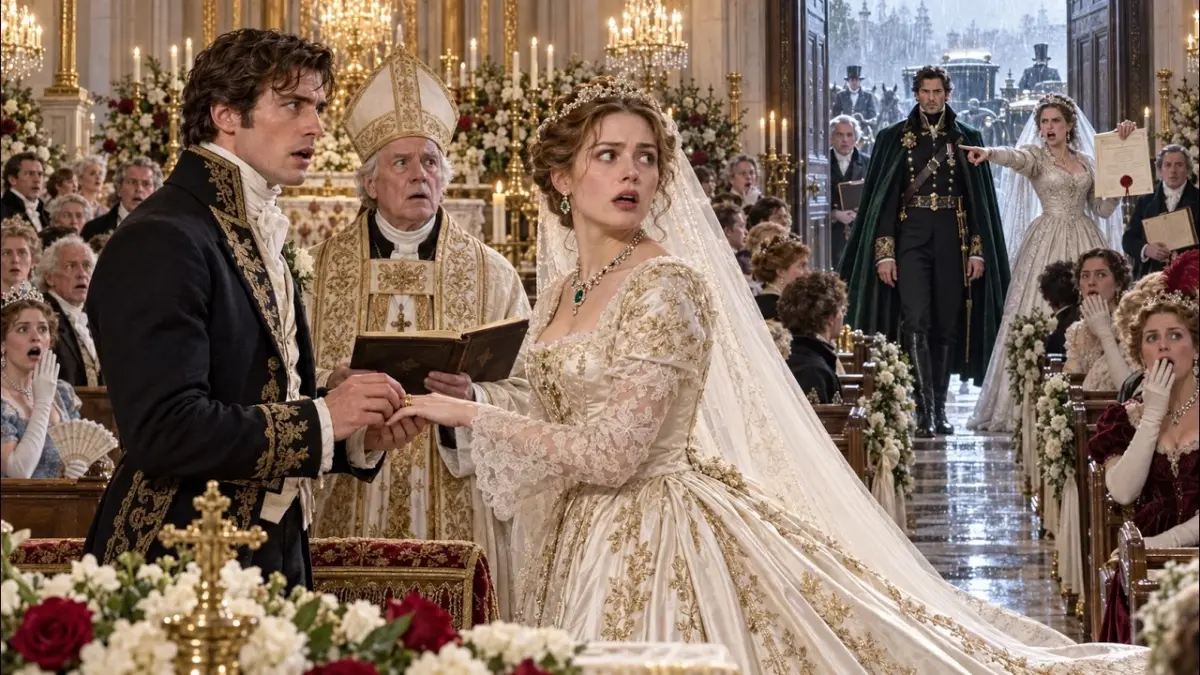
Part 1 — The Bride Who Was Betrayed
Her Fiancé Secretly Married His Mistress—Then She Discovered Why He Needed Her £40,000
Lady Eleanor Hartwell was standing before three tall mirrors, dressed in an ivory wedding gown worth more than most servants earned in a year, when a small parcel arrived that destroyed seven years of her life.
Madame Bisset was still adjusting the final pearl at Eleanor’s waist when the shop boy placed the brown-paper package into her hands. There was no sender’s name, only a note requesting that Lady Eleanor open it herself.
Inside was a miniature portrait.
Her fiancé, Julian Ashkam, Viscount Ravenshaw, stood outside a country chapel with another woman clinging to his arm. Both wore wedding rings.
Beneath the portrait lay a parish record dated three days earlier.
Julian Ashkam and Miss Cesily Bain had been married by special licence.
Eleanor read the document twice before her expression changed.
Then she simply said, “Do not alter the wedding gown.”
That evening, she watched Julian leave his London office with Cesily beside him. He smiled at the young woman with a tenderness Eleanor had not seen from him in months.
The next morning, her solicitor confirmed something even worse.
Julian’s estate was drowning in debt, and several creditors had already been promised that Eleanor’s £40,000 marriage settlement would rescue him.
Julian arrived that evening, still pretending nothing had happened.
When Eleanor placed the parish record before him, his face finally changed.
“I intended to explain after our ceremony,” he said.
“You married another woman before our wedding.”
“It need not change anything.”
Eleanor stared at him in disbelief.
Julian calmly proposed that she continue with the wedding breakfast, pretend to be his wife in society, and allow Cesily to remain hidden.
When Eleanor refused, he smiled coldly.
“You are nearly thirty, Eleanor. A broken engagement will follow you for the rest of your life.”
For seven years, she had mistaken his patience for devotion.
Now she understood.
He had never been waiting to marry her.
He had been waiting for her money.
Eleanor looked toward the ivory gown hanging in the next room and made a decision that would soon shock every house in London.
If Julian wanted a wedding without a marriage, she would give him exactly what he had asked for.
Only the bridegroom would not be Julian.
And when Eleanor finally revealed the man who would take her arm into that crowded wedding breakfast, even Julian would realize that he had made the greatest mistake of his life.
Who could possibly agree to become the “bridegroom” of a woman whose wedding had already become London’s most scandalous secret—and why did Eleanor choose a Duke?
#HistoricalRomance #RegencyRomance #DukeRomance #Betrayal #SecondChanceLove #RomanceStory #StrongFemaleLead #LoveAndRevenge
Part 2 — The Duke’s Secret
She Asked a Duke to Pretend to Be Her Husband—But He Had Already Prepared a Marriage License
The man Eleanor approached was the one person in London she trusted not to mistake her desperation for weakness.
The Duke of Ansley had known her since childhood, long before titles, gossip, and marriage settlements had complicated their lives. Nathaniel Gray had once pulled Eleanor from a frozen pond when she was nineteen, then disappeared into military service before returning years later with a scar along his jaw and a reputation for refusing every ambitious marriage proposal placed before him.
He listened without interrupting as Eleanor explained Julian’s betrayal.
When she finished, Nathaniel quietly poured her tea.
“You need someone to stand beside you at the wedding breakfast,” he said.
“Yes.”
“And you intend to expose Ravenshaw before five hundred guests.”
“Yes.”
A faint smile touched his mouth.
“You came to a Duke because subtlety seemed insufficient.”
“I came because you are the only unmarried man I trust.”
Nathaniel opened a drawer.
What he placed on the desk made Eleanor forget how to breathe.
It was a special marriage licence.
Her name was already written beside his.
“How long have you had this?”
“Two days.”
“You expected me to ask?”
“No,” he said. “I prepared an option.”
He then placed a second document before her: a marriage settlement protecting every pound of her fortune, her estates, and her independence.
“I will stand beside you without asking anything in return,” Nathaniel said. “But if you want my name as protection, you may have that too.”
Eleanor stared at him.
Julian had offered her a grand house in which she would be useful, ornamental, and deceived.
Nathaniel was offering her a life in which she could remain entirely herself.
Then he said the words she had never expected to hear.
“I have loved you since the winter you tried to rescue a dog that could swim better than you.”
Eleanor looked at the licence again.
Three days later, she stood beside Nathaniel in a private chapel.
When the chaplain asked whether she truly consented, Nathaniel leaned toward her.
“You may still stop.”
Eleanor thought of Julian.
Then she thought of the man standing beside her, giving her the freedom to walk away.
“I do not wish to stop.”
Nathaniel placed the ring upon her finger.
“Good morning, Duchess.”
But the real confrontation was still waiting.
Because five hundred guests were already gathering at Hartwell House, expecting to watch Eleanor marry Julian Ravenshaw.
And Eleanor intended to walk into that room wearing the ivory gown he had paid for.
Only this time, she would not be walking toward Julian.
What will happen when the doors open and Julian discovers that his abandoned bride has arrived beside a Duke—with a wedding ring already on her finger?
Part 3 — The Wedding That Became a Reckoning
The Wedding That Became a Scandal—And the Duke Who Changed Everything
On the eighteenth of June, five hundred guests gathered beneath the chandeliers of Hartwell House, dressed in their finest silks and jewels, pretending that they had come to celebrate a respectable marriage rather than witness what everyone in London suspected might become the season’s greatest scandal.
The flowers had arrived at dawn, the musicians had tuned their instruments, and the dining tables glittered beneath hundreds of candles. Every detail had been arranged for the marriage of Lady Eleanor Hartwell and Viscount Ravenshaw.
There was only one problem.
There would be no such marriage.
Julian sat near the rear of the ballroom with his parents, still maintaining the composed expression of a man who believed himself capable of controlling the situation. He had convinced himself that Eleanor would eventually surrender, because for seven years she had always been patient, reasonable, and willing to forgive.
He had mistaken patience for weakness.
Beside him, Cesily sat beneath a veil, wearing the pearl earrings Julian had purchased with money secretly diverted from his estate accounts. She believed that once Eleanor’s £40,000 settlement had been secured, Julian would finally have the freedom to establish her properly.
Neither of them understood what was about to happen.
At noon, the ballroom doors opened.
Conversation stopped.
Eleanor entered wearing the ivory wedding gown she had originally chosen for Julian.
The French lace fell elegantly from her sleeves, the long train swept across the polished floor, and every pearl at her waist caught the candlelight.
But Julian was not the man on her arm.
The Duke of Ansley walked beside her.
Nathaniel Gray wore formal black with the blue ribbon of the Garter across his chest, and his expression held none of the triumph Julian expected to see. He did not look like a man who had stolen another man’s bride.
He looked like a man who had been invited to stand beside the woman he loved.
Julian rose so quickly that his chair crashed backward.
“Ansley.”
Nathaniel did not answer.
Eleanor continued toward the center of the room.
She accepted a glass from a servant but did not drink.
“My friends,” she began, her voice calm enough to carry through the entire ballroom, “you were invited here to celebrate my marriage to Viscount Ravenshaw. That marriage cannot occur.”
A murmur swept through the room.
Julian stepped forward.
“Eleanor, this is a private matter.”
“It ceased to be private when five hundred people were invited to witness it.”
She turned toward the guests.
“Three days before my final wedding fitting, Lord Ravenshaw married another woman.”
The silence that followed was almost unbearable.
Mr. Bellamy, Eleanor’s solicitor, began distributing copies of the parish record. The papers moved rapidly through the ballroom.
Julian’s face lost its color.
“You promised me you would not do this.”
“I promised you nothing.”
“You are humiliating both our families.”
“No,” Eleanor replied. “You did that when you married Miss Bain and then expected my fortune to rescue your estate.”
Every eye turned toward Cesily.
The young woman rose, trembling beneath her veil.
“Lord Ravenshaw loves me,” she said. “Lady Eleanor knew his heart belonged elsewhere, yet she intended to force him into marriage because of her money.”
Eleanor’s expression barely changed.
“An unfortunate claim, Mrs. Ashkam.”
She unfolded another document.
“Because your own letter appears to tell a different story.”
Bellamy had recovered the letter from one of Julian’s creditors. Eleanor read aloud the essential passage concerning the plan to use her settlement to clear the northern mortgage before placing Cesily in the Suriri house.
Cesily’s face drained of color.
Julian lunged toward the letter, but Nathaniel stepped between them.
“Do not touch my wife.”
The words were quiet.
They were also enough.
The room suddenly seemed to remember that Eleanor was no longer merely the abandoned bride everyone had expected to pity.
She was the Duchess of Ansley.
Eleanor lifted her left hand, revealing the plain gold wedding ring beneath her glove.
“His Grace and I were married privately three days ago.”
Gasps erupted again.
Julian stared at her.
“You married him to punish me.”
“You flatter yourself,” Eleanor replied. “I married him because he offered me a choice.”
Nathaniel’s eyes moved briefly toward her, and Eleanor felt the quiet reassurance that had become familiar in the short weeks since their marriage.
Julian had offered her a role.
Nathaniel had offered her freedom.
That difference mattered more than any title.
Mr. Bellamy then placed a ledger upon the table.
“The £40,000 settlement remains under Lady Eleanor’s control,” Eleanor announced. “The guarantees connected to Lord Ravenshaw’s debts have been revoked. Any creditor who was informed that Lady Eleanor’s fortune would discharge those obligations has been notified.”
Julian looked genuinely frightened for the first time.
“Ravenshaw will collapse.”
Eleanor looked at him steadily.
“Then perhaps Ravenshaw should never have been built upon money that did not belong to you.”
His father began protesting, but Eleanor continued.
“We have also discovered payments recorded as repairs to tenant cottages that were never completed. The money appears to have been used for private expenses, including jewelry.”
Cesily touched the pearl earrings at her ears.
Several guests noticed.
Her hand immediately dropped.
The scandal was no longer a matter of romance.
It was a matter of accounts, creditors, and evidence.
And that distinction would prove disastrous for Julian.
Within days, the story appeared in London’s scandal sheets. Julian’s principal creditor demanded repayment. Several of his political connections quietly withdrew. His club requested that he surrender his membership, and the people who had once praised his charm suddenly became remarkably interested in his financial conduct.
Society was capable of forgiving many sins.
Bad credit was another matter.
Cesily discovered that being Viscountess Ravenshaw did not automatically bring servants, invitations, or security. Julian installed her in a poorly maintained cottage while he struggled to prevent creditors from seizing what remained of his estate.
Eleanor heard about it through solicitors.
She did not celebrate.
She had spent seven years loving Julian. She could not transform that history into hatred simply because he had betrayed her.
Instead, she turned her attention toward the people who had never deserved to suffer for his choices.
Several tenant families were at risk of losing their homes because their properties had been used as security for Julian’s private debts. Eleanor purchased the most dangerous note through Bellamy and arranged for the leases to be separated from Julian’s personal obligations.
Nathaniel discovered the transaction when the documents arrived at Ansley House.
“You are rescuing Ravenshaw,” he said.
“No. I am protecting people who never betrayed me.”
“And Julian?”
“Julian is responsible for Julian.”
Nathaniel studied her for a moment.
“You are formidable.”
Eleanor smiled.
“I thought you were going to call me foolish.”
“I considered it.”
“Why did you decide against it?”
“Because I am beginning to understand that you are usually most dangerous when you appear unreasonable.”
She laughed.
Their marriage had begun as an arrangement born from disaster, but slowly it became something neither had expected.
Nathaniel gave Eleanor her own suite and never entered without knocking. He never demanded access to her fortune, never questioned her decisions about Rosemir, and never treated her title as a substitute for intimacy.
He courted her after marrying her.
Flowers appeared without cards.
He invited her to ride but accepted refusal.
When nightmares woke her, he sat outside the connecting door and spoke about absurd military dinners until her breathing steadied.
He never once demanded that she heal on his schedule.
One evening, while they reviewed estate accounts, Eleanor looked up and found him watching her.
“You may say it,” she said.
“Say what?”
“That I am still too involved in Ravenshaw’s affairs.”
“I was going to say that you are extraordinary.”
She lowered her eyes.
Nathaniel came closer, then stopped before touching her.
He waited.
Eleanor understood the question without needing it spoken.
She closed the distance herself.
Their first kiss was gentle, uncertain, and then suddenly far less gentle.
When they separated, Nathaniel rested his forehead against hers.
“No promises required,” he whispered.
“That is fortunate,” Eleanor replied. “I dislike being hurried.”
He smiled.
“I have waited eleven years.”
She laughed softly.
“Then another minute will not kill you.”
Months passed.
Then Julian came to Ansley House.
Rain had soaked his coat, and exhaustion had hollowed his face. Eleanor agreed to receive him in the blue drawing room, but she kept the doors open and Nathaniel’s secretary nearby.
Julian looked around the room.
“You have done well.”
“You did not come here to admire the furniture.”
He hesitated.
“Cesily and I have separated.”
Eleanor poured herself tea.
“She lied to me,” he continued. “She wanted the title, the money, everything she thought came with being my wife.”
“A tragedy rich in symmetry.”
Julian flinched.
“I never stopped loving you.”
“You married another woman.”
“I was foolish.”
“Yes.”
“I can change.”
“Then change,” Eleanor said. “It requires no audience.”
He stared at her.
“Leave Ansley. Our marriage could perhaps be annulled. We could go abroad until the scandal fades.”
For one brief moment, Eleanor remembered the man she had loved for seven years.
But memory was no longer command.
“You still imagine my life is a room you may enter whenever your preferred door closes.”
Julian’s eyes filled.
“You cannot love him after a few months.”
Eleanor considered the question honestly.
Love had once meant waiting, forgiving, explaining, and hoping.
With Nathaniel, love had become something different.
It had grown through open doors, separate keys, shared breakfasts, and the absence of fear.
“I can,” she said.
At that moment Nathaniel appeared in the doorway.
He did not cross the room.
He looked only at Eleanor.
The choice remained hers.
Julian followed her gaze and finally understood.
He had not lost Eleanor to a Duke.
He had lost her when he believed she had no life beyond him.
Eleanor eventually protected the tenants of Ravenshaw’s estate, while Julian was forced to sell much of what remained to satisfy his creditors. His mother, ashamed of his conduct but unwilling to abandon him entirely, moved away from London.
Cesily returned to society several months later with an even more ambitious story.
She claimed she was carrying Julian’s heir.
The announcement briefly unsettled Ravenshaw’s creditors because an heir could affect the inheritance of entailed property.
Eleanor might have ignored the matter.
Then Cesily forged a letter in Lady Ravenshaw’s handwriting, suggesting that Julian’s mother wished society to receive her for the sake of the unborn child.
That was the final mistake.
Eleanor arranged a private gathering and invited several influential women, along with Mr. Bellamy, a parish clerk, and Dr. Harkort, whose name appeared on Cesily’s supposed medical certificate.
Piece by piece, the truth emerged.
The doctor had never examined Cesily.
His signature had been copied.
The midwife named in the story had died months earlier.
The document concerning the supposed pregnancy could not be authenticated.
When confronted, Cesily’s confidence collapsed.
Eleanor did not shout.
She simply said, “You wanted society to protect you because of a child who exists only in your story.”
Cesily looked around the room.
No one came to her defense.
The scandal destroyed what remained of her reputation.
Julian publicly denied the pregnancy, and Cesily responded by producing his private letters. Their mutual accusations became so destructive that each exposed evidence against the other.
Eventually, Julian withdrew from London and began working for a shipping concern on the coast.
Cesily left England with an aunt.
Eleanor never followed either of them.
Instead, she used the attention surrounding the scandal to establish a small legal fund for women facing fraudulent marriage settlements and financial manipulation.
Within a year, several women had protected inheritances that might otherwise have disappeared into insolvent estates.
Eleanor considered that far more satisfying than revenge.
Two years after the wedding that was never supposed to happen, she stood in the gardens at Rosemir while masons completed a row of new tenant cottages.
Each house had a sound roof, a kitchen garden, and windows large enough to admit the morning light.
Nathaniel approached carrying their infant daughter with the solemn concentration of a statesman transporting a diplomatic treaty.
“She dislikes my cravat,” he announced.
“She has excellent taste.”
The baby grasped the offending linen and laughed.
Nathaniel smiled.
Eleanor looked at them both and realized that motherhood had not completed her.
She had been complete before.
The child was simply another happiness she was free to choose.
That evening, a letter arrived from the coast.
It was from Julian.
He did not ask forgiveness.
He did not ask her to return.
He wrote only that his mother had told him about the cottages and that he had finally understood something Eleanor had told him months earlier.
Change required no audience.
Eleanor read the letter once.
Then she placed it in the fire.
Nathaniel watched silently.
“Do you regret it?” he asked.
“No.”
“Do you regret him?”
Eleanor thought for a moment.
“I regret the woman I became while waiting for him.”
Nathaniel reached for her hand.
“That woman brought you here.”
“No,” Eleanor said softly. “She survived long enough to become me.”
The following winter, Madame Bisset transformed the ivory wedding gown.
The long train was removed, the silk dyed midnight blue, and the pearls were rearranged along the sleeves.
Eleanor wore it to a charity concert supporting the legal fund.
No one recognized the gown.
That pleased her.
Once, it had represented the future Julian had promised her.
Now it belonged entirely to her.
During the interval, a young woman approached nervously with a folded marriage settlement.
“Your Grace,” she whispered, “I was told you might know someone who could help me understand this.”
Eleanor smiled.
“Of course.”
She led the woman toward Bellamy and the legal advisers.
“But before you decide anything,” Eleanor added, “you will understand every word.”
Across the room, Nathaniel watched.
He did not interrupt.
He did not claim credit.
When Eleanor returned, he simply offered his arm.
“Would you like to?”
She placed her hand upon his sleeve.
Outside, snow softened the edges of London.
Inside, music began.
They walked onto the dance floor together.
People still told Eleanor’s story incorrectly.
They called her the jilted bride who captured a Duke.
They said she had taken £40,000 and married above her station.
They said Nathaniel was the prize she won after defeating Julian.
But Eleanor knew the truth.
Her victory had happened long before the Duke, long before the ballroom, and long before the evidence crossed a silver tea tray.
It happened in the quiet hour when she removed Julian’s ring and understood that seven years given to a man did not entitle him to the eighth.
She had not won another husband.
She had recovered ownership of her future.
Nathaniel leaned closer.
“You have disappeared into your thoughts, Duchess.”
“I was remembering the ivory gown.”
“Burn it.”
“Certainly not. I paid an outrageous sum for it.”
“Then alter it.”
She smiled.
“I already did.”
The orchestra began another waltz.
Nathaniel held out his hand.
This time, Eleanor took it without hesitation.
“Ready to go home?”
The word once meant a title waiting at the end of obedience.
Now it meant unlocked doors, accounts bearing her own signature, muddy dogs sleeping on expensive carpets, a child laughing in the garden, and a man who understood that love was not possession.
“Yes,” Eleanor said.
Together they stepped into the winter night.
Not toward the future someone else had promised her.
Toward the future she had chosen herself.
(Descargo de responsabilidad: Este contenido puede haber sido generado por IA con fines de entretenimiento. Cualquier parecido con personas, eventos o lugares reales es pura coincidencia.)