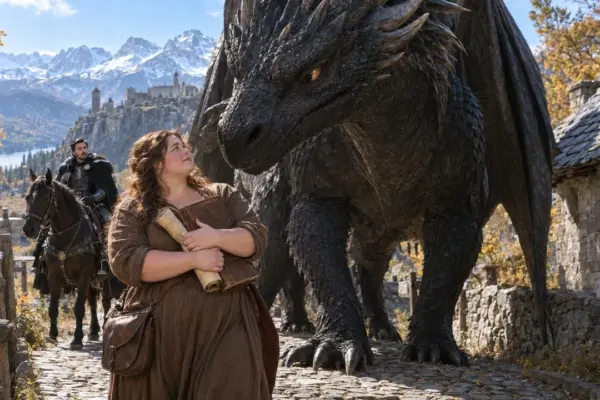
THE DRAGON DRAGGED ITS BROKEN WING FOR 11 MILES — THEN COLLAPSED AT THE DOOR OF A LONELY WIDOW
THE DRAGON DRAGGED ITS BROKEN WING FOR 11 MILES — THEN COLLAPSED AT THE DOOR OF A LONELY WIDOW
PART 1 — THE CREATURE THAT REFUSED THE PALACE
The dragon’s wing broke at four thousand feet.
The bolt that shattered it was six feet of ironwood tipped with Ashen Mountain metal, fired from a ballista that should never have existed, by men who somehow knew exactly where the Emperor would be flying that night. The weapon struck beneath the dragon’s left shoulder joint, where the great muscles anchored to bone, and the Ashen metal continued burning after it entered.
Yet the dragon did not fall.
He descended.
There was a difference.
Below him, the empire stretched through the darkness, its roads glowing faintly beneath the moon. The Jade Palace waited to the east, surrounded by physicians, guards, and men who had sworn their lives to protecting him. Three garrisons burned signal fires beside the river. Farther south stood the healing temple at Doran’s Cross, where the sisters kept enough dragon salve to treat wounds exactly like his.
The dragon passed every one of them.
Because something inside him remembered a different place.
Eleven miles beyond the palace, where the pine trees thinned and the mountain became bare granite, stood a lonely wooden hut.
Two years earlier, he had flown over that hut and seen a woman kneeling beside a dying hawk, holding one finger against its breast so the creature would not die alone.
He had never forgotten her.
Now, bleeding fire into the snow, the Emperor of the Nine Provinces dragged himself toward that tiny house.
The last two miles were made on three legs.
His broken wing scraped across frozen stone, leaving a dark furrow behind him as he climbed through the night.
At last, beneath the mountain wind, he saw it.
A thin line of firelight beneath a wooden door.
He lowered his enormous head against the threshold.
Inside, Senna Voss froze beside her worktable.
Then the door shook.
Once.
A deep, enormous sound moved through the house, and every glass jar on her shelves trembled.
Senna picked up her lamp, opened the door, and stared into the darkness.
A dragon lay across her doorstep.
One wing was broken beyond anything she had ever seen.
A burning ironwood bolt protruded from his shoulder.
And his enormous copper eye was watching her.
Senna swallowed, stepped closer, and whispered the only thing her hands knew how to say.
“Let me see the wing.”
The dragon closed his eye.
And for the first time since the attack, the Emperor finally allowed himself to collapse.
Would you open your door to a wounded dragon that could swallow you whole, especially when you knew powerful men were hunting him? What would you do if you discovered the creature had chosen your home for a reason?
#FantasyStory #DragonTale #DarkFantasy #FairyTale #EpicFantasy #StoryTime #EmotionalStory #FantasyReaders #DragonLovers #ShortStory
PART 2 — THE WIDOW WHO HID THE EMPEROR
Senna Voss had spent three winters alone on the mountain since her husband, Toman, died in a rockslide.
She had learned to live with silence, and she had learned something even more important: broken creatures did not need to be questioned before they were helped.
So she did not ask the dragon who he was.
She did not ask who had shot him.
She did not ask why six feet of burning ironwood had been driven through his wing.
She simply worked.
The bolt came out at dawn.
It took rope, a lever, a stone trough, and every ounce of strength she possessed. When the ironwood finally tore free, the dragon screamed so violently that an avalanche thundered two ridges away.
Senna did not run.
“Done,” she whispered through the falling snow. “It is out.”
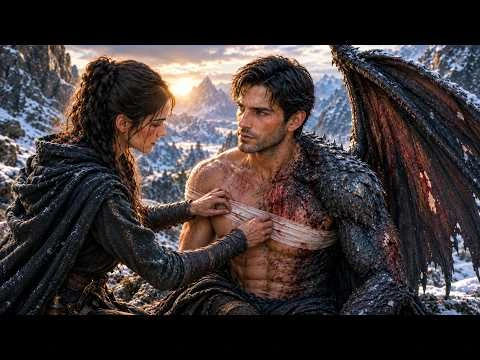
She packed the wound with every piece of wound moss in her hut, boiled comfrey into paste, and used every strip of linen she owned. When those ran out, she opened the cedar chest containing Toman’s old shirts.
Then she climbed onto her roof and cut away an eleven-foot ridge beam to use as a splint.
For three days, she worked while the dragon watched.
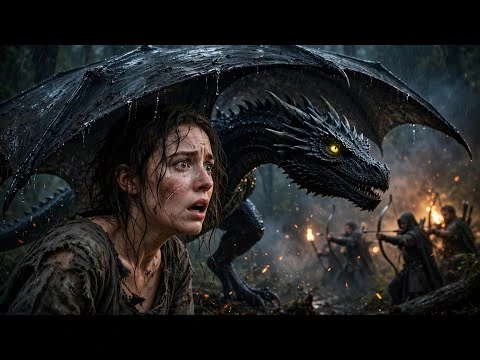
On the third morning, six Imperial soldiers arrived searching for a wounded beast.
They offered a reward.
They also warned her that anyone concealing the creature would be punished.
Senna lied.
“I heard something fall in the night.”
The soldiers searched the yard, but they did not find the enormous creature hidden beneath pine branches behind her woodshed.
When they finally left, Senna returned to him.
“You are hiding from your own soldiers,” she said quietly. “That means either you are a criminal, or someone wearing that uniform is.”
The dragon’s copper eye remained fixed on her.
Senna picked up Toman’s old spear and placed it beside the door.
“I do not ask my patients their politics before I treat them.”
But there was one thing Senna still did not know.
Two years earlier, the dragon had watched her kneel beside a dying hawk.
And that single memory was the reason he had chosen her hut over every palace, fortress, and healing temple in the empire.
Why would the most powerful creature in the empire trust a lonely widow he had never spoken to, and what secret would she discover when the wounded dragon finally revealed who he really was?
PART 3 — THE EMPEROR WHO CHOSE THE WOMAN WHO ASKED FOR NOTHING
The dragon stayed.
At first, Senna told herself it was because the wing was too badly damaged to fly, and there was no point wasting strength by attempting to move him down the mountain. She told herself that when she woke before sunrise and found his enormous black body still lying beside the woodshed, and she told herself the same thing when she fell asleep beside the fire and heard his breathing outside, slow and deep beneath the winter wind.
But after a while, excuses became unnecessary.
The dragon had chosen the mountain.
And he had chosen her.
Senna called him nothing because she knew better than to give names to things that might leave.
She simply talked.
While grinding herbs, she told him about Toman, the man who had once sung badly on purpose because he knew it made her laugh. While repairing hawk cages, she told him about the rockslide that had taken him and half the northern pasture. On nights when the wind shook the shutters, she told the dragon things she had never told another living soul, perhaps because he could not interrupt, perhaps because his silence was kinder than most people’s answers.
The dragon listened.
He listened when she complained about the cold.
He listened when she cursed the price of salt in the valley.
He listened when she cried without realizing she was crying.
And slowly, almost without either of them noticing, the mountain changed.
One morning, Senna discovered that the winter deadfall along her pasture wall had been broken into stove lengths.
The dragon had done it.
Another morning, the wolf tracks that had circled her sheep pen for years were gone.
They never returned.
Then came the strangest thing.
Senna kept injured hawks in wooden boxes behind the hut, and normally they panicked whenever anything large came near them. But these birds became strangely calm.
One evening, she carried a box outside and placed it where the dragon could see.
“Whatever you are telling them,” she said, “keep telling them.”
The dragon slowly turned his enormous head.
Senna studied him.
“You are telling them there is nothing on this mountain allowed to hurt them.”
The dragon closed his copper eye.
She laughed.
It was a small sound, almost forgotten, but it startled her because she realized she had not laughed like that since Toman died.
Weeks passed.
The dragon healed.
The broken bone knitted slowly beneath the splint, and when the first true warmth of spring reached the mountain, Senna stood in the yard as the dragon unfolded his enormous wing.
Forty feet of black membrane opened against the morning sky.
The splint fell away.
The wing held.
Senna stared upward as the dragon beat it once, sending snow across the pasture like smoke.
“You can fly,” she whispered.
The dragon looked at her.
“You have somewhere to go.”
He did not move.
Senna sighed.
“Whoever shot you is still out there.”
Still, he stayed.
Then the air changed.
The dragon stepped backward.
Light gathered around him.
For one impossible moment, Senna could see scales becoming skin, wings folding into shoulders, claws becoming hands.
Where the dragon had stood, a tall man now stood barefoot in the melting snow.
There was a pale scar across his left shoulder.
Senna stared at it.
She knew that scar.
She had spent an entire winter cleaning it.
The man looked at her with the same copper-colored eyes.
“You asked me once,” he said, his voice rough from months of silence, “whether I was a criminal or whether my soldiers were.”
Senna slowly lowered the knife she had been holding.
“The soldiers,” he continued. “My Chancellor sold my flight path to my enemies. He bought the ballista that brought me down.”
Senna stared at him.
Every coin in her purse carried his face.
“You are the Emperor.”
“Yes.”
She looked toward the woodshed.
Then back at him.
“You could have told me.”
“I could not.”
“Why?”
The Emperor looked at her hut, the crooked roof, the stacked firewood, the splints hanging beside the door.
“Because I did not know whether I was safe until I reached this place.”
Senna was silent.
The Emperor of nine provinces stood before her, yet he looked strangely smaller than he had as a dragon.
Not weaker.
Just human.
“What will you do now?” she asked.
“Justice.”
“And then?”
For the first time, the Emperor looked uncertain.
“Then I would like to come back,” he said. “If the door opens.”
Senna folded her arms.
“It depends.”
“On what?”
“Whether you bring soldiers.”
He almost smiled.
“I will not.”
“Servants?”
“No.”
“Heralds?”
“Never again.”
Senna considered him.
Then she opened the door.
“Come in before the snow melts.”
He did.
The Chancellor was arrested that autumn.
The investigation revealed that the Emperor’s flight path had been sold by one of the very men trusted to protect him. The ballista had been built secretly, the Ashen metal smuggled across the border, and the attack had been planned to look like an accident.
But when the Emperor testified, he spoke about none of that first.
He spoke about a woman on a mountain.
He told the court that after being wounded, he had flown past his palace, his garrisons, and a temple filled with physicians.
He had passed all of them.
Not because they lacked the power to save him.
Because he no longer knew which hands were safe.
Then he told them about Senna.
Two years before the attack, he had seen her from the sky, kneeling beside a dying hawk.
The bird was beyond saving.
There was no reward for staying.
No one was watching.
The night was freezing.
Yet Senna had remained beside it until the end, keeping one finger against its breast so the final thing it felt would be warmth.
That was what the dragon remembered.
Not her face.
Not her name.
Not her wealth.
Her choice.
When danger came, he remembered the woman who stayed.
And so he dragged his broken body eleven miles through the darkness toward her door.
The Emperor returned to the mountain many times after that.
At first, he came as a dragon.
Later, he came as a man.
He split firewood badly, and Senna laughed at him for it. He tried to repair the roof and made it worse. He drank her cider, complained about the cold, and eventually learned that an emperor could survive being mocked by his own future wife.
Because that is what happened.
They married the following spring in a small valley chapel.
There were eleven witnesses.
No court poets.
No grand ceremony.
No golden throne.
Senna kept the mountain hut.
The Emperor kept the empire.
And every winter, when the passes closed and the pine trees disappeared beneath snow, the Imperial Court learned not to schedule important meetings because their Emperor would be gone.
He would be somewhere high above the valley, beside a crooked stone hut with a repaired roof beam.
There, the Empress would be setting the wing of a wounded hawk.
And the Emperor would be holding it.
The dragon never forgot the scar.
In his dragon form, the old wound remained as a pale seam along his left wing.
The flight masters said that wing eventually became stronger than the other.
Perhaps they were right.
Perhaps broken things sometimes become stronger precisely where they were once weakest.
But Senna knew the truth.
The strength had not come from the bone alone.
It had come from the journey.
Eleven miles through darkness.
Eleven miles away from palaces, soldiers, power, and every hand that wanted something from him.
Eleven miles toward one small light beneath a wooden door.
Because sometimes the safest place in the world is not where you are most powerful.
Sometimes it is the place where someone sees you wounded, asks for nothing, and simply says:
“Come inside.”
And perhaps that was the real miracle.
The dragon had not found a healer.
The Emperor had not found a subject.
Two broken creatures had found the one thing neither of them had known they were searching for.
A place where neither needed to be powerful.
A place where neither needed to be afraid.
A place where the broken parts could finally be held straight long enough to heal.
And every winter, when the first snow covered the mountain, travelers sometimes claimed they could see a black dragon circling above the hut before landing quietly beside the door.
They said he always waited there.
As if remembering the night he had dragged his broken wing eleven miles through the dark.
As if remembering the woman who opened the door.
As if reminding the whole empire that sometimes, when everything else has failed you, the smallest light in the darkness can be the place that saves your life.
(Descargo de responsabilidad: Este contenido puede haber sido generado por IA con fines de entretenimiento. Cualquier parecido con personas, eventos o lugares reales es pura coincidencia.)