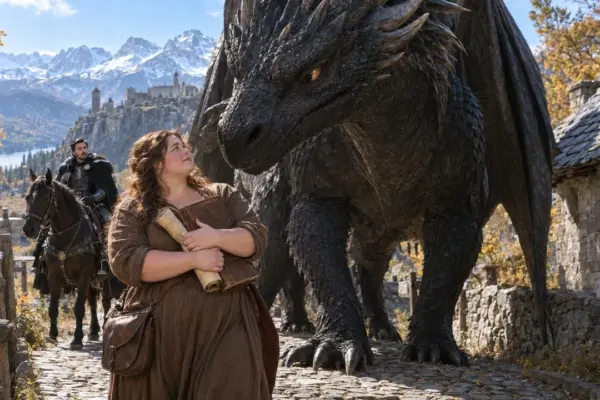
They Chained Her to a Rock as a Sacrifice—Then the Ancient Dragon Broke Her Chains and Chose Her
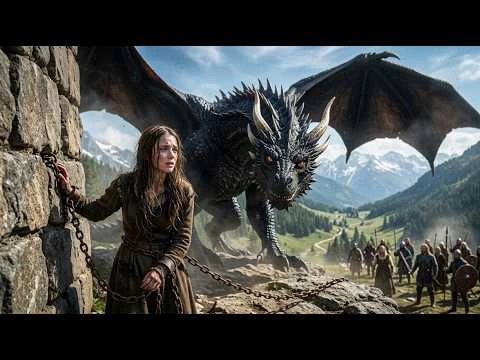
They Chained Her to a Rock as a Sacrifice—Then the Ancient Dragon Broke Her Chains and Chose Her
Part 1
In Marrow Vale, fear had become stronger than kindness. When the village decided to appease the ancient dragon rumored to haunt the mountains, Magistrate Corin arranged a lottery to choose a sacrifice, but the drawing was rigged because Elsa Marin, the miller’s twenty-seven-year-old daughter, had refused his son’s marriage proposal. Her name was pulled from the jar, and four hundred villagers watched as her father fought to stop them, while Elsa stood silently and accepted the sentence.
At dusk, the village smith chained her to Sentinel Rock, high above the valley, where the wind screamed through the stone and the clouds swallowed the stars. Before leaving, the trembling smith whispered, “Forgive me.”
“You are not the one I need to forgive,” Elsa answered.
They believed the dragon would come for her before dawn. They were wrong.
The creature watching Marrow Vale from the clouds was Varos, an ancient crown dragon who had once carried Emperor Aldrich through wars and whose bond with the imperial family had never truly died. He had never demanded tribute, never asked for a maiden, and never wanted Elsa sacrificed.
When Varos finally descended, Elsa heard the thunder of his wings before she saw him. He landed with terrifying gentleness, studied the chains, then looked directly into her eyes.
“If you are what they say you are,” Elsa whispered, “be quick. But if you are not, I am sorry they chained me in your name.”
Varos reached down with one claw—and snapped the iron apart.
Then he turned toward the village and stood between Elsa and the only path down the mountain.
What happened next would reveal who the real monster was. Continue to Part 2…
#FantasyRomance #AncientDragon #DragonBond #Betrayal #Justice #EpicLove #Romantasy #StoryTime
Part 2
Elsa expected Varos to fly away after breaking her chains, but the ancient dragon did something that frightened the village far more: he stayed.
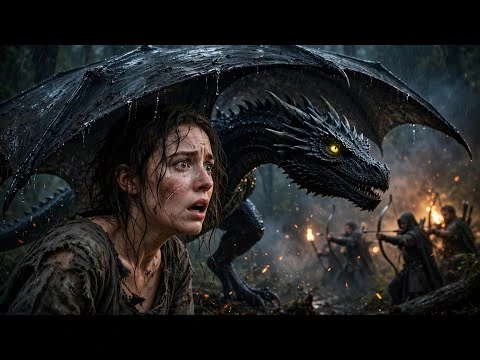
He lowered his enormous body across the path and kept watch through the freezing night, while Elsa sheltered beneath one of his wings. By morning, the villagers had gathered below, and Magistrate Corin climbed the hill with armed men, pretending that the dragon had somehow “chosen” to protect the sacrifice.
Elsa stood beside Varos and told him the truth in the same plain voice she had used in the square. The dragon was not tame, she said. He was simply just, and he had never asked for their tribute.
When Corin ordered the men forward, Varos rose.
One movement was enough. The delegation fled down the mountain without touching Elsa.
Then the village priest discovered something hidden beneath the dragon’s old harness scars: the faded marks of the imperial flight. Varos was no wild beast. He was the legendary crown dragon who had carried Emperor Aldrich, the current Emperor Cashin’s grandfather, and disappeared forty years earlier.
A rider was sent to the capital.
For four days, Elsa lived beside Varos, talking to him about her mill, her mother, and the foxes she fed during winter. Slowly, fear became trust, and trust became something neither of them could explain.
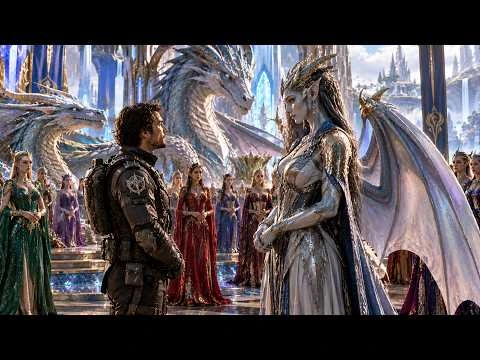
On the fifth morning, nine imperial dragons appeared over the valley, carrying Emperor Cashin himself.
He looked at the broken chains, then at Varos standing protectively beside Elsa, and finally toward the village where Corin was already trying to destroy the evidence.
Cashin asked only one question:
“Who chained her?”
But when the emperor learned that Varos had bonded with Elsa after forty years without a rider, he faced a decision no law or tradition had prepared him for.
If you were Elsa, would you trust the emperor after everything that happened, and what do you think Varos’s choice really means? Share your thoughts in the comments before Part 3 reveals what happens when the ancient dragon chooses her for good.
Part 3
By the time Emperor Cashin reached Sentinel Rock, the truth was already impossible to hide. The broken chains lay in the frost, Elsa stood alive beside Varos, and the villagers who had watched her sacrifice were now gathered below, waiting to discover what the empire would do with the crime they had all allowed to happen.
Cashin did not begin with threats. He began with questions.
Imperial law clerks took testimony from the village smith, who admitted that Corin had ordered the chains and that he had wept while making them. They questioned the priest, Elsa’s father, her brother, the bailiff, and finally Elsa herself. She described the rigged lottery, Corin’s revenge after she rejected his son, the moment she was dragged to the mountain, and the four nights Varos had spent guarding her.
She told the story without exaggeration, just as she had told everything else.
“He guarded me,” she said. “They fed me to the monster, and the monster was the first thing in this valley that looked at the chains instead of looking at me.”
The words silenced the hillside.
Then Cashin turned toward the village and explained what Corin had deliberately hidden. Varos was not some wild creature demanding tribute. He was a crown dragon who had served the empire for more than two centuries, first beside Emperor Aldrich and later as a living symbol of the bond between the imperial throne and its dragons. His commission had never been revoked, and the supposed tribute demanded in his name had never existed.
The lie had been entirely human.
Corin was arrested that afternoon, and his son and the bailiff were taken with him for their roles in the scheme. The village was fined, and imperial officials ordered the establishment of a school of law so that future magistrates could no longer manipulate fear and superstition for personal revenge. The smith, still ashamed of what he had been forced to make, was allowed to destroy the sacrificial cuffs himself, striking them apart from the same iron with which they had been forged.
But one question remained.
What would happen to Varos?
Cashin had spent six years searching for the dragon his grandfather had loved, and now he had finally found him. Naturally, the emperor wanted to bring the ancient creature home.
Varos refused.
When the imperial flight formed up and Cashin’s crimson dragon called for departure, Varos simply walked back to Elsa, lowered his enormous body beside her, and remained there.
The flight master stared in disbelief.
“Forty years without a rider,” he whispered. “That should not be possible.”
Cashin watched Elsa rest one hand against Varos’s storm-gray scales. The dragon’s posture was unmistakable. He had not merely rescued her. He had chosen her.
In the old imperial tradition, a dragon bond was not created by command, ceremony, or bloodline. It was formed by recognition, and Varos had recognized something in Elsa that no one else had seen clearly enough to value.
Cashin approached her alone.
“Will you come south with me?” he asked. “He will not leave without you, and I have spent six years searching for him. I do not want to lose him twice.”
Elsa studied him carefully.
“The last powerful man who wanted something from me rigged a lottery when I refused him,” she said. “What happens if I refuse you?”
“Then I ride home,” Cashin answered. “Varos can remain here if that is what he chooses, and I will visit the north more often than my council would like.”
There was no threat in his voice, no demand hidden beneath courtesy.
For the first time since the lottery, Elsa smiled.
“Then I will come,” she said, “because you asked instead of taking. But the foxes near the mill must be fed through winter. That comes with me.”
Cashin agreed, and the imperial clerks eventually wrote the request into law: the crown would provide for the winter feeding of the mill foxes in perpetuity.
Elsa left Marrow Vale with the imperial flight, riding on Varos’s back as the ancient dragon carried her south. The villagers watched the legendary creature they had once feared transport the woman they had sacrificed toward the capital, and the meaning of their old story changed forever.
The palace did not know what to make of her.
Elsa was a miller’s daughter, not a noblewoman, not a court scholar, and certainly not someone trained to flatter emperors. Yet she had survived a rigged execution, earned the loyalty of a two-hundred-year-old dragon, and walked into the imperial court with the same plain honesty she had used on the mountain.
She fed the palace ravens every morning.
She spoke plainly.
And when someone tried to intimidate her with titles or ceremony, she simply looked at them until they remembered that she had once faced an ancient dragon while chained to a rock and had not begged.
Cashin began finding reasons to visit the dragon grounds.
At first, the reasons were practical. He wanted reports about Varos. He wanted to discuss the old dragon’s condition. He wanted to know whether Elsa needed anything after the journey south.
Then the visits grew longer.
He discovered that Elsa had no interest in flattery, which meant that she was one of the few people in the palace who would tell him when his ideas were foolish. She discovered that beneath the crown, Cashin carried the memory of a grandfather who had lost his oldest companion and a responsibility to an empire that expected him never to hesitate.
Their conversations became familiar.
Varos noticed.
The ancient dragon would lie beneath the high winter sky while Elsa and Cashin sat beside his foreleg, and whenever the wind became too cold, he would quietly shift one enormous wing so that both of them were sheltered beneath it.
The flight master claimed the dragon was doing it deliberately.
No one dared argue.
On a midwinter night, Cashin finally stopped searching for excuses.
There was no crowd around them, no lottery jar, no guards, and no political ceremony. Only frost, dragon fire glowing in the distance, and the same ancient creature who had once broken Elsa’s chains.
Cashin asked her plainly.
Elsa looked at him for a long moment.
“They chained me to a rock once as a payment,” she said. “You are the second thing that came out of the sky afterward and refused to take me as one.”
Then she glanced toward Varos.
“He broke the chains. You never once pretended they had been anything else.”
Varos lifted his enormous head toward the winter stars and released a deep, resonant call that had not been heard over the capital in forty years. One by one, the other dragons answered, until the sound rolled across the city and lights appeared in thousands of windows.
That spring, Elsa and Cashin were married.
Varos stood beside them.
And the place where Elsa had once been chained as a sacrifice became a symbol of something entirely different.
The people of Marrow Vale had believed the old stories meant dragons were monsters, sacrifices were necessary, and fear was stronger than courage. Elsa proved otherwise simply by refusing to surrender the truth of what had happened to her.
The dragon was never the creature they needed to fear.
The real danger had been the people who used fear to justify cruelty.
And Elsa was never the price of anything.
She was the woman who stood alone on a mountain, looked into the eyes of an ancient dragon, and spoke the truth even when she believed she was about to die.
Varos recognized her because he understood something the village had forgotten: courage does not always roar, power does not always demand obedience, and kindness does not always arrive in a human shape.
Sometimes it arrives from the sky.
Sometimes it breaks the chains.
And sometimes, after forty years of wandering alone, an ancient dragon looks at one frightened woman and decides that he has finally found his home.
(Descargo de responsabilidad: Este contenido puede haber sido generado por IA con fines de entretenimiento. Cualquier parecido con personas, eventos o lugares reales es pura coincidencia.)