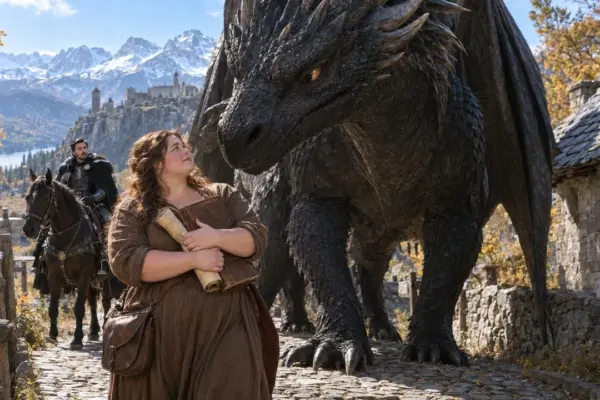
They Chained Her to the Rock as a Sacrifice — The Dragon Broke the Chains and Guarded Her Instead
Part 1 — The Sacrifice
They Chained Her to the Rock as a Sacrifice — The Dragon Broke the Chains and Guarded Her Instead
The chains were forged in the village smithy, and the old blacksmith wept while he made them because he knew exactly what they were for. Marrow Veil had once been a kind village, but fear had slowly taught its people to mistake cruelty for survival. For generations, they had told stories about the dragon that lived beyond the northern mountains, and when a vast gray-black shadow appeared above the clouds seven times that summer, the stories became law.
“Dragons demand tribute,” the elders said. “Give the beast a maiden, or it will come for the whole village.”
So Magistrate Corin organized a lottery.
Everyone knew it was supposed to be fair. Everyone also knew it was not.
The name drawn from the jar belonged to Elsa Marin, the twenty-seven-year-old miller’s daughter who had rejected Corin’s son three weeks earlier. She had refused him plainly, without cruelty, and his father had never forgiven her for it.
When Elsa heard her name, four hundred villagers lowered their eyes.
Her father fought the guards. Her brother swung at the bailiff. Elsa simply stood there, pale but steady, and said, “Your jar has only my name in it. I will go, so no one else has to. But all of you will remember what you did.”
At dusk, they chained her to Sentinel Rock.
The blacksmith could barely hold the hammer as he locked the final pin.
“Forgive me,” he whispered.
“You are not the one I need to forgive,” Elsa answered.
Then the villagers left her alone beneath the stars.
Hours later, the sound of enormous wings rolled across the mountain.
Elsa looked up.
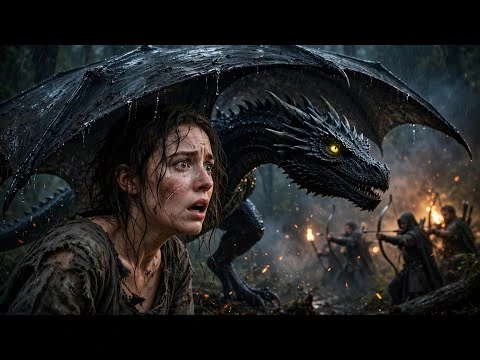
A dragon descended from the darkness, so immense that the stars disappeared behind its wings.
And when it landed before her, it did not open its jaws.
It looked at the chains.
Then it looked toward the village.
And something in its ancient amber eyes changed.
What happens when the “monster” finally discovers who the real sacrifice was?
#FantasyStory #DragonTales #DarkFairyTale #StoryTime #FantasyRomance #EmotionalStory #BookTok #ReadersOfTikTok #ViralStory
Part 2 — The Dragon Chooses Her
The Dragon Did Not Eat Her — It Chose to Stand Between Her and the Village
The dragon lowered its enormous head until Elsa could see her frightened reflection in its amber eyes. She had expected fire, teeth, perhaps the terrible end the villagers had promised her, but instead the creature studied the broken iron around her wrists with the quiet attention of someone examining a crime.
“If you are what they say you are,” Elsa whispered, forcing herself not to tremble, “then be quick. But I want someone besides me to know that I did nothing wrong.”
The dragon remained silent.
Then one enormous talon slipped beneath the chain.
With a single effortless movement, the iron snapped.
The cuffs came next, removed with astonishing delicacy, and fell into the frost beside her.
Elsa stared at the dragon, rubbing her aching wrists.
“Thank you,” she whispered.
The creature did not leave.
Instead, Varos turned toward the village and settled its massive body across the only path down from Sentinel Rock. Its wings folded around the hillside, its head lowered toward the distant lights, and its amber eyes remained open.
Elsa slowly realized what it was doing.
It was guarding her.
The villagers had sent her to the mountain as an offering, believing the dragon was their enemy. Yet the ancient creature had looked at the chains, looked at the people who had placed them there, and somehow understood exactly where the danger truly lived.
That night, when Elsa finally fell asleep against the cold stone, one enormous wing remained suspended above her like the roof of a shelter.
At sunrise, four hundred villagers stood below and stared upward.
The sacrifice was alive.
The chains were broken.
And the dragon was between her and them.
But no one in Marrow Veil yet understood what kind of dragon had come to their mountain—or why the emperor himself would soon be riding north to find it.
When the emperor learns that his grandfather’s legendary dragon has returned after forty years, what will he do when he discovers whom the ancient creature has chosen to protect?
Part 3 — The Treasure They Never Expected
The Dragon’s Choice Changed an Empire
For four days, Elsa lived on Sentinel Rock with the dragon the villagers had spent generations fearing.
She called him Gray because she did not yet know his true name, and because his scales carried the color of a storm that had not decided whether it would bring rain or sunlight. She talked to him because silence had become unbearable, and the ancient creature seemed strangely willing to listen.
She told him about the mill, the broken gate her father never repaired, the winter foxes she fed with scraps, and her mother’s grave beneath the old ash tree.
When she mentioned the foxes, the dragon’s great amber eyes turned toward her with sudden interest.
“They are small,” Elsa explained with a faint smile. “And winter is cold. It costs me almost nothing to keep them alive.”
The dragon remained perfectly still.
But somewhere inside that ancient heart, something had recognized her.
Varos had once carried an emperor.
Two centuries earlier, he had flown beside Emperor Aldrich the Steady through wars, coronations, and long journeys across the empire. For forty years, however, the dragon had lived alone. His rider had died peacefully with age, and the bond between them had never truly disappeared. It had simply become an ache that followed Varos through every season.
He had wandered north because he could not bear the capital without the man who had been his rider.
Then he had noticed Elsa.
He had watched her leave food for foxes during winter. He had heard her singing badly to the millstones when she thought nobody was listening. He had seen her care for creatures weaker than herself without expecting praise.
To Varos, these were not insignificant habits.
They were the habits of a rider.
They were the habits of someone who protected what depended on her.
So when the village chained Elsa to the rock, the ancient dragon did not see a sacrifice.
He saw someone who had been imprisoned by fear.
And he knew exactly what it meant to stand guard over another life.
On the third night, Elsa slept against the warmth of his foreleg while snow gathered across the mountain. Varos remained awake, his body positioned between her and the wind.
On the fourth morning, she woke before dawn.
“Why me, Gray?” she asked quietly. “Why did you stay?”
The dragon could not answer in words.
Instead, he slowly lifted one foreleg and placed a talon around his own ankle, forming the shape of a cuff. Then he withdrew it and placed his enormous foot between Elsa and the path leading down the mountain.
Elsa stared at him.
“You know what it means to be trapped,” she whispered.
The dragon lowered his head.
She understood enough.
For forty years, Varos had been trapped by grief.
Now he had found someone who understood what it meant to be trapped by the decisions of others.
Neither of them had asked for the bond.
Perhaps that was why it was so strong.
Then, on the fifth morning, the sky filled with dragons.
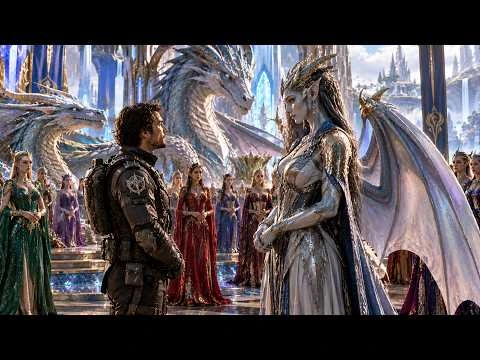
Nine imperial dragons appeared above the southern ridge, flying in perfect formation beneath the banners of the crown. At the center flew a magnificent crimson dragon carrying Emperor Cassian.
The villagers gathered in the square, watching the imperial flight descend toward Sentinel Rock.
Nobody spoke.
Everyone understood the danger now.
They had not sacrificed a girl to a wild monster.
They had chained her in front of the empire’s oldest dragon.
Cassian was thirty-four years old, the third emperor of his line, and he had spent six years searching for Varos.
He had grown up hearing stories about the legendary dragon who had carried his grandfather through two wars and a coronation before disappearing into the northern wilderness on the night of the old emperor’s funeral.
Cassian had promised his grandfather that Varos would never be forgotten.
He climbed the final path alone.
His guards protested, but he ignored them.
Then he saw the broken chains.
He saw Elsa standing behind the enormous gray-black dragon.
And he saw Varos lying across the path like a living fortress.
“Varos,” Cassian whispered.
The dragon raised his head.
For a long moment, the emperor and the ancient creature stared at one another.
Then Varos made a deep, resonant sound that rolled through the mountain like distant thunder. He lowered his head in the old imperial gesture of recognition.
Cassian’s eyes filled with emotion.
“You came home,” he said.
Varos did not move.
He remained between the emperor and Elsa.
Cassian looked at the broken chains again.
His expression changed.
“Who chained her?”
The question was quiet.
That made it worse.
By sunset, the truth had begun to spread through the village.
The smith confessed.
The priest confessed.
Elsa’s father told the story of the forced lottery.
Her brother described the guards dragging him away.
Finally, Elsa herself stood before the emperor and told everything plainly.
“The jar was rigged,” she said. “Magistrate Corin wanted revenge because I rejected his son. They told the village the dragon demanded tribute. He never did.”
Cassian listened without interrupting.
When she finished, the emperor turned toward the village.
“The empire does not take tribute,” he said. “And it never demanded this woman’s life.”
Magistrate Corin was arrested before nightfall.
His son and the bailiff were taken with him.
The blacksmith was permitted to strike the chains apart himself, using the same forge that had created them.
But Elsa’s story did not end with justice.
Because Varos still refused to leave her.
The imperial flight prepared to return to the capital.
The crimson dragon called.
Varos rose.
For one hopeful moment, Cassian believed the old dragon would finally come home.
Instead, Varos walked to Elsa, lowered himself beside her, and settled back onto the mountain.
The flight master stared in disbelief.
“He has chosen her.”
Cassian looked at Elsa.
“A dragon bond without ceremony,” the flight master continued. “Without trials. Without permission. I have never seen anything like it.”
Cassian smiled faintly.
“My grandfather chose Varos in much the same way.”
Then he approached Elsa.
“Will you come south?”
Elsa looked at him carefully.
“The last powerful man who wanted something from me rigged a lottery when I refused him,” she said. “What happens if I refuse you?”
Cassian did not hesitate.
“Then I return to the capital without you. Varos can remain here. I will visit him as often as my council allows.”
Elsa studied his face.
There was no command in his voice.
No threat.
No hidden bargain.
Only a question.
She glanced at Varos.
The old dragon made a low sound that Elsa had come to recognize as something dangerously close to laughter.
“Then I will come,” she said. “But the foxes near my father’s mill must be fed through winter.”
Cassian nodded.
“Consider it imperial law.”
And so the miller’s daughter traveled south on the back of the legendary dragon.
The capital had never seen anything like her.
The court expected a frightened village girl.
Instead, Elsa arrived with her chin raised, spoke plainly when everyone else used careful political language, and fed the palace ravens every morning.
Some courtiers called her the Rock Girl behind closed doors.
Others began calling her something else.
They called her honest.
Cassian noticed her immediately.
Not because she wanted the throne.
Not because she wanted wealth.
But because she wanted almost nothing for herself.
She had stood before a dragon and asked only that the truth be heard.
She had survived a rigged sacrifice without allowing fear to turn her cruel.
And when given the chance to enter the palace, she remembered the foxes.
That was what stayed with the emperor.
He began finding reasons to visit the dragon grounds.
At first, the reasons were official.
Then they became unnecessary.
He would arrive simply to talk.
Elsa would sit beneath Varos’s enormous wing, and Cassian would sit nearby while the ancient dragon watched them both with half-closed amber eyes.
Winter came.
On one bitter night, beneath the same kind of frost that had covered Sentinel Rock, Cassian finally asked the question he had been carrying for months.
He did not send a servant.
He did not summon a council.
He did not command her.
He simply stood before her and said, “Elsa, will you marry me?”
She looked at him for a long moment.
Then she glanced at Varos.
The ancient dragon’s eyes were very much open.
Elsa smiled.
“They chained me to a rock once as payment,” she said. “You were the second powerful man who came out of the sky afterward and refused to take me as one.”
Cassian said nothing.
Elsa reached up and placed her hand against Varos’s storm-gray scales.
“He broke the chains,” she whispered. “You made sure nobody would ever put them back.”
The emperor took her hand.
“No chains,” he promised.
“No bargains,” she replied.
“No bargains.”
Only then did Varos lift his enormous head toward the winter sky.
He released a sound the capital had not heard in forty years.
It was the old imperial flight call.
The coronation call.
The song of a dragon who had finally found his way home.
One by one, the other dragons answered.
Their voices rolled across the capital like thunder, and lights appeared in thousands of windows as people stepped outside to listen.
Elsa and Cassian were married the following spring.
Varos remained beside them.
And the village of Marrow Veil never again held a lottery for sacrifice.
The old schoolhouse kept its book of fairy tales, but the children eventually added another page to it.
They wrote about the miller’s daughter who was chained to a rock because frightened people believed a monster demanded her life.
They wrote about the ancient dragon who arrived expecting to find cruelty and instead found someone worth protecting.
They wrote about an emperor who learned that authority meant nothing if it could not hear the word “no.”
And they wrote one final sentence beneath the story:
The girl was never the tribute.
She was never the price.
She was never the sacrifice.
She was the treasure.
It simply took a dragon two hundred years old, carrying the grief of a lost empire, to recognize her.
And perhaps that is why the story survived.
Because sometimes the greatest danger is not the monster waiting in the darkness.
Sometimes it is the fear that convinces ordinary people to become cruel.
And sometimes, when everyone has decided who the victim must be, it takes a creature they were taught to fear to stand between her and the world and say, without speaking a single word:
She is not yours to sacrifice.
(Descargo de responsabilidad: Este contenido puede haber sido generado por IA con fines de entretenimiento. Cualquier parecido con personas, eventos o lugares reales es pura coincidencia.)